
Focused resource · Laboratory Verification
Why Independent Assay Lab Results Are More Credible
Why impartiality, controlled sampling, documented methods, quality checks, and transparent reporting matter when parties have competing interests.
12 min read · Knowledge Centre resource
Direct answer
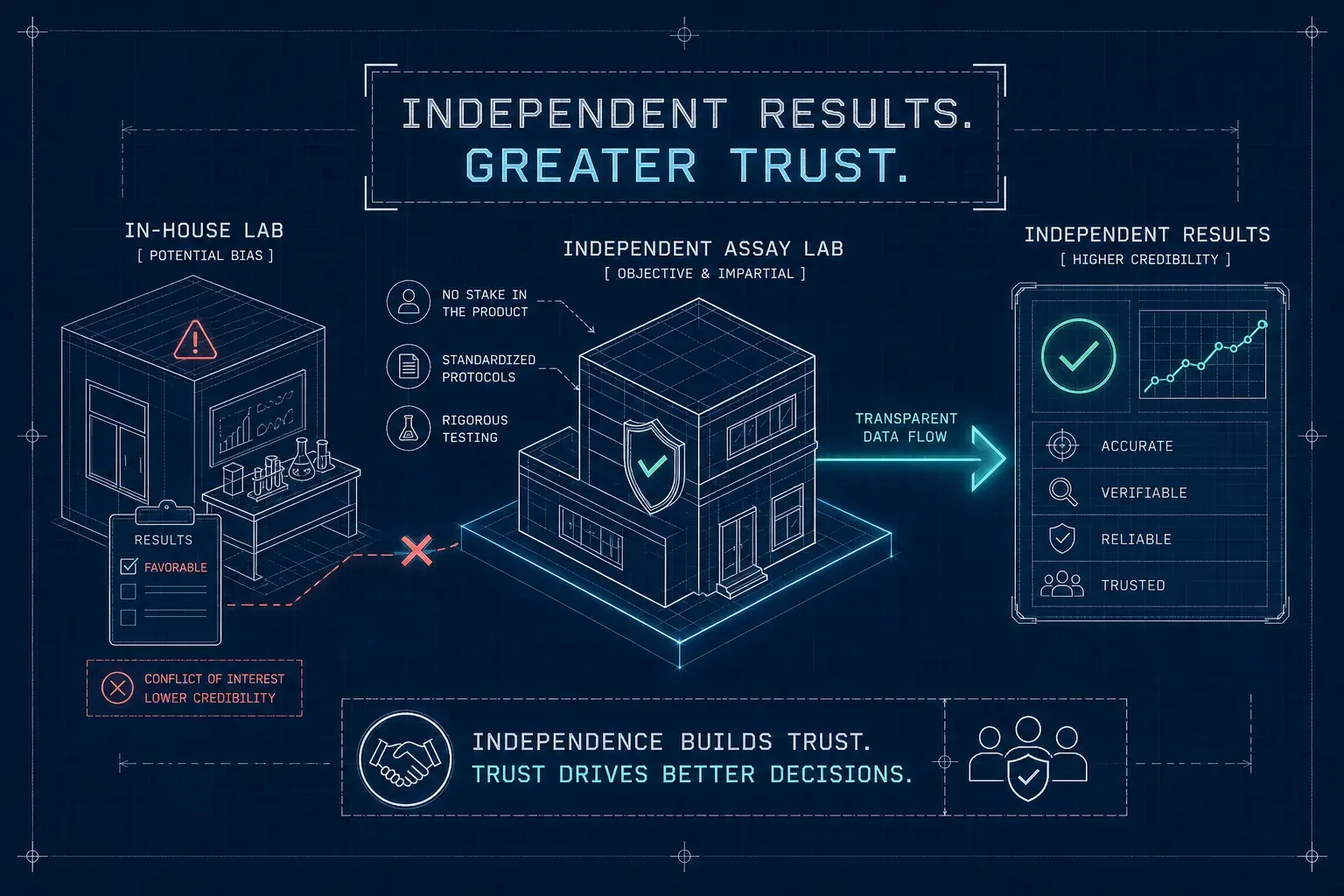
An independent laboratory reduces one conflict of interest by keeping the analytical result separate from the commercial outcome.
A seller slides a test result across the table and says, "We had it tested." Those four words should make any careful buyer pause. The lab that ran the test works for the seller. The number on that paper directly affects the price the seller will receive. That alone is enough reason to ask a different question: who tested it, and what did they have to gain from the result?
An independent assay lab result is more credible for one foundational reason: the lab has no financial stake in what the number says. Whether the gold comes in at 99.5% fineness or 87%, the lab collects the same fee and moves on to the next sample. Contrast that with in-house or seller-commissioned testing, where a higher purity reading translates directly into a higher transaction price, a stronger negotiating position, or a better-looking inventory report. That structural difference is why independent assay lab credibility is recognized across international markets, and why serious counterparties insist on it.
This is exactly the structure that earns independent labs their standing in high-stakes markets. In East African gold trade, where material crosses borders and changes hands between miners, traders, refiners, and international buyers, labs like Bilex Minerals EA build credibility precisely because they have nothing to gain from the result. A number that comes from a lab with no commercial interest in the gold is a number that both parties can stand behind. Why financial stakes compromise in-house and seller-run tests The conflict of interest is structural, not personal The problem with seller-run or buyer-run testing is not usually dishonesty.
Most lab technicians are professionals doing honest work. The problem is structural: when a lab, a buyer, or a seller has money tied to the outcome of a test, that relationship introduces bias that no amount of good intention fully eliminates. This can be as overt as a performance bonus tied to a particular result, or as subtle as the unspoken pressure to keep a long-standing client satisfied. Research on compliance monitoring makes this concrete.
Short and Toffel's peer-reviewed work on private compliance monitoring found that third-party monitors cited fewer violations when they were paid by the audited suppliers than when they were paid by the brand commissioning the audit. The method did not change. The personnel did not change. The financial relationship did, and so did the results.
The same dynamic operates in any testing arrangement where the payer has a stake in the outcome, which is the central reason why an independent assay lab result is more credible than a buyer's or seller's own test. In-house testing faces the same pressure from the inside Internal quality-control labs face a version of this problem from the other direction. The personnel report to the same company whose product is being evaluated. Management sets the acceptance criteria, controls the testing budget, and also owns the revenue targets the business is trying to hit.
When testing rigor and revenue pressure conflict, testing rigor does not always win. In-house testing has genuine value for process control and ongoing batch monitoring, that is what it is designed for. What it cannot offer is external credibility in a transaction where the other party needs to trust the result independently. A result generated by the seller's own lab is not a neutral data point; it is the seller's own representation of their product, formatted to look like one.
Why independent assay lab results carry stronger chain-of-custody integrity What a documented custody trail actually proves Chain of custody is a continuous, documented record of who collected the sample, who transferred it, how it was sealed, and who handled it at each stage inside the laboratory. This documentation is what makes a result legally defensible. Without it, there is no way to prove that the sample tested was the same one collected from the material in dispute, and no way to rule out substitution, splitting, or contamination somewhere along the way. Inside a credible independent assay lab, this process runs from the moment a sample arrives.
Every step is captured: receipt and logging, seal verification, secure storage, sample preparation, analytical processing, QC review, and final result authorization. Every handoff is recorded with the sample ID, date, time, analyst, and action taken. That unbroken trail is what links the certificate of analysis to the physical material it describes. How independent labs protect sample integrity versus interested parties In an independent lab, the interested party never touches the sample after submission.
Samples arrive from an outside client, are logged under a unique ID, sealed, and tracked through the testing process under strict protocols. The organization that owns the gold has no access to the lab floor, no influence over the testing sequence, and no opportunity to resubmit a different sample if the first result is inconvenient. Buyer or seller testing works differently by definition. The same organization that owns the material also controls the sample from collection through reporting.
The opportunity to substitute, cherry-pick, or misrepresent a sample exists at every step, not always intentionally, but structurally. Independent third-party assaying removes the interested party from the chain entirely. That removal is the foundation of every credibility advantage a third-party assay holds over an interested party's own test. Accreditation and QA/QC: what a credible independent assay report actually contains What ISO/IEC 17025 requires and why it matters ISO/IEC 17025 is the international standard for testing and calibration laboratory competence.
To earn accreditation, a lab must demonstrate qualified and authorized personnel, validated testing methods appropriate for the materials being tested, calibrated and maintained equipment with documented traceability, suitable environmental controls, and a quality management system that includes internal audits and ongoing risk management. The critical distinction is that accreditation is not self-declared. An independent accreditation body reviews the lab's actual practices and results against both technical and managerial requirements, and that assessment continues on an ongoing basis. A lab that claims to follow good practices is making a statement about itself. A lab that holds ISO/IEC 17025 accreditation for specific test methods has had those claims verified by an external body.
For a refiner, a bank, or a regulatory authority, that distinction is the deciding factor. The QA/QC markers a credible report must show A credible independent laboratory assay does more than report a number. It documents the conditions under which that number was produced, so the reader can evaluate whether the method was under control when the sample was run. Before accepting any assay report, check for these specific elements: The calibration standards and certified reference materials used Control samples included in the same analytical batch Replicate results or precision metrics such as relative percent difference Method blanks confirming contamination was absent Pre-defined acceptance criteria and confirmation the run passed those criteria The lab's accreditation status and the specific methods covered by that accreditation A report that omits these elements cannot confirm the method was performing correctly when the sample was tested.
The number may be accurate, but there is no technical evidence to support that claim. For a transaction involving significant value, that gap is unacceptable. Blind testing and proficiency programs: the external proof of consistency How proficiency testing challenges a lab without warning Proficiency testing is the strongest independent proof of laboratory reliability available. An external body sends a participating lab blind samples with known reference values.
Nobody inside the lab knows which samples are proficiency checks. The lab runs them using its standard methods and submits results, which are then evaluated against the assigned reference values and the performance of other participating labs. When a lab consistently passes proficiency testing across multiple rounds, that proves the result is reproducible across different batches, different operators, and different points in time. It is not a one-time event staged for a particular client.
Consistent proficiency testing participation is the clearest technical proof that an independent assay lab's results can be trusted across transactions, not just within a single run. Why in-house and buyer-run tests cannot replicate this Blind testing requires an external party to design and supply the unknown samples. That external party cannot be the same organization that owns the material or has a financial stake in the result. A seller's own lab can run internal duplicates, but those are not blind tests, they are repetitions of the same process by the same team under the same conditions, with the same potential biases operating throughout.
Without external proficiency participation and transparent reporting of those results, there is no independent evidence that the method performs correctly across different batches and operators. Internal duplicates prove consistency within a single run. They prove nothing about whether the result itself is accurate. Legal standing and who actually accepts certified independent assay results The parties that require independent lab documentation The demand for independent assay lab results is not a matter of preference, it is a requirement from the counterparties that matter most.
International refiners and bullion banks operating under the LBMA Good Delivery framework require independent documentation because they cannot rely on the interested party's own report. Export authorities and US regulatory frameworks, including Dodd-Frank conflict minerals requirements and anti-money-laundering due diligence, impose the same standard. A refinery accepting dore from an East African supplier needs a result from an independent laboratory assay with no commercial stake in the incoming material. A US commodity importer satisfying AML or responsible sourcing obligations needs certified documentation from an independent third party that can withstand external scrutiny.
The seller's in-house test satisfies neither requirement, regardless of how professionally it was conducted. Fire assay and XRF as the internationally recognized methods Fire assay (cupellation) and XRF spectrometry are the two primary testing methods accepted by refiners, banks, and regulators worldwide. Fire assay is the reference method for gold lot acceptance, delivering precise, internationally recognized determination of precious metal content. XRF provides rapid, non-destructive elemental screening for preliminary evaluation and is useful for identifying gross misrepresentation before committing to a full fire assay.
Bilex Minerals EA runs both methods from its laboratories in Nairobi and Dar es Salaam under an independent, third-party structure with no commercial interest in the gold being tested. That independence is why their certified assay reports carry weight with international counterparties who need documentation they can trust. Bilex Minerals EA also supports licensed export documentation, which adds a layer of regulatory credibility to the test result and reduces the number of intermediaries a client needs to engage to move material legally across borders. What to check before accepting any assay result Red flags on a seller's or buyer's own test Some warning signs on an assay report are immediately visible.
The lab name on the report matches the entity selling or buying the material. The report lacks any reference to calibration standards or control sample results. No accreditation body or external validation is cited. The sampling process is not documented, or the report was prepared at the transaction site rather than in a controlled laboratory environment.
Any one of these signals is sufficient reason to request an independent retest before finalizing a deal. The subtler red flags are worth watching for as well. A report that shows only a final purity number without supporting QC data is not a validated result, it is an assertion. A report dated the same day as a scheduled transaction suggests the testing timeline was driven by deal pressure rather than analytical process.
Neither condition automatically indicates fraud, but both mean the result cannot be independently verified. Questions to ask a third-party lab before trusting their result Not every lab that calls itself independent has the structure to back that claim up. Before relying on any independent test result, get clear answers to these questions: Is the lab accredited, by whom, and for which specific test methods? Does the lab participate in external proficiency testing programs, and will they share those results?
Can the lab provide a full chain-of-custody record for the sample from receipt through reporting? What QC controls were included in the same analytical batch as your sample? A credible independent lab answers these questions without hesitation, because the answers are documented and the documentation is part of the standard process. A lab that hedges, deflects, or cannot produce these records is telling you something important about the reliability of its results, even if every individual number it reports happens to be accurate.
The credibility gap is structural, not incidental Why are independent assay lab results more credible than a buyer's or seller's own test? The answer comes down to structure, not just skill. Independent lab credibility comes from the absence of a financial motive, from documented sample custody that removes the interested party from the chain, from external validation through accreditation and proficiency testing, and from test methods that regulators and refiners already recognize and accept. Whether you are a gold buyer completing a transaction, a mining company preparing material for export, or a US compliance officer evaluating an East African supply chain, the question you need answered is always the same: does this result come from a source that had nothing to gain from what it says?
That question has a structural answer, not just an ethical one. Labs that produce results trusted by refiners, banks, and export authorities earn that trust through process, independence, and external accountability built into every step from sample receipt to final certificate. Bilex Minerals EA's fire assay and XRF certified reports carry the weight they do for exactly those reasons. When the number has to hold up under regulatory and commercial scrutiny, independent assay lab credibility is not optional, it is the standard.
Keep the answer within its proper scope.
Can this article replace transaction-specific professional advice?
No. It is educational. Confirm current legal, customs, tax, regulatory, technical, and commercial requirements with the responsible authorities and appropriately qualified advisers.
Does an assay approve the wider gold transaction?
No. An assay describes the submitted sample under the stated method. Ownership, origin, seller authority, payment, export, import, sanctions, and logistics require separate checks.
What should I verify before relying on a document or result?
Verify the issuer, scope, date, reference, sample or shipment identity, units, validity, and direct connection to the current parties and material.
Official and primary sources