
Focused resource · Laboratory Verification
Assay Lab Credibility Indicators Every International Gold Buyer Needs
How to evaluate identity, independence, personnel, method scope, custody, quality control, report clarity, security, and verifiability.
11 min read · Knowledge Centre resource
Direct answer
Credibility comes from evidence about competence and process, not branding. Buyers should verify who operates the laboratory, what method is used, how quality is controlled, and how the report connects to the sample.
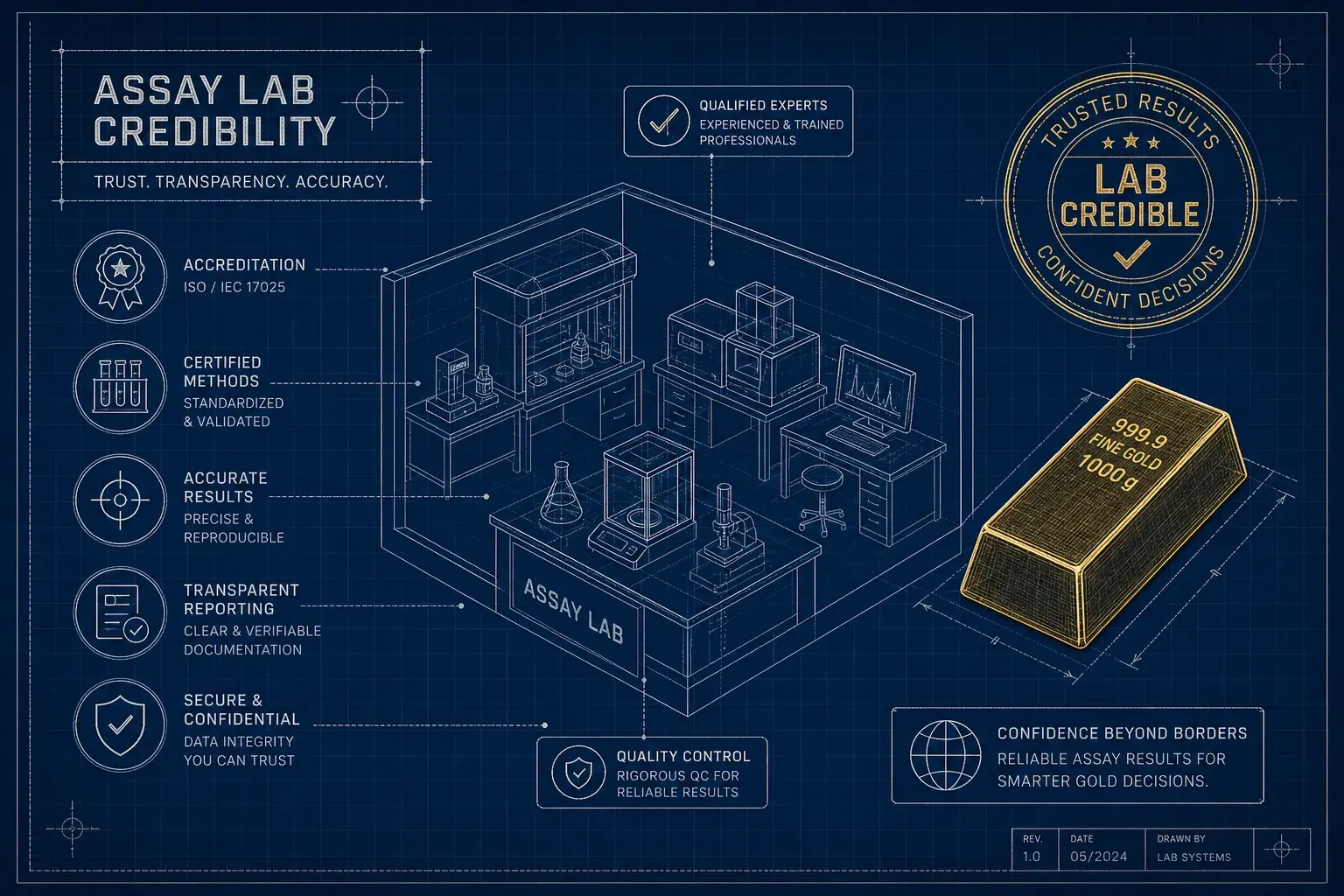
International gold buyers operate at a real disadvantage. You cannot walk into the mine, physically inspect the material before money moves, or audit the lab that produced the certificate sitting in your inbox. Everything you are working from is paperwork, and the reliability of that paperwork depends entirely on who produced it and under what conditions. Understanding the assay lab credibility indicators that matter most for international gold buyers is what separates a defensible purchase from an expensive mistake.
The stakes extend well beyond the financial. A weak or forged assay certificate can mean regulatory exposure under AML frameworks, conflict minerals violations under Dodd-Frank Section 1502, and losses that no insurance policy will cover cleanly. Labs like Bilex Minerals EA in East Africa are built around the principle that buyers need an independent voice in the assay process, one with no commercial stake in the gold being tested. This guide walks through every credibility indicator worth checking before you commit to a cross-border purchase.
Why independence from the seller is the first filter, not the last Most buyers focus on whether a lab has sophisticated equipment. The more dangerous question is who the lab answers to. Equipment quality is irrelevant if the lab's incentive structure points toward the seller's preferred outcome. If the seller hired the lab, paid the lab, and arranged the sample delivery, that lab is not functionally independent regardless of how professional the certificate looks.
A seller-affiliated tester may face structural incentives that create a real risk of biased reporting in favor of the seller's preferred purity figures. This pattern is especially common in informal gold markets across sub-Saharan Africa and Southeast Asia, where buyer and seller are often in different countries and verification is difficult. Genuine third-party independence means the buyer or a neutral agent commissions the test directly. The lab should have no equity stake, no commercial relationship, and no exclusive contract with the seller.
Before engaging any lab, ask directly: "Who typically commissions your tests, buyers, sellers, or both?" The answer will tell you a great deal about how independent the results actually are. Bilex Minerals EA operates as a fully independent third-party assay lab, taking no commercial interest in gold transactions. It tests what is brought to it and reports what the instruments show. That structural independence is what makes its certified assay reports defensible to international buyers and refiners.
Verifying this kind of independence, through accreditation records, published scope documents, and direct contact with the accrediting body, is a step no serious international buyer should skip. Key assay lab credibility indicators: accreditations that carry real international weight ISO/IEC 17025 and why it matters ISO/IEC 17025 is the primary international benchmark for testing and calibration laboratory competence. It certifies the validity of the lab's testing methods, the calibration traceability of its equipment, the competence of its personnel, and the integrity of its quality management system. Business registration, chamber of commerce membership, and government mineral export licenses are not substitutes.
They confirm the lab exists as a legal entity; they say nothing about whether it can produce accurate, defensible results. ILAC MRA verification The accreditation is issued by a national accreditation body, and that body's credibility matters too. To carry international weight, the accrediting body must be a signatory to the ILAC Mutual Recognition Arrangement (ILAC MRA), the mechanism through which accreditations from one country are recognized internationally. You can verify this directly: go to ILAC's signatory search, enter the accrediting body's name or acronym, and confirm it appears as a signatory with a scope that covers testing laboratories.
When you have confirmed the accrediting body, ask the lab for its accreditation certificate and full scope document. The scope lists the exact test methods, instruments, and site address covered. Accreditation is site-specific and method-specific. It is not blanket approval for everything the lab claims.
Confirm the lab appears in the accrediting body's online public directory at the correct address, with the methods you need listed in scope. LBMA claims vs. laboratory credentials One more clarification worth making: LBMA Good Delivery is a market-recognition status for refiners and specific bullion brands, not a laboratory accreditation. A lab citing "LBMA compliance" without appearing on the LBMA's published Good Delivery list is misrepresenting its credentials. Treat that as a red flag, not a reassurance.
What a legitimate assay certificate must contain A certificate of analysis (COA) is only as useful as the information it contains. Generic or incomplete certificates are not just unhelpful, they signal that the lab either lacks proper systems or is deliberately obscuring verifiable detail. Every legitimate assay certificate should include these elements without exception: A unique certificate number tied to internal lab records, not a generic sequential ID that could be duplicated The assayer's mark or the name of the authorized analyst who signed off on the result The full laboratory name, physical address, and accreditation reference number The testing methodology disclosed explicitly: fire assay, XRF, or ICP-MS, phrases like "in-house method" or "standard laboratory testing" are a red flag Sample weight and a description of the material tested Gold fineness or purity expressed numerically, such as 999.9, not vague language like "high purity" or "certified gold" Date of assay and the analyst's signature confirming the date-paired sign-off The certificate number should be verifiable. Call the lab using contact details you find independently, not from the document itself, and ask them to confirm the certificate number, sample ID, and result on record.
A legitimate lab can do this without hesitation. Also request the measurement uncertainty value. Accredited labs are required under ISO/IEC 17025 and ILAC guidance to report this figure alongside results; labs operating without proper systems often cannot produce it. A fire assay result expressed to fineness such as 0.9999 is credible when paired with a documented uncertainty range.
An XRF result reported to the same precision without a stated uncertainty range is not credible, the claimed precision is indefensible without it. Testing methodology transparency: when fire assay is non-negotiable The method used to determine gold purity is not a technical footnote. It determines how defensible the result is in a transactional or regulatory context, and international gold buyers should understand the difference before they accept any certificate as final. Fire assay (cupellation) is the internationally accepted reference method for gold purity determination.
Its accuracy runs to approximately 2 to 3 parts per ten thousand, and it is required for hallmarking-level purity claims, high-value bullion transactions, and any situation where the result will be cited in a legal or regulatory document. For high-value bullion consignments and transactions subject to regulatory documentation requirements, fire assay is the standard to demand. XRF spectrometry is a rapid, non-destructive screening method. Under field conditions, portable XRF can deviate from fire assay results by a margin equivalent to roughly 3 parts per 24, approximately 12.5% of a karat on a 24-point scale, and realistic XRF accuracy runs to approximately 0.4% with standard calibration.
It is a useful first-pass tool for preliminary evaluation, but it is not sufficient as the sole basis for a high-value transaction. ICP-MS, when used alongside fire assay digestion for trace element profiling, is also accepted for high-accuracy determinations. It is, however, less widely available than fire assay in many regional laboratory settings. When selecting a lab, confirm which methods fall within its accredited scope and request documentation accordingly.
Bilex Minerals EA uses XRF for rapid preliminary screening and fire assay to confirm purity for certified documentation. That layered approach gives buyers both speed and defensible accuracy in a single engagement. A lab that offers XRF only and frames it as equivalent to fire assay for final transactional purposes is either uninformed or misleading. The method must match the transaction type, and a credible lab discloses the method on the certificate without being asked.
How to spot a forged or unreliable assay report Document fraud in gold transactions follows predictable patterns. Knowing what to look for reduces exposure considerably, and most checks require nothing more sophisticated than a careful eye and a phone call. At the document level, watch for missing or inconsistent certificate numbers, mismatched fonts, pixelated signatures, and uneven text spacing. Open the PDF in a viewer that shows document layers; text pasted onto a scanned template leaves visible traces in the file structure.
Round-number purity results, exactly 99.9% across multiple batches, and results clustered precisely at specification limits are statistically implausible in legitimate assay data. Legitimate results carry natural variation. A result that looks too clean should prompt further verification, not confidence. For phone and directory checks: call the lab directly, confirm the certificate number and sample ID, and ask them to read back the result.
Cross-reference the lab name against the accrediting body's public directory and confirm the scope covers the method listed on the report. For high-value purchases, go further: request the raw instrument output, whether spectra or a fire assay calculation sheet, as a spot-check condition. Accredited labs retain this data as part of their quality management obligations under ISO/IEC 17025. Labs without proper systems cannot produce it.
Comparing serial numbering and report format against other certificates from the same lab also reveals template reuse, serial-number gaps, and lot-number repetition, consistent patterns in forged documentation. Chain of custody and export licensing: the final verification layer An accurate assay result is only as useful as the documentation that surrounds it. Chain of custody (CoC) records trace the sample from collection to result delivery, and every transfer point should show the handler's name, signature, date and time, sample ID, and the condition of the sample at transfer. Request a completed CoC alongside the assay certificate.
A lab that cannot produce one, or produces a vague single-page form, has a documentation gap that undermines the defensibility of its results regardless of how accurate the test was. For international transactions, CoC records may be required by import regulators, AML compliance teams, or refiners on the receiving end. This is not a bureaucratic detail; it is the documentation chain that proves the gold moved through a verifiable process rather than an informal one. In markets like Kenya and Tanzania, licensed export documentation carries additional significance.
It confirms the gold moved through a regulated, traceable channel. For US buyers subject to Dodd-Frank Section 1502 conflict minerals compliance or responsible sourcing requirements, working with a lab that also facilitates licensed mineral export documentation reduces the number of intermediaries and potential documentation gaps in the chain. Bilex Minerals EA combines fire assay testing, XRF screening, certified assay reporting, and licensed mineral export documentation under one roof, a practical advantage for international buyers sourcing gold from East Africa who need a streamlined, well-documented chain from test to export. Before completing any cross-border purchase, request the full documentation package: the assay certificate with explicit method disclosure, the chain of custody record showing every custody transfer, and proof of export licensing where applicable.
A credible lab produces all three without hesitation. Verification is a process, not a single document check These assay lab credibility indicators for international gold buyers are not a checklist to skim once. They form a layered verification process covering structural independence, accreditation status, document completeness, methodology transparency, and chain of custody integrity. Each layer catches a different class of risk, and skipping any one of them leaves a gap that fraud or negligence can fill.
International gold buyers who bypass this process are not simply accepting financial risk; they are accepting regulatory and compliance exposure that can outlast the transaction itself. Every indicator covered here can be checked before money moves or a purchase agreement is signed. The process takes time, but it is far less costly than the alternative. If you are sourcing gold from East Africa, Bilex Minerals EA offers the structural independence, methodological transparency, and documentation support that international transactions require.
Contact Bilex Minerals EA to request a sample assay package or discuss your documentation requirements before your next purchase.
Keep the answer within its proper scope.
Can this article replace transaction-specific professional advice?
No. It is educational. Confirm current legal, customs, tax, regulatory, technical, and commercial requirements with the responsible authorities and appropriately qualified advisers.
Does an assay approve the wider gold transaction?
No. An assay describes the submitted sample under the stated method. Ownership, origin, seller authority, payment, export, import, sanctions, and logistics require separate checks.
What should I verify before relying on a document or result?
Verify the issuer, scope, date, reference, sample or shipment identity, units, validity, and direct connection to the current parties and material.
Official and primary sources