
Screen Gold Bars & Doré
Review suitable selected surfaces without consuming an analytical portion.
X-Ray Fluorescence Analysis
Fast, Non-Destructive Analysis for Gold & Metallic Samples
Need to assess a gold bar, doré or metallic sample without consuming it?
Bilex Minerals EA provides X-ray fluorescence (XRF) analysis for rapid elemental screening and comparison of suitable gold and metallic samples.
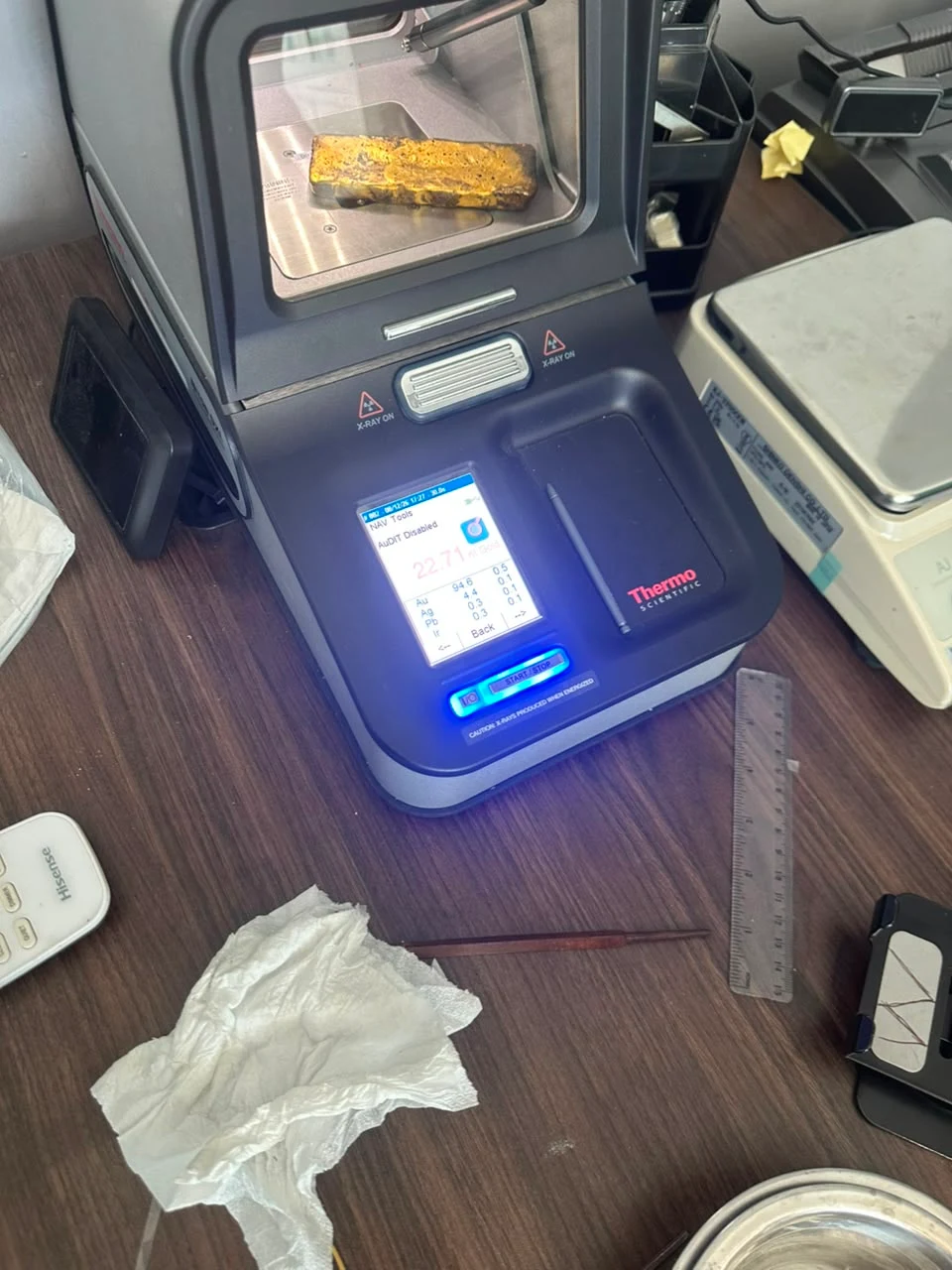
XRF uses X-rays to excite elements in the selected test area. Those elements produce characteristic fluorescent responses, which the instrument measures and software interprets against the applicable calibration.
The result applies to the measured region. It should be read with the sample condition, selected area and method limitations in mind.
Review suitable selected surfaces without consuming an analytical portion.
Examine suitable bullion and metallic areas under an applicable calibration.
Check selected locations for similarities or visible elemental differences.
Use measured elemental responses to flag areas that may need further review.
Obtain rapid surface information before deciding whether another method is justified.
Use screening results and the testing question to consider the next analytical step.
Client benefits
Rapid measurements provide timely information from selected test areas.
Normally no prepared analytical portion is consumed.
Different areas can be compared during the same screening session.
Suitable items can be examined without destructive sampling.
Identify a suitable surface region and record the measurement location.
The instrument directs X-rays at the selected region.
Elements in that region produce characteristic responses.
The instrument measures the response and software interprets it.
The measured region is reported within the applicable method scope.
Important limitation
A surface reading is not automatically a bulk result.
XRF measures the region being examined. If surface composition differs from the interior, the XRF reading may not represent the entire item.
Multiple readings can help identify variation, but they cannot guarantee that the interior composition matches the measured surface.
The selected surface region can provide useful preliminary elemental information.
Preservation matters and destructive sampling is not currently appropriate.
Several selected locations need to be screened for differences.
The screening result can help determine whether another method may be justified.
Further testing may be appropriate when surface information alone is insufficient or when a representative prepared-sample analysis is required.
Explore Fire AssayThe right method depends on the question, the material and whether destructive testing is permitted.
| Comparison | XRF Analysis | Fire Assay |
|---|---|---|
| Primary use | Rapid screening | Representative prepared-sample analysis |
| Sample damage | Normally non-destructive | Analytical portion is consumed |
| Measurement | Surface region | Prepared sample portion |
| Speed | Rapid | More involved |
| Multiple-area comparison | Yes | Requires sampling |
| Interior composition | Not automatically represented | Depends on representative sampling |
| Best suited to | Screening and comparison | Representative determination |
Gold Testing & Assaying
Representative gold determination from a prepared analytical portion.
Learn MoreQuantitative multi-element analysis after suitable sample preparation.
Learn MoreInternal structural examination of suitable solid bullion.
Learn MoreSupporting physical mass-to-volume verification.
Learn MoreCommon questions
XRF is normally non-destructive. It examines the selected surface region without consuming a prepared analytical portion under normal measurement conditions.
Yes, suitable gold doré surfaces can be screened with XRF. Surface condition, geometry, coatings and internal variation must still be considered when interpreting the reading.
Not automatically. XRF measures the selected surface region. If the surface differs from the interior, the reading may not represent the entire bar.
Neither method is universally better. XRF supports rapid, non-destructive surface screening and comparison. Fire Assay analyses a representative prepared portion where destructive testing is appropriate.
Yes. Multiple XRF readings can compare selected areas and help identify variation. They still cannot guarantee that the interior matches the measured surfaces.
Under normal XRF measurement conditions, no analytical portion is consumed. Bilex should still review the item and testing requirement before confirming the scope.
XRF testing enquiry
Tell Bilex what material you have, its approximate quantity or form, what you need to establish, whether the item must remain intact and how the result will be used.
Contact Bilex before travelling with valuable material. The team can review your enquiry and advise on the appropriate next step.