
Focused resource · Laboratory Verification
Questions to Ask a Gold Testing Lab Before Submitting Samples
What to ask about independence, method scope, sample preparation, custody, quality control, reporting, timing, fees, and confidentiality.
10 min read · Knowledge Centre resource
Direct answer
Ask what method will be used, whether it suits the material and decision, how the sample is handled, what quality checks support the result, and exactly what the report will state.
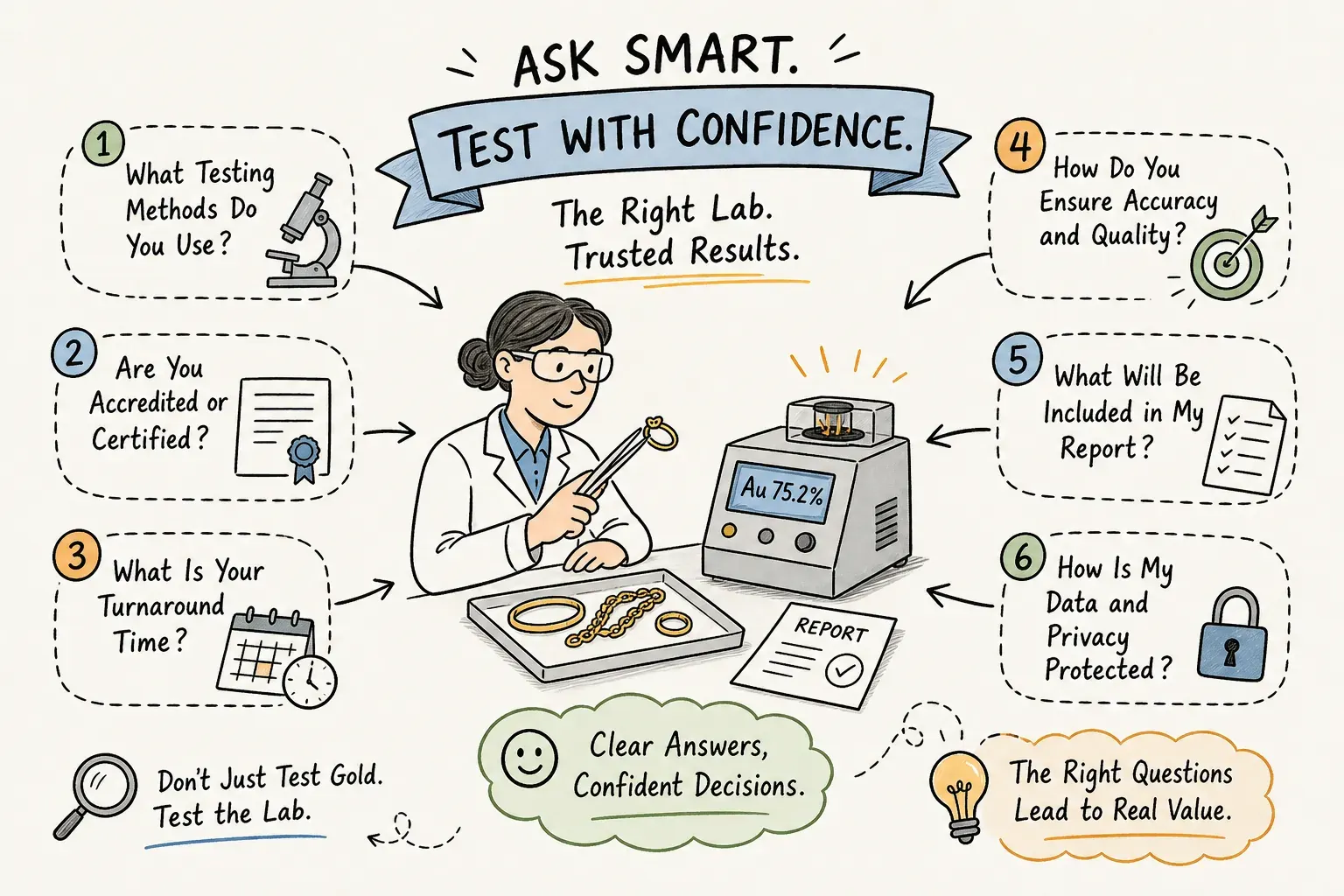
The wrong assay laboratory costs more than the test itself. A buyer who gets a result their refinery won't accept, a seller whose certificate falls apart at customs, an exporter who discovers the laboratory's scope never covered precious metals at all, these problems do occur, and they happen when people hand over gold without asking the right questions first. This article covers the essential questions to ask a gold testing laboratory before submitting samples, so you know exactly what to require before a single gram moves. The goal isn't to catch anyone out.
The goal is to understand precisely what you're paying for and whether the results will hold up when it matters. Is the laboratory accredited, and does that accreditation actually cover gold testing? Most buyers have heard of ISO/IEC 17025 and know it signals a credible laboratory. Fewer know to ask about the scope, the part that actually determines whether your result is defensible.
A laboratory can hold ISO/IEC 17025 for one category of analysis and still run your gold through a method that sits entirely outside its accredited scope. What ISO/IEC 17025 actually certifies ISO/IEC 17025 assesses technical competence: calibration traceability, documented procedures, impartiality, and measurement uncertainty. It is not the same as ISO 9001, which is a process quality certificate. ISO 9001 tells you the laboratory has organized its workflow.
ISO/IEC 17025 tells you the laboratory can produce technically reliable test results under that workflow. That distinction matters enormously for gold. Why the scope document matters more than the certificate The scope of accreditation must explicitly list precious metals assay, or the specific method being applied to your material. "Analytical chemistry" or "elemental analysis" in general terms is not enough.
Ask for the current accreditation certificate and its scope as a PDF before proceeding. Check that the scope names the material (gold bullion, doré, ore), the method (fire assay, XRF, ICP-OES), and the measurement range the laboratory is authorized to cover. The independence question most buyers forget to ask A laboratory with no commercial interest in the gold being tested produces a structurally different result than a seller's in-house test. True third-party independence means the laboratory doesn't buy, sell, broker, or process the material it analyzes.
Ask directly whether the laboratory has any commercial relationship with counterparties in your transaction. Any hesitation on that question is information worth having. Questions to ask a gold testing laboratory before submitting samples: method selection Method selection changes everything downstream. Accuracy, destructiveness, turnaround time, and whether the final certificate will be accepted by a refinery or regulatory authority all hinge on this choice.
The three methods you'll encounter most often are fire assay, XRF, and ICP-MS, and each belongs in a specific part of the process. Fire assay: the reference method and when it applies Fire assay is the benchmark for bullion, doré, ores, and concentrates. The method fuses the sample, separates precious metals through cupellation, and delivers accuracy of approximately ±0.05 to 0.1% in standard laboratory practice, with some validated high-purity protocols reaching ±0.05 parts per thousand (0.05‰). Refiners and export authorities rely on fire assay specifically because of this precision and its long international track record.
The tradeoff is that it is destructive, consuming the analytical portion entirely. Typical reported assay portions range from roughly 100 to 500 mg depending on the sample matrix and the laboratory's protocol. XRF: fast screening, not a final answer XRF is useful for rapid preliminary evaluation. It reads only the top 20 microns of a surface, though penetration depth varies with instrument energy and sample matrix, which means a bar with surface coating, plating, or near-surface impurities can return a misleading result.
Typical accuracy under standard calibration runs around ±0.4%, and application-specific calibration can improve that to roughly ±0.2%. Use XRF to screen and orient a transaction, but never rely on it as the sole test when the deal depends on the number. ICP-MS and when trace-element analysis matters ICP-MS suits clients who need multi-element composition data or detection limits at the parts-per-billion range, or who face regulatory-grade trace element reporting requirements. The method requires full sample dissolution, making it destructive, but it is highly precise and can confirm or challenge fire assay results at high purity levels.
One short declarative worth remembering: if your buyer, refinery, or compliance framework requires detailed elemental reporting beyond gold content, ICP-MS is the method to ask about before submission. Gold sample submission checklist: what the laboratory needs from you before testing begins Sample preparation and chain-of-custody protocols are the questions most buyers skip and then regret. Arriving unprepared costs time, adds charges, and can compromise the result before testing even starts. Working through a gold sample submission checklist in advance keeps the process clean and ensures the results reflect the actual material you submitted.
Mass, form, and packaging requirements Laboratories typically accept bulk ore samples in the range of 0.2 to 3 kg, but only a small analytical aliquot, often 30 to 50 g, is actually tested. To get there, laboratories dry the material, jaw crush it to approximately 2 mm, riffle split it for a representative sub-sample, and then pulverize it to a fine pulp passing 95% through 150 mesh. Ask whether the laboratory performs this preparation or whether you need to submit prepared pulps, and confirm whether prep is included in the quoted price or billed separately. Chain of custody: how the laboratory protects your sample from entry to result A credible chain-of-custody protocol includes sealed sample bags, logged intake records, secure storage, and full documentation of every person who handles the sample between submission and reporting.
This is the question that separates laboratories with real process discipline from informal operators. Ask the laboratory to describe their intake procedure specifically: what gets recorded, where samples are stored, and how they prevent mix-ups or cross-contamination between client submissions. What will it cost, and what fees won't appear on the headline price? Standard fire assay in U.S. commercial laboratories typically runs around $30 to $50 per sample, with sample preparation adding $10 or more per sample when the material isn't already prepped.
These figures reflect general market benchmarks and can vary by laboratory and region. Turnaround benchmarks cluster around 5 to 10 business days for standard service, with rush options in the 24 to 48-hour range. Note that the turnaround clock usually starts at laboratory receipt, not at shipment, so shipping time adds to the total wait regardless of the quoted timeline. The fees most quotes don't mention upfront Watch for these add-ons, buyers typically discover them only after submitting: Sample preparation charges for crushing, drying, and pulverizing Rush or expedited service surcharges, sometimes 100% of the base rate for 24-hour turnaround Re-run fees for unusual sample matrices or poor homogeneity Disposal or hazardous-material handling fees for certain prep chemistries High-end analytical packages such as NiS fire assay with ICP finish, which can run several hundred dollars per sample Getting a complete quote before you ship Request a full written quote that itemizes every potential charge before anything moves.
Confirm whether rush service requires pre-arrangement or can be requested on arrival. Ask what happens to residual sample material after testing: some laboratories return it, some dispose of it, and some charge for disposal. A laboratory that can't produce an itemized quote deserves further scrutiny before you commit. What will the report show and how do you know the results are reliable?
Most clients accept an assay certificate at face value. That's a mistake when the certificate isn't backed by adequate quality controls or when the reporting format obscures rather than communicates precision. Knowing what a legitimate certificate should contain lets you evaluate the report rather than simply receive it. Reading the certificate: units, precision, and uncertainty A legitimate assay certificate reports results in the correct unit for the application: troy ounce, gram, ppm, or fineness depending on what was tested and for what purpose.
The number of significant figures should reflect method precision, not exceed it. Excessive decimal places are not a sign of precision, they signal overclaiming. Measurement uncertainty must be stated, because a result without uncertainty cannot be meaningfully compared against a specification or acceptance criterion. QA/QC data: what blanks, CRMs, and duplicates tell you A credible certificate of analysis is backed by three categories of quality control data.
Method blanks confirm that contamination during testing was negligible. Certified reference material (CRM) results confirm the instrument read a known standard accurately on the day your sample was run. Duplicate analyses confirm the result is repeatable on your material, not just on the reference. Ask the laboratory whether this QA/QC data is included in the report or available on request.
A laboratory that can't produce it isn't running adequate quality controls, and that gap flows directly into your result. How are your results delivered, reviewed, and kept confidential? Confidentiality and delivery format are the questions most buyers don't think to ask until a result ends up in the wrong hands or they receive a PDF they can't interpret without support. Both have practical and legal dimensions for anyone moving significant volumes of gold across borders.
Who receives the report and how is your data protected? Ask directly whether results are shared with any third party under any circumstance, how long the laboratory retains client data, and what access controls protect your file. For exporters and traders operating under anti-money laundering or conflict minerals compliance frameworks, this is a due diligence question as much as a privacy one. The laboratory should be able to answer it without hesitation, and in writing if you request it.
Why it matters how the report is handed over There is a meaningful difference between a laboratory that emails a PDF and one that walks you through the findings, confirms that sample identity matches what was submitted, and answers methodology questions directly. An appointment-based review process eliminates the ambiguity that comes with remote-only delivery and gives buyers a direct line to clarify interpretation before acting on the numbers. At Bilex Minerals EA, results are reviewed with clients in person for precisely this reason, a structure that protects everyone in the transaction, not just the laboratory. Bring these gold assay questions into every laboratory conversation These questions to ask a gold testing laboratory before submitting samples cover six areas: accreditation scope, method match, sample preparation clarity, transparent pricing, credible QA/QC reporting, and a clear confidentiality and delivery process.
None of these questions are adversarial. They are the standard any serious buyer, exporter, or refinery-bound seller should apply before entrusting a laboratory with material that carries real financial and regulatory weight. Any reputable laboratory will answer every one of these questions without hesitation. Reluctance to answer is itself useful data.
A laboratory that deflects on accreditation scope, can't itemize fees, or won't describe its chain-of-custody process is telling you something important before you've submitted a gram. These questions belong in every laboratory conversation before a sample moves. If you're sourcing, trading, or exporting gold from East Africa and need an independent laboratory that offers fire assay and XRF testing alongside export documentation support, contact Bilex Minerals EA to discuss your testing requirements before your next submission.
Keep the answer within its proper scope.
Can this article replace transaction-specific professional advice?
No. It is educational. Confirm current legal, customs, tax, regulatory, technical, and commercial requirements with the responsible authorities and appropriately qualified advisers.
Does an assay approve the wider gold transaction?
No. An assay describes the submitted sample under the stated method. Ownership, origin, seller authority, payment, export, import, sanctions, and logistics require separate checks.
What should I verify before relying on a document or result?
Verify the issuer, scope, date, reference, sample or shipment identity, units, validity, and direct connection to the current parties and material.
Official and primary sources