
Focused resource · Testing Methods
Gold Testing Methods: Which One Is Right for You?
Compare visual checks, magnets, hallmarks, density, acid testing, electronic tools, ultrasound, XRF, and Fire Assay by purpose and limitation.
15 min read · Knowledge Centre resource
Direct answer
Use simple checks only to identify obvious inconsistencies. Use XRF for rapid, non-destructive elemental screening. Use representative sampling and Fire Assay when a commercial decision requires a dependable bulk gold result.
Gold is frequently counterfeited across markets worldwide, and choosing the right gold testing methods is what separates a confident purchase from an expensive mistake. A karat stamp on a piece of jewelry, a bar, or a coin tells you what the seller claims it is, it does not tell you what it actually is. Tungsten-filled bars pass weight checks. Gold-plated alloys survive a quick visual inspection.
Convincing fakes circulate across multiple documented markets, from estate sales in the U.S. to commercial transactions in East Africa. The gold testing method you choose determines whether you actually know what you have, or whether you just feel better about what you think you have. Those are very different outcomes, and the gap between them can cost you real money. This article walks through every major gold testing method in order of complexity, from a free magnet check to lab-grade fire assay, so you can match the right approach to your specific situation.
One principle applies throughout: casual curiosity about a piece of jewelry calls for a different approach than a commercial transaction involving significant weight or value. Know what's at stake before you choose your method. Gold testing methods: quick checks to rule out obvious fakes These initial checks won't confirm gold purity. What they do is filter out the crudest fakes quickly and give you useful context before committing to more involved testing.
Think of them as Step 0, not Step 1. The magnet test: free, instant, and only a first filter Gold is not magnetic. Hold a strong rare-earth magnet near the piece. If the metal pulls hard toward the magnet, you're dealing with a base metal core, and you can stop there.
What this test won't catch is significant: many common fake gold alloys are also non-magnetic. Passing the magnet test eliminates the crudest counterfeits, nothing more. Do not interpret a non-magnetic result as confirmation of gold. Reading hallmarks and fineness stamps correctly Gold items are often stamped with a millesimal fineness number indicating parts of gold per thousand.
The common marks translate as follows: 375 equals 9K, 417 equals 10K, 585 equals 14K, 750 equals 18K, 916 equals 22K, and 999 equals 24K near-pure gold. You may also see a maker's mark or an assay office mark alongside the fineness number, indicating the item was submitted to an official testing authority at the time of manufacture. The critical caveat: a stamp indicates claimed purity, not confirmed purity. Stamps can be applied to plated or counterfeit material.
They're a useful starting point for cross-referencing against a standard chart, but independent testing is the only way to confirm what the stamp says. The density and specific gravity method Gold has a density of approximately 19.3 g/cm³, which is distinctive enough to serve as a useful screening tool. Weigh the item dry, then weigh it again fully submerged in water. The ratio of those two weights lets you calculate density and compare it against the expected value for the stated karat.
For solid, uniform pieces, this is a cheap, chemical-free check. The method has real limits. It doesn't work reliably on hollow jewelry, stone-set items, or anything with trapped air. More critically, tungsten has a density almost identical to gold, which means a tungsten-filled bar passes a density test without issue.
For suspect bars specifically, ultrasound testing is a better screen for exactly that reason. The acid test: how it works and where it falls short The acid or scratch test is the most widely used low-cost field method for testing gold. It works by exploiting a simple chemical property: gold resists dissolution by most acids, while base metals and lower-karat alloys do not. How to perform a scratch and acid test safely Start by rubbing the item against a touchstone or unglazed ceramic tile to leave a visible metal streak.
Apply karat-specific acid starting from the lowest concentration (10K) and working upward through 14K, 18K, and 22K until the streak no longer survives the acid. Each bottle in a standard test kit corresponds to a minimum purity threshold. Safety is not optional here. Wear nitrile or acid-resistant gloves and safety glasses.
Work in a ventilated space and keep baking soda close to neutralize spills immediately. The acids used for 22K and higher testing can involve particularly hazardous mixtures, including formulations that release toxic fumes if mishandled. Follow the kit instructions exactly. Reading acid test results: what survives and what doesn't The interpretation logic is straightforward: if the streak holds after the acid is applied, the surface metal is at or above that karat level.
If the streak fades, the purity is below that threshold. If the streak dissolves quickly, you're looking at a base metal or heavily diluted alloy. This is a threshold test, not a precise measurement. Results are qualitative, not quantitative.
Why acid tests miss plated and hollow pieces The acid reacts only with the surface streak, which is drawn from the item's outer layer. If the piece is gold-plated, the streak reads as gold even though the interior is base metal. Scratching deeper improves the picture slightly, but it also damages the piece, which matters for anything with resale value. Acid testing is the right call for a quick, low-cost gold authenticity check on solid jewelry where the purchase price doesn't justify professional testing.
For high-value or commercial transactions, it simply isn't built for the job. Consumer acid test kits typically run from roughly $15 to $50; note that pricing varies by region and retailer. Jewelers or pawnshops often offer acid testing as a service, generally for $20 or less, though rates differ by location. Electronic testers and ultrasound: the middle-ground options Between the touchstone and a professional laboratory sit two tools that offer speed and portability with more consistency than acid testing, but less precision than XRF or fire assay.
How electronic gold testers work and what to expect Conductivity-based testers apply an electrical signal to the metal and compare the reading against calibrated karat values, producing a digital readout in seconds. They're portable, chemical-free, and fast. Device cost typically runs from $150 to $600, and they work well on simple, solid, plain gold items like coins or unadorned bands. The limitations are real.
Electronic testers struggle with plated items, hollow pieces, and complex multi-metal construction because they read a shallow surface zone and infer composition from a physical property rather than measuring elemental content directly. They also require regular calibration to stay accurate. Because conductivity testing relies on calibrated reference values, unknown alloy construction defeats the calibration entirely, which is why this approach works best as a screening step, not a final answer. Ultrasound testing: the option for suspicious bars Ultrasound testing passes high-frequency sound waves through the item and measures the return signal.
Because tungsten and gold have very different acoustic properties, a tungsten core or insert changes the echo pattern in a way that a density check will not catch. This makes ultrasound particularly useful for evaluating gold bars where internal fraud is a concern. Results depend on good surface contact, proper frequency setup, and operator skill, so it's not a casual in-hand tool. Neither electronic nor ultrasound testing replaces XRF or fire assay for precise purity determination.
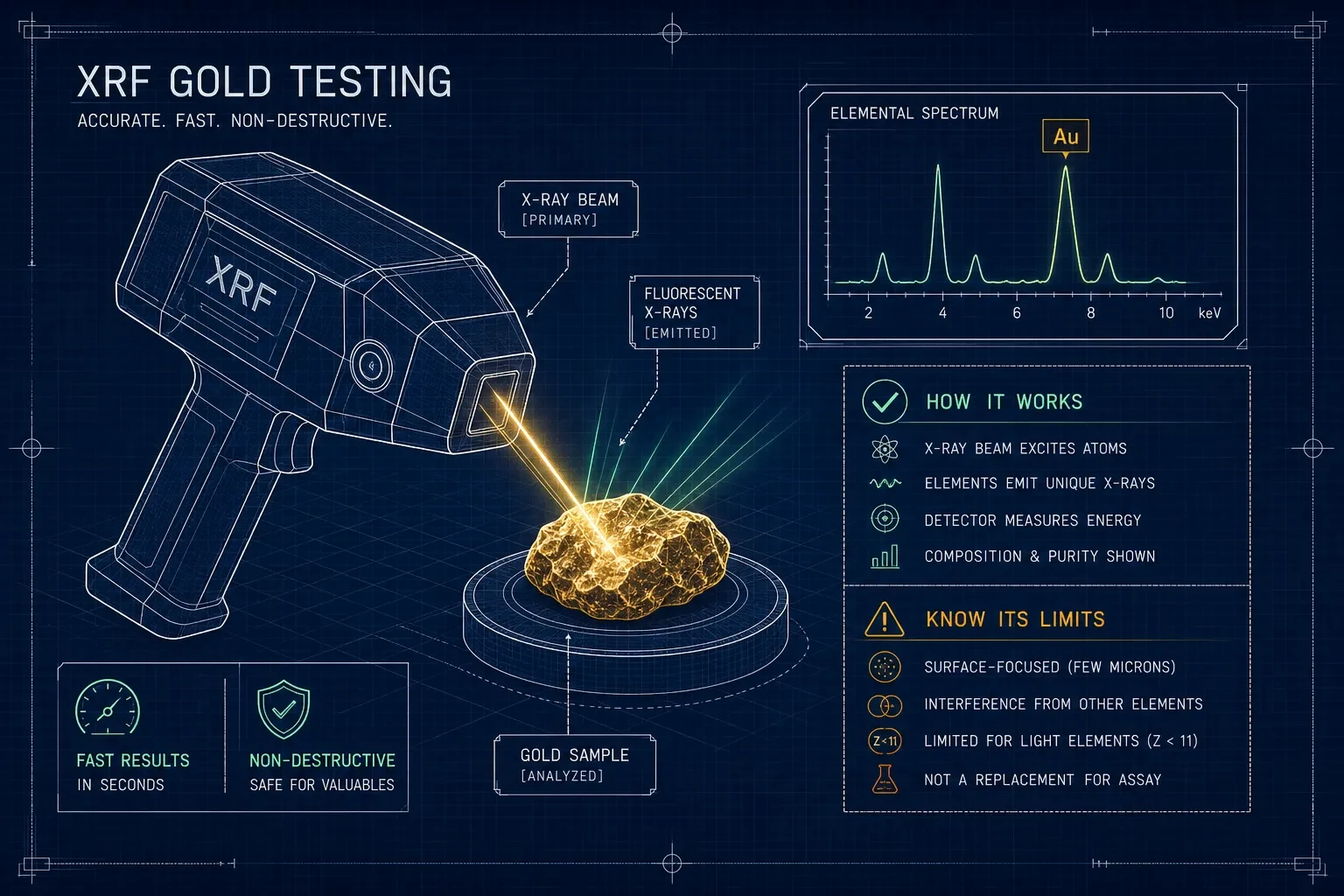
Both are advanced screening tools, useful for flagging items that warrant deeper investigation, not for settling final numbers. XRF: a gold testing method for fast, non-destructive screening X-ray fluorescence testing is where professional screening begins. It's non-destructive, fast, and capable of delivering elemental composition data that acid and electronic tests can't approach. How X-ray fluorescence reads gold composition XRF instruments fire X-rays at the sample surface.
The atoms in the metal absorb that energy and re-emit element-specific fluorescent X-rays, which the detector converts into a quantified elemental breakdown. Results appear within seconds as a percentage composition or karat value. A well-calibrated instrument can reliably distinguish 24K, 22K, 18K, 14K, and 10K alloys when the material is homogeneous and the test settings are optimized for the sample type. Accuracy buyers can realistically expect from XRF Under consistent conditions with application-specific calibration, well-maintained XRF instruments achieve roughly ±0.2 to 0.4% accuracy, based on published instrument specifications and industry validation benchmarks.
Some handheld units report down to 0.1% with optimized settings. That level of precision far exceeds what acid testing or electronic testers can deliver, and it's the standard for professional screening and preliminary purity evaluation across the bullion and refinery sectors. The surface-plating problem: XRF's main blind spot XRF penetrates only the near-surface layer, typically a few micrometers to about 10 to 15 micrometers deep, based on established instrument physics and laboratory guidance on XRF information depth. Gold plating in the range of 15 to 20 microns or thicker can produce a "solid gold" reading even when the core is base metal, because the substrate no longer contributes enough signal to change the result.
Common jewelry plating runs from 0.5 to 5 microns, which XRF can usually see through. Heavy plating approaches the saturation threshold and becomes a genuine blind spot. Dirty, rough, or coated surfaces also distort readings. Testing multiple points on irregular or suspicious pieces improves reliability but can't fully compensate for layered construction.
XRF's surface limitations are precisely the gap that fire assay is designed to close, which is why serious commercial workflows use both methods in sequence. Fire assay: why this method sets the commercial standard When the number has to be right, fire assay is the method that professionals, refiners, and export authorities rely on. It measures bulk composition rather than surface composition, a distinction no portable instrument can replicate. What cupellation actually does to a gold sample Fire assay is a destructive process.
A prepared sample is mixed with flux and lead oxide, then fused at high temperature in a furnace. The fusion collects precious metals into a lead button. That button is then cupelled: heated in a porous crucible so the lead oxidizes and is absorbed, leaving behind a pure precious-metal bead. That bead is weighed gravimetrically, or dissolved and measured by AA or ICP, to determine the exact gold content.
The process consumes the sample, that's the only real trade-off. Accuracy, turnaround, and real-world cost Fire assay delivers accuracy to approximately 1 part in 10,000 under validated laboratory conditions, aligning with ISO 11426 and ASTM E1335, the two internationally recognized standards for precious-metal fire assay. Repeatability requirements under ISO 11426 specify that duplicate determinations must agree within 0.2 parts per thousand for gold alloys of 990 fineness or higher. That's a level of precision no surface-based method can match.
Routine commercial turnaround runs 24 to 48 hours per batch in professional labs, with rush arrangements available when the situation demands it. Cost per assay varies by sample type, batch size, and finish method. As a general benchmark, fire assay is a moderate-cost service relative to the transaction values it protects, an important consideration for anyone weighing lab fees against deal risk. Where professional labs fit into commercial gold verification Fire assay and XRF are the two internationally accepted gold testing methods for commercial-grade verification, and the most reliable workflow combines both.
XRF provides a fast, non-destructive screen and helps identify the best sampling point. Fire assay delivers the certified reference result that refiners, buyers, and export authorities rely on when settling a transaction or satisfying a regulatory requirement. Bilex Minerals EA, an independent precious metals testing and assaying laboratory operating in Nairobi and Dar es Salaam, runs both methods under one roof for exactly this reason. Clients receive a rapid XRF preliminary reading followed by fire assay confirmation when the transaction or compliance requirement demands it.
Because Bilex Minerals EA holds no financial interest in the gold it tests, that independence is the baseline condition for credibility in any market where conflicts of interest are routine. For U.S.-based importers and investors evaluating East African gold supply chains, independent third-party assay documentation supports due diligence requirements under AML frameworks, responsible sourcing standards, and applicable regulatory guidance such as Dodd-Frank Section 1502, though specific compliance determinations should always be confirmed with qualified legal counsel. Matching the right gold testing method to your situation Every method described above has a legitimate role. The question is which one fits your stakes, and understanding that distinction is what separates buyers who get hurt from buyers who don't.
The standard screening workflow for serious buyers For high-value commercial gold, the most reliable approach runs in stages: a magnet and density check as an initial filter, XRF for non-destructive elemental screening, and fire assay for certified final confirmation. Skipping straight to fire assay without XRF wastes money on samples that might fail the screen. Stopping at XRF alone leaves a meaningful gap for plated or layered material. The two-stage professional workflow exists because no single gold testing method solves every problem.
When DIY checks are enough A magnet test, hallmark inspection, and acid test are reasonable for low-value jewelry purchases where the cost of professional testing genuinely exceeds what the piece is worth. For personal curiosity or casual small transactions, an electronic tester or acid kit covers the basics. Just hold the ceiling of those results clearly in mind: they screen for red flags. They don't confirm the truth.
When independent, certified results are non-negotiable Commercial transactions, export documentation, refinery intake, investor due diligence, and any situation involving significant value or regulatory compliance require certified fire assay results from an independent lab. A seller's own test carries an obvious conflict of interest, whether or not the seller is acting in good faith. Third-party assaying removes that variable entirely, which is why independent laboratories exist in this market. Know what your result actually proves The full spectrum of gold testing methods runs from a free magnet check to reference-standard fire assay.
The right method depends entirely on what's at stake. DIY methods screen for red flags. Professional lab methods confirm the truth. Those are not the same thing, and treating one as the other is where buyers get hurt.
For transactions where accuracy matters, buying bullion, verifying commercial-grade material from East Africa, or meeting compliance documentation requirements, fire assay and XRF from an independent lab are the gold testing methods that hold up internationally. Every other method is a filter, not a final answer. If you need that level of certainty on East African gold, Bilex Minerals EA provides independent fire assay and XRF testing with no financial stake in the outcome, plus licensed export documentation support for clients moving material across borders. Know what you're testing, know what your result actually proves, and when the number matters, send it to a certified lab.
Keep the answer within its proper scope.
Can a magnet prove that an item is gold?
No. A strong attraction can reveal some obvious non-gold materials, but many non-gold alloys are also non-magnetic.
Is acid testing safe for valuable jewellery?
It may mark the item and involves hazardous chemicals. Use a trained professional and consider non-destructive screening first.
Can XRF see through thick plating?
XRF mainly measures the surface region. Layer thickness and composition affect whether the underlying material contributes to the reading.
Why not use Fire Assay for every item?
Fire Assay consumes a sample. For jewellery or low-risk screening, a non-destructive method may answer the question without unnecessary damage.
Official and primary sources