
Focused resource · Gold Assaying
What Is a Gold Assay Test and What Do the Results Mean?
Understand what an assay measures, how Fire Assay and XRF differ, how purity is reported, and why laboratory independence matters.
13 min read · Knowledge Centre resource
Direct answer
A gold assay is a controlled analytical determination of gold in an identified sample. The report should state the method, result, units, sample reference, date, and relevant limitations.
Picture a gold transaction that should close in a day. The buyer has the funds ready. The seller has the material. But when the purity figures come out, nobody agrees on which test to trust, and without an independent gold assay test, there is no neutral ground to stand on.
The seller's XRF reading says one thing. The buyer's contact says another. The deal stalls, and both parties walk away frustrated and empty-handed. This scenario plays out constantly in gold markets across East Africa and beyond, and it is almost always avoidable.
A gold assay test is the standardized, analytical process a laboratory uses to determine the actual precious metal content of a gold sample. Not an estimate. Not a visual check. A documented, quantitative measurement that both parties can rely on.
The catch is that not every test is equal, and not every lab is neutral. Independent laboratories like Bilex Minerals EA exist precisely because a result means nothing if the party reporting it has a financial interest in what that result says. The following sections cover what assaying actually measures, which testing method fits which situation, how to read the numbers on an assay certificate, and why the source of that report matters just as much as the method used to produce it, including why the lab's neutrality is the argument that ties everything else together. What a gold assay test actually measures Assaying is not a gold detector.
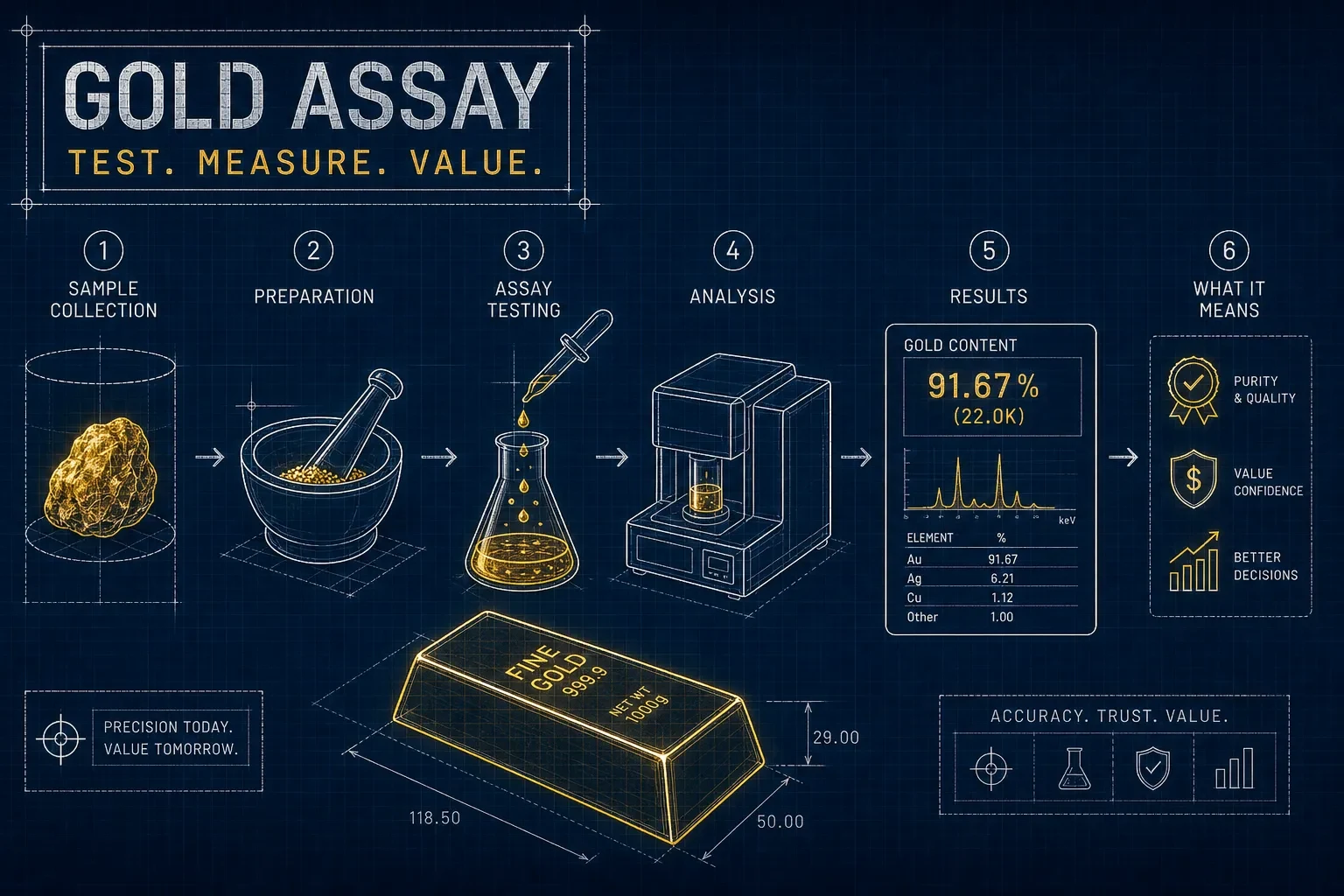
It is a quantitative chemical or spectrometric analysis that determines the concentration of gold, and often every other element present, in a given sample. The result is a precise figure expressed to multiple decimal places, not a ballpark range based on color or weight alone. The core measurements: purity, composition, and weight A standard assay report captures three things: gold purity expressed as a percentage or fineness, the presence and proportion of other metals in the alloy such as silver, copper, and zinc, and the weight of recoverable gold per troy ounce or gram of sample. For ore or concentrate, the report also includes grade, how much gold is present per ton of material.
This composite picture is what makes a gold assay test valuable for pricing negotiations, refinery intake decisions, and export documentation. Why the full alloy breakdown matters Knowing the complete elemental composition is not an academic exercise. Copper content affects melting behavior and refining costs directly. Silver content determines how gold is parted and valued during processing.
A buyer paying spot price for "high-purity gold" needs confirmation that the purity figure holds throughout the entire sample, not just at the surface. An independent gold assay test answers that question with documented precision that protects both sides of the transaction. Gold assay test methods: fire assay vs. XRF Several gold assaying methods exist, each with different accuracy levels, cost points, and practical trade-offs.
The right choice depends on what the gold is (jewelry, bullion bar, ore, scrap), what question needs answering, and the stakes attached to that answer. Fire assay (cupellation): the benchmark method Fire assay is the definitive standard in precious metals analysis, and understanding how it works explains why. The sample is mixed with fluxes and a lead collector, then heated at temperatures around 1,050 to 1,150 degrees Celsius. The lead collects all precious metals into a button while the waste material forms slag.
That lead button is then placed in a porous cupel and heated again, causing the lead to oxidize and absorb into the cupel walls, leaving behind a tiny precious-metal bead. For gold specifically, that bead is treated with nitric acid to remove silver, and the remaining gold is weighed on precision balances. The result is a bulk measurement of what is actually present throughout the entire tested portion, not just on the surface. Accuracy for well-controlled bullion work is typically within 0.01%, or about 1 part in 10,000.
The trade-off is straightforward: fire assay is fully destructive. The tested portion of the sample is consumed in the process, which makes it unsuitable for situations where the original item must be preserved intact. XRF testing: fast screening with real limitations X-ray fluorescence (XRF) works by bombarding the sample surface with high-energy X-rays. The atoms in that surface layer emit element-specific fluorescent signals, which an XRF gold analyzer converts into elemental percentages and a karat or fineness estimate.
Results come back in seconds to minutes, and the item is not damaged. For jewelry screening and quality control in manufacturing, XRF is the practical workhorse of the industry. Its critical limitation is depth. Most handheld XRF instruments read only the outermost few microns of the surface, typically between 5 and 15 microns in a standard gold application.
Gold plating thicker than approximately 10 to 15 microns can fool an XRF reading entirely, because the instrument cannot see far enough into the material to detect the base metal or tungsten underneath. Instrument settings and outdated calibration can introduce additional error, a risk well-documented in refinery intake protocols and a known tool of sophisticated fraud. For quick screening, XRF is genuinely useful. For final settlement on a significant transaction, it is a starting point, not a conclusion.
Acid tests and supplemental methods Acid or touchstone testing has been used for centuries and remains a useful quick-screen tool. The process involves rubbing the gold across a dark stone and applying nitric acid or aqua regia to observe the reaction of the residue. It is minimally destructive and useful for rough categorization, but it produces no precise measurement. Density and specific gravity testing, along with ultrasonic testing, serve as non-destructive cross-checks that are particularly effective for detecting tungsten-core fraud in coins and bars.
These methods work alongside fire assay, not as substitutes for it. How long the process takes, from screening to final report Turnaround time depends entirely on the method selected, and the answer matters for planning on both sides of a transaction. XRF screening delivers results in minutes, sometimes as fast as 30 seconds per reading, and a full screening session is typically completed the same day. Fire assay at a professional laboratory takes one to two business days for routine samples, with some labs offering next-day service for standard submissions.
What affects turnaround beyond the method itself Sample preparation requirements add time before the analysis even begins. Ore samples need grinding and precise weighing. Jewelry or bullion bars need surface preparation. Lab queue and batch scheduling affect when your sample enters the process.
Wet chemical assays, which combine aqua regia dissolution with instrumental analysis, typically take one to three days depending on sample complexity. Appointment-based labs that walk clients through results in person, as Bilex Minerals EA does, add transparency to the process without meaningfully extending the timeline. One important caution: a lab offering fire assay results within two hours should raise serious questions about process integrity. Cupellation requires controlled furnace time, proper cooling, and precise weighing at multiple stages.
Rushing it compromises the accuracy that makes it worth running in the first place. How to read assay results: fineness, karat, and percent Once the test is complete, the assay certificate presents numbers. Knowing how to read them is as important as having the test done at all. Three formats, one measurement Gold purity appears in three equivalent formats depending on the market context.
Percent purity is the most intuitive: 99.5% gold means 995 parts out of 1,000 are gold. Fineness expresses the same figure per thousand, so that becomes 995 fineness. Karat is a gold-specific scale out of 24, where 24K represents theoretically pure gold. Bullion markets use fineness.
Jewelry markets use karat. Assay certificates typically report fineness because it is the most precise format for traded quantities. The key conversions worth knowing are summarized below: Karat Fineness Purity % 24K 999, 999.9 99.9%+ 22K 916 91.6% 18K 750 75.0% 14K ~583 58.3% 10K ~417 41.7% In the United States, 10K (417 fineness) is the legal minimum for jewelry marketed as gold. LBMA Good Delivery standards for investment-grade gold bars require a minimum of 995 fineness. What the numbers commit you to in a transaction A certified assay report documents not just the purity figure but the method used to reach it, the sample weight, and the lab's quality controls.
LBMA reporting rules require fineness values to be expressed to four significant figures with specific rounding rules, and a result of 999.9 carries precise legal and commercial meaning in settlement terms. The tolerance rules matter too: in the US, a stamped karat claim on a jewelry item must be accurate within 3 parts per thousand for unsold items, or 7 parts per thousand when solder is present. These details determine whether a report is accepted by a refinery, a bank, or an export authority, so they deserve careful reading. Why the lab running the gold assay test matters as much as the method Most buyers focus carefully on which test was run but give far less thought to who ran it, and a mispriced transaction or a failed export clearance is often the consequence of that oversight.
The conflict of interest in seller-provided assay results When a seller provides their own assay results, the buyer is asked to make a financial decision based on data the seller controlled from start to finish. Even if the seller is acting in good faith, the buyer has no way to verify that the sample tested was representative, that the method was properly applied, or that the result was not selectively reported. In a market where gold fraud ranges from surface plating to tungsten-filled bars to outright fabricated certificates, relying on seller-provided assay data is a structural vulnerability. It is not a reasonable shortcut; it is an unmanaged risk.
XRF readings can be manipulated through instrument settings or outdated calibration, a fact well-documented in refinery intake protocols. Single-method testing is specifically flagged as a risk exposure because counterfeiters design products to defeat the most commonly used checks. The only structural fix is removing the seller from the testing process entirely. What third-party, independent assaying actually changes An independent assay laboratory has no commercial interest in the gold being tested.
It does not buy from the seller or sell to the buyer. Its revenue comes from the assay fee, not the transaction outcome. That neutrality is what converts a test result into a document both parties can actually trust. Bilex Minerals EA operates on exactly this model, providing independent fire assay and XRF analysis from assay office services in Nairobi and Dar es Salaam with no stake in the transactions its clients are completing.
For US-based buyers sourcing gold from East Africa, independent assay documentation is also a compliance requirement, not just a negotiating tool. Anti-money-laundering regulations, Dodd-Frank conflict minerals rules, and responsible sourcing standards require certified, independent assay documentation with chain-of-custody records. A result from an independent lab is a compliance document. A result from the seller's lab is a seller's claim.
Matching the right gold assay test to your situation Take a specific scenario: a mineral exporter shipping doré from Tanzania needs documentation before a European refinery will accept the consignment. An XRF screen alone won't satisfy that requirement. A fire assay certificate from an accredited independent lab will. The method and the source both have to be right.
For buyers evaluating a purchase Any buyer completing a significant gold transaction, whether purchasing raw ore, bullion bars, doré, or refined scrap, should require a fire assay conducted by a neutral, independent laboratory on a representative sample before settlement. XRF serves well as a screening step to identify obvious problems or confirm surface composition on jewelry, but fire assay should anchor the final valuation. The cost of an independent gold assay test is small relative to the risk of pricing a transaction on incorrect purity data. That ratio makes the decision straightforward.
For sellers and exporters proving value Sellers benefit equally from having independent assay documentation in hand before negotiations begin. A certified assay report from a recognized independent laboratory makes gold easier to price, easier to sell, and easier to export legally. It removes the friction that arises when a buyer reasonably questions whether the seller's own test reflects reality. For mineral exporters working across East African borders, a certified report from an independent lab also satisfies the documentation requirements that international refineries and regulatory bodies demand before accepting a consignment.
Arriving at the negotiation with that document already prepared is the professional standard, not an optional extra. The assay is the foundation, not the formality A gold assay test is a precise, documented measurement of what a gold sample actually contains. The method chosen shapes the accuracy and depth of that measurement, with fire assay as the definitive benchmark and XRF as the practical screening tool for surface composition and rapid evaluation. The numbers on a certified assay certificate carry specific meaning in specific markets, and reading them correctly protects both buyers and sellers from mispriced transactions.
None of that analytical precision counts for much if the lab running the test has a stake in the outcome. Independent assaying, from a laboratory like Bilex Minerals EA that operates entirely outside the transaction, is what converts a test result into a trusted document. Whether you are buying, selling, mining, or exporting, that document is the foundation the rest of the deal is built on. Everything else rests on the quality and credibility of that single piece of paper. If you are working with gold in East Africa or evaluating supply chains from the region, contact Bilex Minerals EA to schedule an appointment.
The assay fee is fixed. The conflict of interest is zero. The result is yours to use.
Keep the answer within its proper scope.
Is a gold assay the same as a valuation?
No. An assay measures composition. Valuation also needs verified weight, a market reference, deductions, and agreed commercial terms.
Does an assay report cover an entire shipment?
Only when the sample was collected and prepared under a plan designed to represent that defined shipment.
Can an XRF result be called an assay?
XRF is an analytical method and may be reported as analysis, but its surface-region scope should be stated clearly and not confused with a representative Fire Assay.
Can a Fire Assay result be wrong?
Any analytical result depends on sampling, preparation, method control, quality checks, calculations, and review. Strong systems reduce and identify error rather than claiming it is impossible.
Official and primary sources