
Focused resource · Gold Buying
How to Find Legitimate Gold Sellers in East Africa
A buyer-focused framework for checking company records, mineral licences, seller behaviour, independent assays, payments, and export documents.
14 min read · Knowledge Centre resource
Direct answer
Start with official company and mineral-licensing records, then verify the seller's authority for the exact role claimed. Keep the material, assay, contract, payment account, and export file connected to the same legal entity.
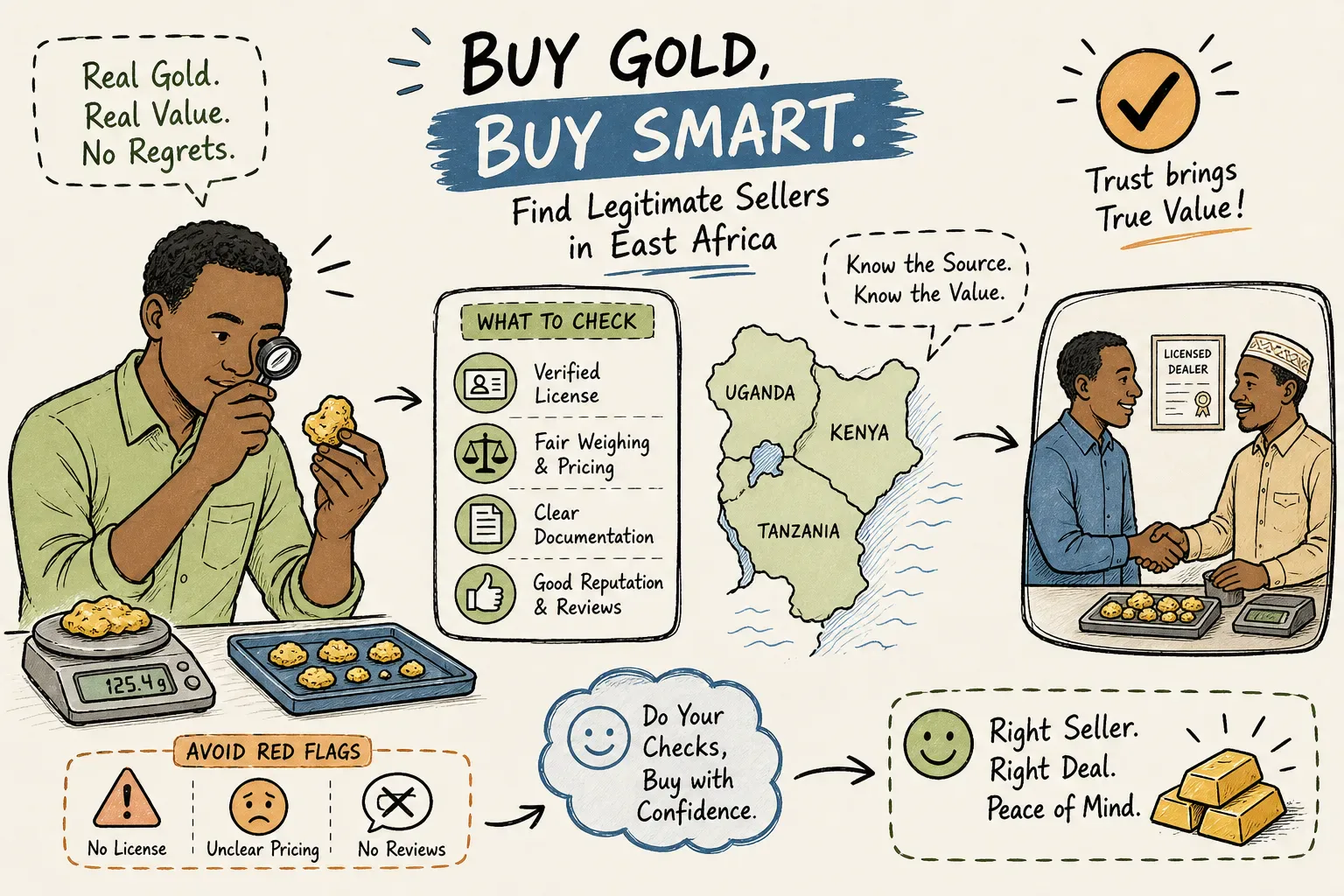
: A Buyer's Guide This guide explains how to find legitimate gold sellers in East Africa and how to verify their licenses and assay reports before a single dollar moves. East Africa's gold market is real, active, and genuinely worth engaging. Kenya, Uganda, Tanzania, and their neighbors sit above significant gold deposits, and legitimate licensed sellers operate across all three countries every day. The problem is that the same opportunity that draws serious buyers also draws sophisticated fraudsters, and international buyers from the United States are among the most targeted.
The first signal something is wrong almost always looks the same: pricing well below spot and the promise of "direct from miner" access that no credible seller would casually offer a stranger. Finding legitimate gold sellers in East Africa requires a systematic framework: identifying credible East African gold suppliers, checking their credentials against official government registries, requesting the right documents, and requiring independent assay verification before any payment is released. This guide is built on how legitimate transactions actually work in this market, not on how fraudsters want you to think they work. What legitimate licensing looks like for East African gold sellers The three-tier structure: mining, trading, and exporting A license to mine is not the same as a license to trade, and neither automatically grants export authority.
In Kenya, sellers operating in domestic gold trade need a Mineral Dealer's Licence from the Ministry of Mining; cross-border shipment requires a separate Mineral Export Permit. In Uganda, the Directorate of Geological Survey and Mines (DGSM) issues a Mineral Dealer's License to authorized traders. In Tanzania, the Tanzania Minerals Commission (TMC) issues Mineral Trading Licences, and the Tanzania Mining and Minerals Authority (TMAA) oversees compliance across the sector. A seller who cannot distinguish between these three document types, or who conflates them casually, is a red flag in itself.
Why "licensed miner" doesn't mean "authorized exporter" A small-scale mining permit does not confer export rights, and a domestic mineral dealer's licence in Kenya specifically does not make a seller eligible to export. When you engage a potential seller, ask directly which license covers their specific role in the chain: miner, dealer, or exporter. Then request the corresponding document for each role claimed. If the seller holds all three, you should see three distinct documents from three distinct issuing authorities.
If they hand you one piece of paper and call it everything, stop there. How to Find Legitimate Gold Sellers in East Africa: Credential Verification Steps Checking company registration across East African jurisdictions Start with the business registry, not the seller's website. In Kenya, company verification runs through the Business Registration Service (BRS) via the eCitizen portal, where you can confirm a company's registration number, incorporation date, and listed directors. Uganda has its own company registrar, and Tanzania's equivalent is the Business Registrations and Licensing Agency (BRELA).
Look for exact matches between the company name on the registry and the name used in all seller communications. A discrepancy between any of these details is a stop sign, not a minor formatting issue. Cross-referencing mining and trading licenses on official portals After confirming company registration, move to the mineral licensing layer. Kenya's Mining Cadastre Portal allows you to search a licence number and confirm its status, holder name, type, and whether it is active or lapsed.
For Uganda, verification goes through the DGSM registry; for Tanzania, the Minerals Commission is the authoritative issuer and confirming authority. The company name on the business registry, the mineral dealer's licence, the bank account, and any export permit must be identical. Even a minor variation between documents (an abbreviation here, a missing word there) is grounds to pause the process until the seller explains the discrepancy in writing. What to do when online records are incomplete Not every East African licensing database has a clean public search interface.
When online records are incomplete or unavailable, contact the issuing authority directly using the official phone number or email address listed on the government ministry's website, not contact details the seller provides. Log every communication in writing and note the date, name of the official contacted, and response received, this documentation log becomes part of your due diligence record. A legitimate seller will not object to this step; a fraudulent one typically will. Red flags and scams that consistently target international buyers How the most common fraud patterns work Four dominant scam types appear repeatedly in documented East African gold fraud cases.
The first is fake-gold substitution: real gold is shown during inspection, then base metal is substituted before delivery. The second is advance-fee fraud disguised as legitimate transaction costs, labeled as export fees, customs clearance, security escort charges, or tax releases. The third is forged documentation packages that look credible at a glance but fall apart under verification. Finally, bait-and-switch shipment fraud occurs when legitimate gold is shown to the buyer during inspection but base metal is what gets shipped.
Kenyan authorities documented cases in 2024 and 2025 involving fraud schemes targeting American, Malaysian, and UAE-based buyers, with individual losses ranging from $100,000 to over $1.35 million per case. Communication and behavioral warning signs The behavioral signals of a fraudulent seller are consistent across documented cases. Watch for any of the following: Pricing significantly below the current international spot price Communication confined to personal WhatsApp or Gmail accounts rather than company systems Meetings pushed to hotels or informal locations instead of a registered office Demands for upfront clearance, release, or "security escort" fees before delivery Resistance to third-party inspection or independent testing of any kind Documents with mismatched dates, seals, company names, or spelling errors Any single one of these signals warrants caution. Multiple signals together mean you should walk away.
Independent assay verification: the step that separates cautious buyers from fraud victims Why seller-provided test results carry an inherent conflict of interest A seller who controls the assay process controls the result. This is not a hypothetical risk; it is the central mechanism behind a substantial portion of East African gold fraud. Even an XRF reading performed by the seller, or commissioned from a lab the seller selected and paid for without buyer involvement, cannot be treated as neutral. XRF spectrometry is a useful rapid screening tool, but it is not a final settlement assay.
Fire assay using cupellation is the internationally accepted standard for gold fineness determination, and it must be performed by a laboratory with no commercial stake in the transaction. How to write independent assay into your purchase terms Include a contractual clause requiring the seller to present a certified assay report from a named, independent third-party laboratory before payment is released. The clause should specify that the buyer, not the seller, nominates the laboratory. A legitimate assay certificate must show the sample ID, the testing method used (fire assay or XRF), the date of analysis, and the analyst's signature.
It must also include a chain-of-custody record documenting how the sample was handled from submission to result, and the fineness result expressed in parts per thousand or karat. Without all of these elements, the document is not an assay certificate, it is a piece of paper. Checklist: What a valid assay certificate must include Sample ID and date of analysis Testing method (fire assay or XRF) Analyst's name and signature Chain-of-custody record from submission to result Fineness result in parts per thousand or karat Laboratory name, accreditation details, and contact information Where Bilex Minerals EA fits into this process Bilex Minerals EA operates from Nairobi, Kenya and Dar es Salaam, Tanzania as a fully independent assaying laboratory with no commercial interest in the gold being tested. The lab performs both fire assay and XRF testing and issues certified assay reports accepted by international buyers, refiners, and export authorities.
International buyers can name Bilex Minerals EA specifically in their purchase agreements as the required pre-transaction assay provider, giving the clause real teeth because it identifies a specific, verifiable lab the seller must engage. For buyers who cannot be on the ground in East Africa, requiring the seller to use Bilex Minerals EA and share the certified report directly with the buyer is a practical, enforceable layer of protection that costs far less than a failed transaction. The lab works on an appointment basis and reviews results directly with clients, including remotely for international parties. How to Find Verified Gold Dealers in East Africa: Where to Start Your Search Government registries as the first filter The Kenya Mining Cadastre Portal, Uganda's DGSM registry, and Tanzania's Minerals Commission database are the most reliable starting points for identifying currently licensed gold dealers when buying gold in Kenya, Uganda, or Tanzania.
The Uganda Chamber of Mines and Petroleum also publishes member directories that can serve as a secondary reference. These registries will not hand you a curated shortlist of ready-to-transact sellers, but they tell you who holds a valid, current license, which is the baseline any legitimate seller must clear before further engagement. What due diligence signals to look for beyond the registry A legitimate seller has a physical office at a verifiable street address, uses corporate email on a company domain, maintains an established banking relationship with a licensed institution, and raises no objection to third-party due diligence or independent assay requirements. These qualities consistently appear across verified gold dealers in East Africa.
Sellers who welcome scrutiny are the operators worth building a supply relationship with. Those who resist any of these checks are not, regardless of how compelling their pitch sounds. Completing the purchase safely: payment, logistics, and documentation Payment structures that protect international buyers Use escrow accounts held by a neutral third party whenever possible. Pay only to a licensed business bank account where the account name matches the seller's company registration exactly, including every word of the legal entity name.
Never wire funds to a personal account, a mobile money channel, or any payment method that cannot be traced or reversed. Document every payment instruction in writing, and treat any last-minute change in banking details as an automatic red flag requiring the transaction to pause until the change is verified independently through the bank. Export documentation and US compliance requirements For gold moving from East Africa to the United States, the full documentation package includes the export permit from the originating country, a certified assay report from an independent laboratory, a certificate of origin, customs declarations, and royalty payment receipts from the exporting country's revenue authority. Gold export licensing in East Africa is jurisdiction-specific, and gaps in that paperwork create customs exposure on the US side.
US importers of gold from sub-Saharan Africa also need to consider Dodd-Frank Section 1502 conflict minerals requirements if the gold may originate in or transit through the Democratic Republic of Congo or adjoining countries, as well as anti-money-laundering sourcing standards under the Bank Secrecy Act. A certified assay report from an independent laboratory, such as the reports issued by Bilex Minerals EA, directly supports this compliance documentation by providing an unbiased, third-party record of the gold's composition, chain of custody, and fineness in a single document that international buyers and their compliance teams can rely on. Applying the framework before you commit any capital Legitimate gold sellers in East Africa exist and can be verified. The market is real, and compliant cross-border transactions happen regularly.
But the verification work is not optional, and it is not bureaucratic friction. It is the difference between a successful transaction and an expensive lesson in how fraud actually works in this market. Before you commit capital, follow these steps to understand how to find legitimate gold sellers in East Africa: confirm the license type and issuing authority, verify the company registration and cross-check every name against every document, require a certified assay report from an independent laboratory before payment is released, and use only traceable payment channels to a verified business account. For buyers who want a named laboratory to specify directly in their purchase terms, Bilex Minerals EA provides independent fire assay and XRF testing from Nairobi and Dar es Salaam, with certified reports built to withstand international scrutiny.
Apply the framework before you move capital. Every shortcut in this process is a transfer of risk from the seller to you.
Keep the answer within its proper scope.
Can Bilex provide a list of approved gold sellers?
No. Bilex provides independent testing and selected coordination support. Buyers remain responsible for counterparty, ownership, licence, source, payment, and transaction due diligence.
Does a mineral dealer licence allow export?
Not automatically. Roles and permits depend on the country and current law. Confirm the exact licence scope and any shipment-specific export authorisation with the competent authority.
Should a buyer accept the seller's assay report?
Use it as information to verify, not as the only evidence. Confirm it with the issuer and arrange buyer-controlled sampling and testing when the value or risk justifies it.
What is the strongest first warning sign?
A pattern of unrealistic pricing, urgency, refusal of independent checks, mismatched records, or payment to unrelated parties is more important than any single cosmetic document issue.
Official and primary sources
Check current requirements directly.
Government-backed risk-based guidance for companies across mineral supply chains.
Tanzania Mining Sector Investor GuideOfficial overview of mineral rights, dealer licensing, and export and import permit requirements.
US Customs Guidance on Bullion and Gold CoinsOfficial customs information on declaring bullion, gold coins, and medals when entering the United States.
FinCEN Guidance for Precious Metals DealersOfficial guidance on risk assessment and anti-money-laundering programmes for covered dealers.