
Focused resource · Gold Assaying
How Refiners Use Assay Certificates to Confirm Gold Composition
How refiners review supplier data, lot identity, sampling, incoming tests, composition, payable terms, reconciliation, and final settlement.
11 min read · Knowledge Centre resource
Direct answer
An assay certificate gives a refiner information about the stated sample and method. The refiner may verify identity, resample, retest, and reconcile results under its own intake and settlement procedures.
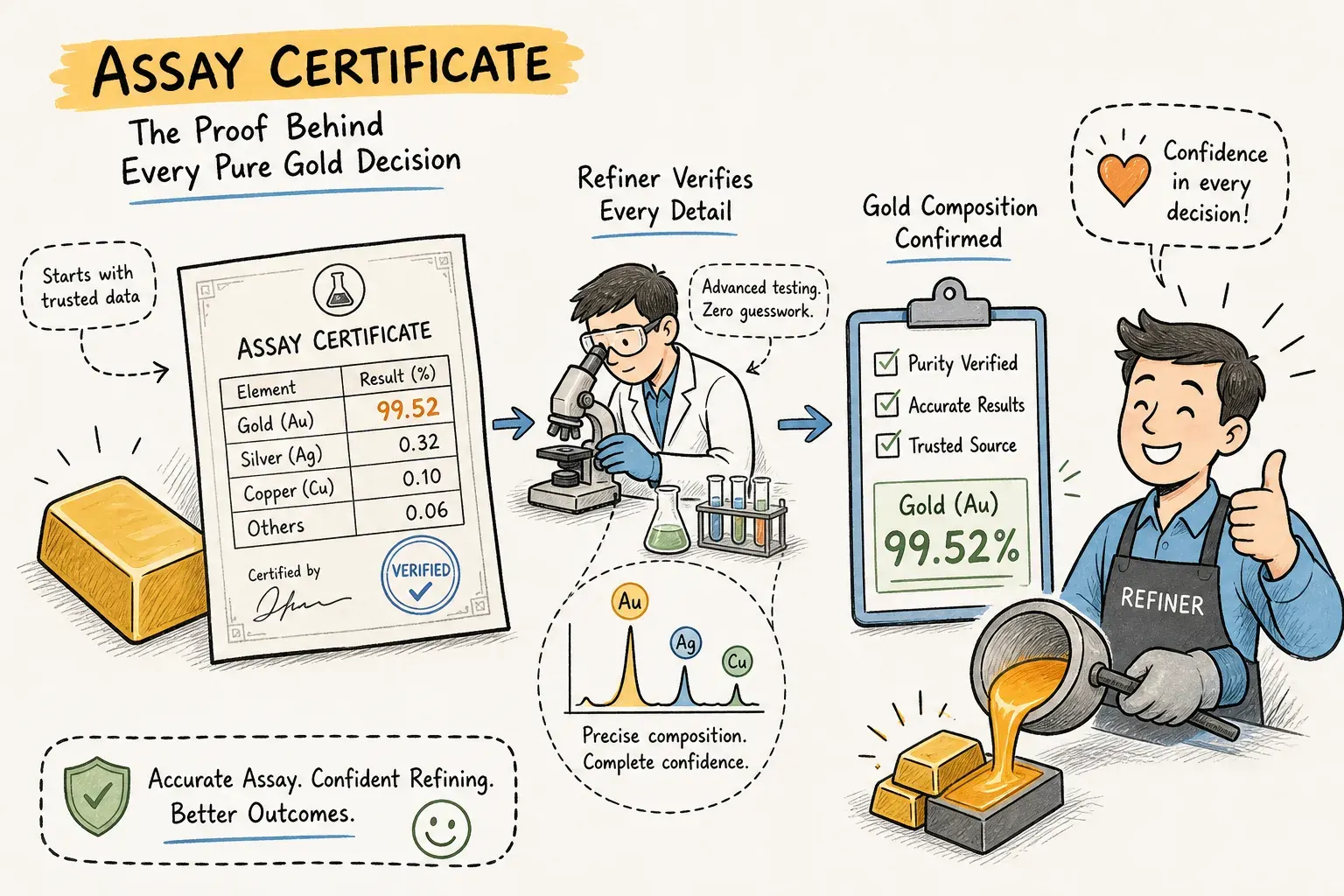
Many gold deals that stall or collapse do so at the certificate review desk, not the scale. A refiner's purchasing workflow treats the assay certificate not as administrative paperwork but as the primary instrument for confirming what they are actually buying. Before a single troy ounce is priced, the assay report has already answered three questions: what is the gold content, who verified it, and how was that determination made? This article explains how refiners use assay certificates to confirm gold composition before purchase, and why understanding that process is the difference between a transaction that closes and one that sits in a queue indefinitely.
What follows is a practitioner-level walkthrough of that document review process. At Bilex Minerals EA, our fire assay reports are structured around these exact refiner verification checkpoints. Every section below maps directly to what a purchasing refiner checks, in the order they check it. What Refiners Actually Read on a Certificate Before Anything Else A refiner's first pass through an assay certificate is not a careful read.
It is a rapid scan for seven specific fields: metal type, fineness expressed in parts per thousand (‰), gross weight in troy ounces or grams, assay method, issuing laboratory name, assay date, and the sample or serial reference number. Each one ties the document to a verifiable physical reality. If any are missing or vague, the certificate fails the first review regardless of the fineness number it reports. The logic behind that sequence matters.
Refiners are not looking to admire a certificate; they are looking for a reason to reject it. Vague methodology, an absent lab name, or a missing sample reference signals that the document cannot be independently verified, which is the entire point of requesting it. A certificate that omits the assay method could reflect any number of testing approaches, some of which a refiner will not accept as a settlement basis. The issuer's name carries more transactional weight than the fineness number itself.
A result of 965‰ from an accredited independent laboratory is more bankable than 995‰ from a lab with no verifiable accreditation, no methodology listed, and a commercial relationship with the seller. The issuer's name, combined with a recognizable accreditation mark, is the frame that determines whether the numbers inside the document mean anything. Seller-affiliated testing and genuinely independent third-party assaying are not equivalent, and experienced purchasing teams treat them differently from the first line of the certificate. This distinction is central to how refiners use assay certificates to confirm gold composition before purchase.
How Fineness Translates Into a Price: The Payable Gold Calculation The moment a certificate clears the first review, the refiner runs a straightforward calculation. Fineness divided by 1,000 gives the gold fraction as a decimal. Multiply that decimal by the gross weight and you get fine gold weight, the number that anchors the offer price, not the gross weight printed on the scale ticket. Payable Gold Calculation Example Consider a 500-gram lot with a certified fineness of 920‰. The calculation runs as follows: 920 ÷ 1,000 = 0.920.
Multiply 0.920 by 500 grams to get 460 grams of fine gold. That 460-gram figure is what the refiner prices, not the gross weight. A certificate reporting 850‰ on the same 500-gram lot would yield only 425 grams of payable gold, a difference of 35 grams that compounds significantly at scale. Sellers frequently misread the gap between their assay result and the offer they receive, attributing it to the refiner taking a larger cut than expected.
The explanation is usually the payable factor. Refiners apply a payable percentage on top of the fine gold weight calculation to account for processing losses, treatment charges, and margin. The payable percentage is a commercial term, not an assay result, so it never appears on the certificate. The certificate's job is to produce the most accurate possible fine gold weight; the negotiation around the payable percentage is a separate conversation.
Understanding that distinction eliminates a significant source of confusion at the offer stage. Why the Testing Method Listed Changes Everything XRF (X-ray fluorescence) is a legitimate and widely used tool for rapid, non-destructive elemental screening. It delivers fast results without destroying the sample, making it useful for intake sorting and preliminary evaluation. Refiners treat an XRF-only certificate as a preliminary indicator, not a final determination.
They will not price a significant lot based on XRF alone, and a certificate listing only XRF as its methodology signals an incomplete analysis to any experienced buyer. The reason is not that XRF is inaccurate under ideal conditions. The problem is that XRF reads the surface layer of a sample and can be misled by surface plating, irregular geometry, or material inhomogeneity. Portable XRF instruments typically report results within 0.1 to 0.5% of fire assay on large, flat, homogeneous pieces. On curved, layered, or heterogeneous material, that gap widens in unpredictable directions.
For artisanal and small-scale mining dore from East Africa, which is commonly heterogeneous, XRF screening is a starting point and nothing more. Fire assay through cupellation is the benchmark method for commercial refiner purchasing. It tests a bulk sample destructively, averages across the material submitted, and yields results typically within 0.05% to 0.1% under commercial laboratory conditions. The triggers that move a refiner from accepting a preliminary screen to requiring fire assay confirmation include: High-value lots Suspected surface treatment or plating Artisanal or heterogeneous dore material Any situation where the result will be used for payment settlement or regulatory reporting For East African dore specifically, fire assay is not optional; it is the expected standard.
What Makes a Certificate Credible to a Refiner ISO/IEC 17025 is the international standard for testing and calibration laboratories. When a certificate carries this accreditation mark from a recognized national accreditation body, such as A2LA, UKAS, NATA, or an equivalent, it tells the refiner that the lab's methods, equipment calibration, staff competence, and QA/QC systems have been independently assessed against that standard. It is not a rubber stamp. It is evidence that the results on that certificate are reproducible under scrutiny and that the lab participates in proficiency testing to demonstrate ongoing performance.
Many certificates from informal testing providers in emerging markets carry no accreditation reference at all, which is itself information. The London Bullion Market Association (LBMA) maintains a list of approved refiners and assayers whose standards serve as a useful reference point for what credible documentation looks like at the international level. Sampling methodology is the detail most sellers overlook entirely, and it is the detail that experienced refiners check carefully. If the sample submitted to the lab was not representative of the full lot, the fineness figure is accurate for the sample but meaningless for the shipment.
Refiners look for language on the certificate indicating how the sample was drawn: systematic incremental sampling, composite preparation, or stratified sub-lot selection. A certificate that gives a fineness reading with no sampling reference raises an immediate question: what exactly was tested, and does it represent the material being offered? Without a clear answer, the document cannot be used as a settlement basis regardless of what the fineness number says. Red Flags That Stop a Deal at the Document Review Stage The most common certificate failures refiners encounter follow a recognizable pattern.
These are not minor formatting issues, each one introduces a gap between what the document states and what the refiner can independently verify: No assay method named Fineness expressed without a clear unit or scale A lab name that matches or resembles the seller's trading entity No accreditation mark or reference An assay date that predates shipment preparation by an implausible margin Chain of custody breaks are a separate and serious category of red flag. A technically sound certificate loses credibility when the connection between sample, lab, and shipment is unclear or absent. Refiners look for a sample reference number on the certificate that can be traced back to a specific lot preparation record. Without that linkage, there is no confirmation that the tested sample came from the lot being offered rather than from a different, higher-grade source.
This is a recognized fraud vector in physical gold trading, particularly in East African markets where certificates from unverifiable labs or recycled from previous transactions surface regularly. In East African gold fraud typologies, certificate irregularities typically appear alongside broader transaction red flags: advance payment demands, seller resistance to independent re-testing, and pressure to close quickly. Certificate fraud is one dimension of a broader compliance picture that includes anti-money laundering (AML) requirements and responsible sourcing obligations. Any one of these issues is enough to pause a deal.
A combination stops it entirely. What This Means for East African Gold Entering International Refiner Supply Chains East African artisanal and small-scale mining gold presents specific documentation challenges that international refiners factor into their certificate review. Heterogeneous dore composition, variable sampling conditions in the field, and a market where informal testing without accreditation has been the norm rather than the exception all contribute to elevated scrutiny. International refiners sourcing from Kenya, Tanzania, and neighboring regions also operate under AML requirements, Dodd-Frank conflict minerals provisions, and responsible sourcing frameworks that require documented, verifiable chain of custody and independently certified composition data.
A certificate that does not satisfy these requirements closes the door on a transaction regardless of what the fineness number says. This compliance landscape is precisely why understanding how refiners use assay certificates to confirm gold composition before purchase matters so much to East African sellers and exporters. A certificate functioning as a certificate of analysis (COA) for an international transaction must go beyond a simple fineness reading, it must document methodology, sampling approach, laboratory identity, and accreditation status in a form a purchasing team can verify independently. Bilex Minerals EA issues fire assay certificates from a fully independent third-party position with no commercial interest in the gold being tested.
Our reports include the specific data fields international refiners require: methodology (fire assay via cupellation), fineness in parts per thousand, gross and fine weight, sample reference, assay date, and laboratory identification. For sellers and exporters preparing East African gold for international buyers, a Bilex Minerals EA fire assay certificate addresses the documentation gaps that most commonly delay or derail transactions at the document review stage. That independence is the core value: a refiner reviewing our certificate knows the result came from a lab with no stake in the outcome. The Certificate Is the Transaction Consider what a failed certificate actually costs: a delayed shipment, a repriced offer, a deal that falls through entirely while gold sits in a bonded facility.
The certificate review happens before the gold is weighed and before commercial terms are discussed. What a purchasing team evaluates is not just the fineness number but the credibility of the entire system that produced it, the lab's independence, its accreditation, its methodology, and its sampling transparency. That is how refiners use assay certificates to confirm gold composition before purchase, and it explains why document quality determines transaction outcomes more reliably than the fineness number alone. For anyone selling or exporting East African gold into international refiner supply chains, understanding how refiners read and verify these documents is not optional knowledge.
It determines whether your shipment gets priced or gets returned with questions. Get the certificate right, and the commercial conversation can begin. Get it wrong, and no amount of follow-up resolves the credibility problem a weak document creates. If you are preparing gold for an international buyer or need to understand what a refiner-ready fire assay report looks like, contact Bilex Minerals EA to request a sample report format or discuss your specific documentation requirements.
Keep the answer within its proper scope.
Can this article replace transaction-specific professional advice?
No. It is educational. Confirm current legal, customs, tax, regulatory, technical, and commercial requirements with the responsible authorities and appropriately qualified advisers.
Does an assay approve the wider gold transaction?
No. An assay describes the submitted sample under the stated method. Ownership, origin, seller authority, payment, export, import, sanctions, and logistics require separate checks.
What should I verify before relying on a document or result?
Verify the issuer, scope, date, reference, sample or shipment identity, units, validity, and direct connection to the current parties and material.
Official and primary sources