
Focused resource · Gold Assaying
Cupellation Method for Raw Gold Evaluation: A Complete Guide
How representative sampling, fusion, cupellation, parting, weighing, quality control, and lead safety shape a raw-gold result.
11 min read · Knowledge Centre resource
Direct answer
Cupellation, commonly used within Fire Assay, separates precious metals from a prepared test portion so the laboratory can determine gold content on a stated basis.
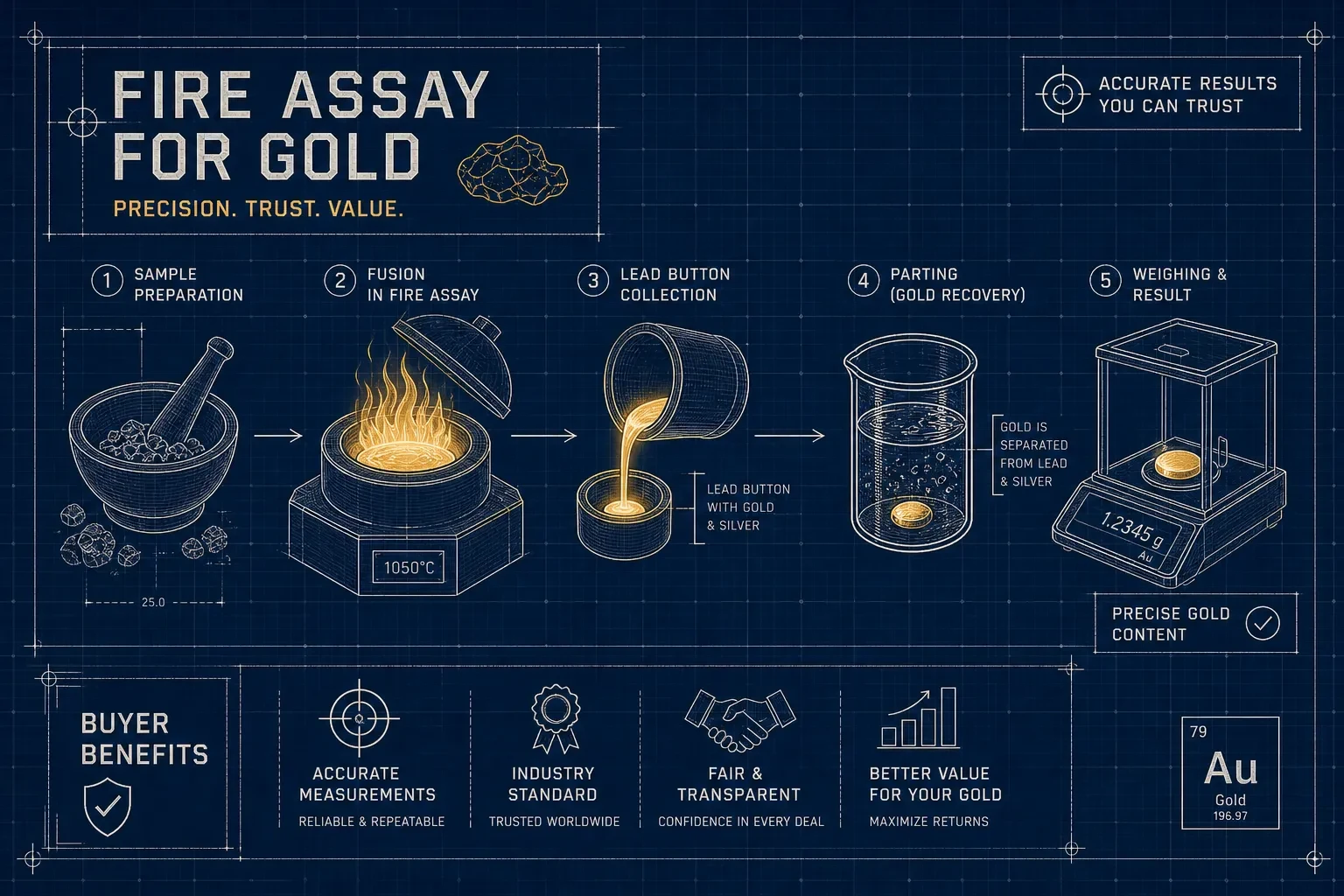
When raw gold changes hands, whether it's alluvial nuggets, placer material, or unrefined doré, the cupellation method for raw gold evaluation is the technique that produces a fineness number buyers, sellers, and export authorities can act on with confidence. A surface scan gives you a reading, but the actual gold content inside the sample can tell an entirely different story. That gap between what a surface test shows and what the material actually contains is where fraud, mispricing, and costly commercial disputes originate. The cupellation method, more formally known as fire assay, closes that gap by processing the entire weighed portion of a sample rather than reading its exterior.
It chemically separates and concentrates the precious metal before measurement, producing a defensible result no surface technique can match. At Bilex Minerals EA, our lab offers fire assay services for raw gold samples for clients across Kenya, Tanzania, and neighboring regions. The method is the same one refineries and international buyers rely on, and for good reason. This article breaks down exactly how the process works, what accuracy you can realistically expect, what the safety requirements are, and when sending your sample to a certified lab is the practical choice.
Why Raw Gold Demands More Than a Surface Test Raw gold, whether alluvial nuggets, placer material, or unrefined doré, is compositionally uneven. The exterior may be richer or poorer in gold than the interior, and trace elements like silver, copper, and iron are distributed irregularly throughout the sample. A reading taken from the surface tells you what's happening in a thin outer layer, not what the material is actually worth. This matters enormously when a transaction is priced per troy ounce of gold content.
Two samples that look identical and pass a visual check can carry fineness values with differences that translate to significant dollar amounts per kilogram at current market prices. In a market where large volumes of raw gold change hands on the basis of a single test, that variance isn't a minor technical footnote. XRF spectrometers are fast and non-destructive, but they read to a depth of roughly 0.1 to 0.5 mm depending on the element and instrument settings. On a heterogeneous raw gold sample, that surface layer is rarely representative of the whole.
Plating, oxidation, and surface enrichment can all push the XRF reading higher or lower than the actual gold content. For raw or unrefined gold, a surface measurement is a starting point, not a conclusion. The cupellation method evaluates the entire weighed sample, which is why it remains the referee technique when accurate fineness data is required. Cupellation Method for Raw Gold Evaluation: Step by Step Sample Preparation and Inquartation The fire assay begins with careful sampling.
A representative test portion of roughly 125 to 250 mg is weighed on a precision analytical balance. Because the process works best when the gold-to-silver ratio in the sample falls within a specific range, silver is added at approximately two to three times the expected gold mass. This step is called inquartation, and it ensures the final alloy can be cleanly separated later without incomplete parting. The sample, silver addition, and a measured amount of lead foil, typically 4 to 6 grams depending on sample weight, are wrapped together and placed in a pre-heated cupel inside the furnace.
The lead acts as a collector metal, gathering the precious metals as everything melts together. Fusion, Cupellation, and Parting The charge melts at temperatures ranging from 960 to 1100°C. The lead collects the gold and silver as it melts, forming a lead button that sinks below the oxidizing slag. That button is then transferred to a fresh, pre-heated cupel, where the furnace's oxidizing atmosphere converts the lead to litharge (lead oxide).
The cupel's porous walls, made from magnesium oxide or bone ash, absorb the litharge as it forms. This continues until only a small, bright bead of precious metal remains on the cupel surface, what analysts call the assay bead or button. The bead is removed, flattened, and placed in dilute nitric acid, which dissolves the silver but leaves the gold intact. What remains after this parting step is called the gold cornet.
It is dried and weighed to a precision of 0.001 mg where the method or applicable standard requires it, and its weight as a proportion of the original sample weight gives the gold fineness, expressed in parts per thousand (‰) or as a percentage. Equipment, Materials, and Furnace Temperatures Required Cupel Selection and Cupellation Furnace Temperatures Running cupellation properly requires a muffle or cupellation furnace with accurate temperature control, a high-precision analytical balance, cupels sized to match the lead charge, assay tongs, and a fume hood with source-capture ventilation. Magnesium oxide cupels of 22 mm diameter are standard for 6 grams of lead, while 26 mm cupels accommodate up to 10 grams. Acid-resistant parting vessels complete the core equipment set.
Standard reagents include lead foil as the collector metal, silver for inquartation, and flux materials such as sodium carbonate, borax glass, silica, and calcium fluoride, with the specific blend depending on the sample's matrix. Cupels should be pre-heated to at least 900°C before the button is placed. Cupellation temperatures vary by method and applicable standard; many labs operate between 960 and 1100°C during the oxidation phase, while some standards specify a range of approximately 1050 to 1150°C. Temperature control is not optional.
Too high, and gold can be lost to volatilization or absorption into the cupel walls. Too low, and the litharge doesn't flow properly, leaving residual lead in the bead and compromising the final result. This is not a setup that can be improvised; each piece of equipment plays a specific role in preventing gold loss or measurement error. Accuracy Expectations and Where Errors Enter the Result Under well-controlled laboratory conditions, fire assay achieves an accuracy of approximately 0.01% (1 part in 10,000) for gold bullion.
For raw gold samples, a slightly wider tolerance is realistic given sample heterogeneity, but duplicate analyses and careful technique can keep results within 0.02% for most commercial purposes. Per ISO 11426 and comparable international standards, duplicate cupellation results are generally required to agree within 0.2‰ for gold alloys at 990 fineness or higher. For a buyer purchasing 10 kilograms of raw gold, a 0.1% error in fineness translates to a meaningful dollar difference at current gold prices. That is why the method's precision matters: not as an academic point, but as a direct commercial one.
Several factors degrade accuracy in cupellation, and professional labs manage all of them: Incomplete cupellation, leaving trace lead in the cornet Parting errors caused by cold acid, vigorously boiling acid, or incorrect acid concentration Sample impurities above roughly 1%, particularly antimony, arsenic, tin, or zinc, which form scoria and increase gold loss Temperature fluctuations during the cupellation stage Weighing and handling errors at any point in the sequence Professional labs control for these by running certified reference materials alongside each batch, using calibrated equipment, and applying strict QA/QC protocols throughout. The discipline required to achieve reliable results is one reason certified independent labs produce numbers that buyers and refiners actually trust. Fire Assay vs. XRF and ICP-MS for Raw Gold: Choosing the Right Method XRF is appropriate for rapid, preliminary screening of gold samples where exact fineness is not the immediate priority.
It produces a result in seconds, doesn't destroy the sample, and for refined, homogeneous gold bars or jewelry with a consistent surface, XRF accuracy typically falls within 0.1 to 0.5%. That's sufficient for a first-pass evaluation, especially early in a buying process. The limitation is real, though. XRF reads only the surface layer and cannot account for internal variation in raw or heterogeneous material.
Surface contamination, oxidation, rough geometry, and uneven grain distribution all introduce bias into the reading. On a raw nugget or unrefined doré bead, that bias can be significant enough to change the commercial outcome of a transaction. ICP-MS provides high sensitivity and multi-element data but requires complete dissolution of the sample and additional preparation time, making it less practical for routine raw gold fineness determination. Aqua regia is a dissolution method, not a measurement technique on its own; it's better understood as preparation for ICP analysis rather than an alternative to fire assay.
For raw gold, doré, nuggets, concentrates, or any material where internal composition may differ from the surface, the cupellation method is the approach that stands up to commercial and regulatory scrutiny. When a buyer, refinery, or export authority requires a certified fineness value, fire assay is the result they will accept. Safety, Lead Waste, and When Professional Testing Is the Practical Choice Cupellation generates significant lead oxide fumes during the furnace stage. Lead is a toxic substance with serious cumulative health effects, and the cupellation step produces more contaminated fumes than any other stage in a fire assay workflow.
Effective source-capture ventilation at the furnace is the primary control; PPE, including heat-resistant clothing, face shield, safety glasses, and respiratory protection, is a supplement, not a substitute for a properly ducted fume hood. No eating, drinking, or smoking is permitted in a fire assay area. Handwashing and clothing decontamination are mandatory after handling lead or litharge. Air monitoring to confirm that exposure levels fall within regulatory limits is a standard requirement in any compliant fire assay operation, and some jurisdictions also require medical surveillance and blood lead monitoring for workers with regular exposure. Used cupels are saturated with lead oxide and must be treated as hazardous lead waste.
They cannot be placed in ordinary laboratory trash. Litharge residues, contaminated gloves, and assay tools that contacted lead must be collected in sealed, labeled containers and disposed of through a certified environmental waste contractor in compliance with applicable regulations. Improper disposal carries both environmental risk and legal liability. Running cupellation in-house means building out a compliant furnace setup, sourcing calibrated equipment, training analysts on technique and safety, and managing hazardous waste contracts.
It also means maintaining QA/QC documentation before producing a result a buyer will trust. Producing a result a buyer will stand behind requires all of it. For most miners, traders, and exporters, that overhead doesn't make commercial sense. Bilex Minerals EA maintains fire assay laboratory facilities in Nairobi and Dar es Salaam, processing raw gold samples for buyers, miners, and exporters across East Africa on an appointment basis.
Clients receive assay reports with chain-of-custody documentation, reviewed directly with the analyst. The lead waste management, the furnace compliance, and the analytical precision are handled at the lab, not by the client. The Method That Gives You a Number You Can Defend The cupellation process earns its reputation as the reference standard in gold testing because it solves the one problem surface testing cannot: it tells you what your gold is actually made of, not just what its exterior looks like. The process is precise, internationally recognized, and the result is widely accepted by refineries, export authorities, and international buyers.
For raw gold that changes hands in East Africa, whether it's placer material from a Tanzanian mine or unrefined doré from an artisanal operation, applying the cupellation method for raw gold evaluation through a certified, independent lab removes the guesswork and the risk from the transaction. Bilex Minerals EA provides exactly that service, without requiring clients to build a compliant lab from scratch or manage hazardous materials on their own. If you're buying, selling, or exporting raw gold and need results you can defend to a buyer, a refinery, or a regulatory body, fire assay through a professional lab is where your due diligence is complete. Book an appointment with Bilex Minerals EA and bring your sample in for testing at our Nairobi or Dar es Salaam facility.
Keep the answer within its proper scope.
Can this article replace transaction-specific professional advice?
No. It is educational. Confirm current legal, customs, tax, regulatory, technical, and commercial requirements with the responsible authorities and appropriately qualified advisers.
Does an assay approve the wider gold transaction?
No. An assay describes the submitted sample under the stated method. Ownership, origin, seller authority, payment, export, import, sanctions, and logistics require separate checks.
What should I verify before relying on a document or result?
Verify the issuer, scope, date, reference, sample or shipment identity, units, validity, and direct connection to the current parties and material.
Official and primary sources