
Focused resource · Gold Buying
Red Flags to Watch When Buying Raw Gold in East Africa
A buyer checklist for pricing pressure, seller identity, document consistency, material verification, payment controls, and export records.
12 min read · Knowledge Centre resource
Direct answer
Several warning signs together, such as an unverifiable seller, deep discount, rushed payment, seller-controlled testing, and inconsistent documents, justify pausing or declining the transaction.
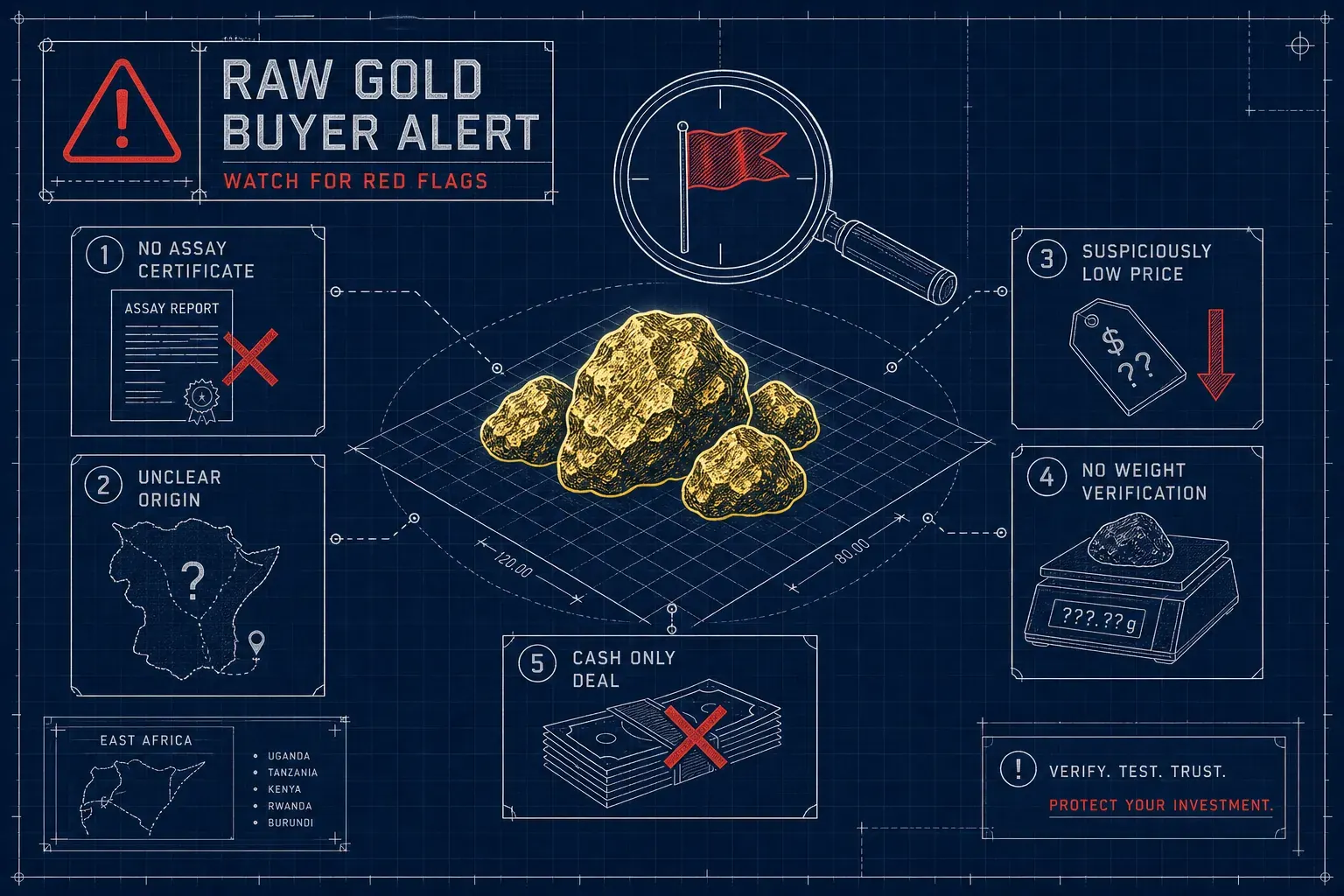
Picture this: a buyer sits down in a Nairobi meeting room, offered a consignment of raw gold at a price that makes the numbers look very attractive. The documentation looks professional, the seller is well-spoken, and the sample passed a quick visual check. Money changes hands. Three weeks later, the gold arrives at a refinery in Dubai and the fire assay comes back at 62% fineness, not the 96.5% the seller's certificate claimed.
The entire transaction unravels. (This scenario is illustrative of a pattern commonly reported across the region; specific details have been generalized.) This is not a rare story. It plays out across East Africa's gold market with enough regularity that independent assay labs like Bilex Minerals EA exist specifically because deals that look solid on the surface frequently don't survive a certified test. This checklist covers the red flags to watch for when buying raw gold in East Africa and shows how to verify purity and paperwork before payment. Raw gold transactions in the region carry genuine financial and legal risk, not because every seller is dishonest, but because the market creates conditions where fraud thrives, documentation is routinely faked, and buyers who skip verification pay dearly for the shortcut.
What follows is a practical gold buyer checklist for East Africa covering seller behavior, documentation, physical testing, and legal compliance, the four areas where deals go wrong most often. Pricing and pressure tactics that should stop you immediately The first warning signs appear before you ever see the gold. Below-market pricing is the most reliable early signal of fraud in East African gold transactions. Legitimate sellers normally price relative to global spot rates, the London Bullion Market Association (LBMA) spot price is the standard reference, and can walk you through their margin.
Deep discounts to market from a first-time contact are a consistent red flag, not a goodwill gesture. Advance-fee scams follow a consistent pattern: the offer is priced to create urgency, then layers of fees get added after the buyer commits. Assay fees, customs clearance, export permits, security escort costs, each one sounds plausible in isolation, but together they extract money before any gold ever moves. By the time the buyer recognizes the structure, the deal has consumed thousands in fees and delivered nothing. The "limited window" offer and what it's designed to do Artificial time pressure is a tool, not a coincidence.
A seller who insists a deal must close within 24 to 48 hours is removing your ability to verify anything independently. Due diligence takes time: checking accreditation records, confirming East Africa gold export permits with the relevant government registry, and scheduling an independent assay all require days. Pressure that eliminates that time benefits only one party. No traceable business identity or registered address A legitimate gold dealer has a registered business, a verifiable licensing history, and a physical location that existed before the transaction started.
Fake-company and staged-office setups are common in Nairobi and Kampala, where scammers rent short-term office space specifically to create the appearance of permanence. If you can't independently verify a company's registration number, its mineral dealer license, and its physical address through a registry that exists outside the seller's own paperwork, treat that as a serious red flag. Red flags to watch for when buying raw gold in East Africa: purity claims without certified proof Sellers quoting precise purity figures without an independently verified assay certificate to support them are providing nothing more than an opinion. Raw gold purity is invisible to the naked eye and cannot be accurately determined by a warehouse receipt, a handwritten note, or a seller's verbal assurance.
Higher purity means a higher price per gram, which is precisely why inflated purity claims are so common: buyers who don't test are paying for fineness that doesn't exist. What a legitimate assay certificate actually contains A credible assay certificate identifies the issuing laboratory by its full legal name and accreditation reference, KENAS, SADCAS, or ISO/IEC 17025:2017 are the relevant standards in East Africa, states the sample weight, identifies the test method used (fire assay or XRF), gives the fineness result, and carries a verifiable certificate number with an issue date. Every one of those details can be cross-checked against the accreditor's public directory. Assay certificate verification is straightforward: if the lab name doesn't appear in the KENAS or SADCAS directory, or if the certificate number returns no match, the document is not worth the paper it's printed on. Signs a document has been forged or recycled Forged assay paperwork in East Africa is often professionally produced and can fool a buyer on first glance.
The tells are usually in the metadata: mismatched fonts between sections, a lab logo without a verifiable accreditation number, a consignment weight that doesn't match the material being offered, or an issue date that predates the seller's claimed mining or collection timeline. When names, dates, signatures, or reference numbers don't align across the paperwork package, that inconsistency is a fabrication signal, not a clerical error. Physical red flags on the gold itself Even when seller behavior and documentation look acceptable, the gold must be tested independently. The most common counterfeiting methods in East Africa include gold-plated brass or copper, tungsten-core bars coated in gold, and sample-switch setups where genuine material is shown during inspection but different product is delivered.
Visual inspection, even by experienced buyers, is not a reliable method for detecting counterfeit gold bars produced through any of these techniques. Why density is useful but not conclusive The Archimedes principle test is a solid screening step: weigh the material in air, weigh it submerged in water, and calculate density from the difference. Pure gold measures approximately 19.32 g/cm³. The critical limitation involves tungsten, which measures approximately 19.25 g/cm³, a gap narrow enough that a tungsten-core bar coated in gold will pass a standard density check.
Density testing is worth running as part of a field assessment, but it cannot be your final answer when the stakes are high. What XRF screening shows and where it falls short XRF is the strongest non-destructive field method available and should be part of any serious pre-purchase screening process. The limitation to understand is that XRF reads surface composition. A gold-plated bar with a base-metal core can return a high gold reading if the plating is thick enough to absorb the X-ray beam.
XRF tells you what the surface is made of; it does not tell you what's inside. Use XRF as a screening step, but not as a substitute for a full laboratory assay, that distinction matters when the gold's interior composition is unknown. Why the seller's own test results mean nothing This is the red flag most buyers overlook, often because challenging it feels impolite. The problem is structural: if the seller is also providing the assay result, the verification process has a conflict of interest built into it from the start.
Both the buyer and seller have a direct financial stake in what the purity reading says. When the seller arranges the testing and hands you the result, the chain of custody that makes that result trustworthy is already broken. The sample-switch problem and how it exploits trust Sample-switching works because it exploits the natural trust in a face-to-face inspection. A buyer examines genuine material, hands it back to the seller for "official" testing, and receives a certificate referencing a sample that may no longer be the same one that was inspected.
Without independent handling and documentation of the sample from collection to result, the certificate proves nothing about what the buyer is actually purchasing. What an independent third-party test actually guarantees When a buyer brings gold directly to an accredited independent lab, the sample is logged, handled under documented chain of custody, and tested without the seller present. The result is unbiased by definition, because the lab has no financial interest in what the fineness number says. That is the difference between a document that reflects reality and one that reflects a seller's preferred outcome.
Export permits and legal documentation you must demand A transaction without proper export documentation doesn't just expose the buyer to fraud risk, it creates direct legal liability. In Tanzania, a consignment-specific mineral export permit, a mineral dealer or exporter license, a certified purity certificate, and proof of royalty payment are all required before gold can legally cross a border. Missing any one of these puts the buyer in possession of material that cannot be legally exported or sold to an international refinery. Kenya's Trading in Unwrought Precious Metals Act is equally clear: transporting unwrought precious metal without a permit is prohibited, and a buyer who cannot demonstrate lawful ownership faces seizure and potential forfeiture proceedings.
The penalties across the region include imprisonment, fines, confiscation of the gold, and loss of licenses. These are not theoretical risks; they are the documented consequences of incomplete paperwork. The licensing and permit chain a legitimate seller can prove A legitimate seller can produce a registered mineral dealer license, a per-shipment export permit for the specific consignment being sold, and royalty clearance documentation tied to that shipment. All three are verifiable through the relevant government registry.
A seller who can't produce all three for the material on offer is selling gold with an incomplete or illegal paper trail, regardless of how credible everything else appears. Chain-of-custody records and why they protect you downstream International refiners and US-based buyers increasingly require chain-of-custody documentation to satisfy Dodd-Frank conflict minerals requirements and AML compliance standards. Missing records are not just a local compliance problem: they can make the gold unsellable once it leaves East Africa. Building that paper trail from the point of purchase is far easier than trying to reconstruct it after the fact.
How independent assay testing counters every red flag on this list Every warning covered in this article, inflated purity claims, forged certificates, physical counterfeiting, seller-arranged tests, and incomplete documentation, has one reliable counter: independent assay testing through an accredited lab with no stake in the transaction. Bilex Minerals EA was built to serve exactly this role. Operating from Nairobi and Dar es Salaam, the lab provides both XRF screening and fire assay (cupellation) testing, combining rapid surface analysis with the internationally accepted reference method for gold purity. Neither the buyer nor the seller arranges the result; the lab does, independently. What fire assay and XRF together tell you that no field test can The two-stage testing approach covers what no single field method can.
XRF gives a fast, non-destructive elemental read for initial screening, useful for flagging surface anomalies and confirming approximate composition before committing further. Fire assay then gives the precise, internationally accepted fineness figure that refiners, export authorities, and international buyers require. Together, they address both surface composition and full material content, which is the only combination that closes the gap a tungsten-core bar or thick gold plating creates. What a certified assay report delivers for your deal A certified assay report from an accredited lab typically includes sample weight, test method, gold fineness, composition of other elements present, the lab's accreditation reference, and the issue date.
This document gives buyers a defensible foundation for pricing, protects against purity fraud, and satisfies the documentation requirements demanded by international refiners and compliance teams reviewing East African sourcing. It's the document that makes a transaction stand up to scrutiny after it closes. Ask Bilex Minerals EA about their current report format and accreditation scope when you book. Getting tested before you pay Accredited independent labs typically operate on an appointment basis: buyers bring material directly to the lab, chain of custody is documented from arrival, and results are reviewed with the client.
This is the step that converts a high-risk transaction into a documented, verifiable deal. Don't pay before you have that report in hand. If the seller is legitimate, a certified test confirms it; if they're not, it stops you from finding out the expensive way. The red flags to watch for when buying raw gold in East Africa are real, here's the response A seller who prices below market, applies time pressure, presents unverifiable purity claims, hands you a certificate they arranged themselves, and can't produce legal export permits for the specific consignment is not an edge case.
This fraud profile is widely reported across the regional gold market and appears in transactions at every price level. The risks compound: each individual warning sign is manageable, but several appearing together in the same deal is a pattern that experienced buyers learn to exit quickly. Every one of those red flags has a direct response, and the most effective response to all of them combined is independent, third-party assay testing through an accredited lab. Bilex Minerals EA exists for exactly this moment in a transaction, before payment, before export, before the deal closes.
Book your appointment before you commit capital, and make sure your certified report is in hand before funds move.
Keep the answer within its proper scope.
Can this article replace transaction-specific professional advice?
No. It is educational. Confirm current legal, customs, tax, regulatory, technical, and commercial requirements with the responsible authorities and appropriately qualified advisers.
Does an assay approve the wider gold transaction?
No. An assay describes the submitted sample under the stated method. Ownership, origin, seller authority, payment, export, import, sanctions, and logistics require separate checks.
What should I verify before relying on a document or result?
Verify the issuer, scope, date, reference, sample or shipment identity, units, validity, and direct connection to the current parties and material.
Official and primary sources
Check current requirements directly.
Official information about mineral dealing rights and export-permit processing in Kenya.
Tanzania Mining Commission Export ProceduresOfficial information about eligible exporters, permits, fees, and responsible authority contacts.
OECD Responsible Mineral Supply ChainsGovernment-backed risk-based due diligence guidance for mineral supply chains.