
Focused resource · Gold Buying
How to Test Gold Doré Before Purchase or Refining
A material-specific guide to doré composition, representative sampling, XRF screening, Fire Assay, and independent verification before purchase or refinery intake.
10 min read · Knowledge Centre resource
Direct answer
Gold doré should be evaluated through representative sampling and Fire Assay for bulk gold content, with XRF used only as preliminary surface screening.
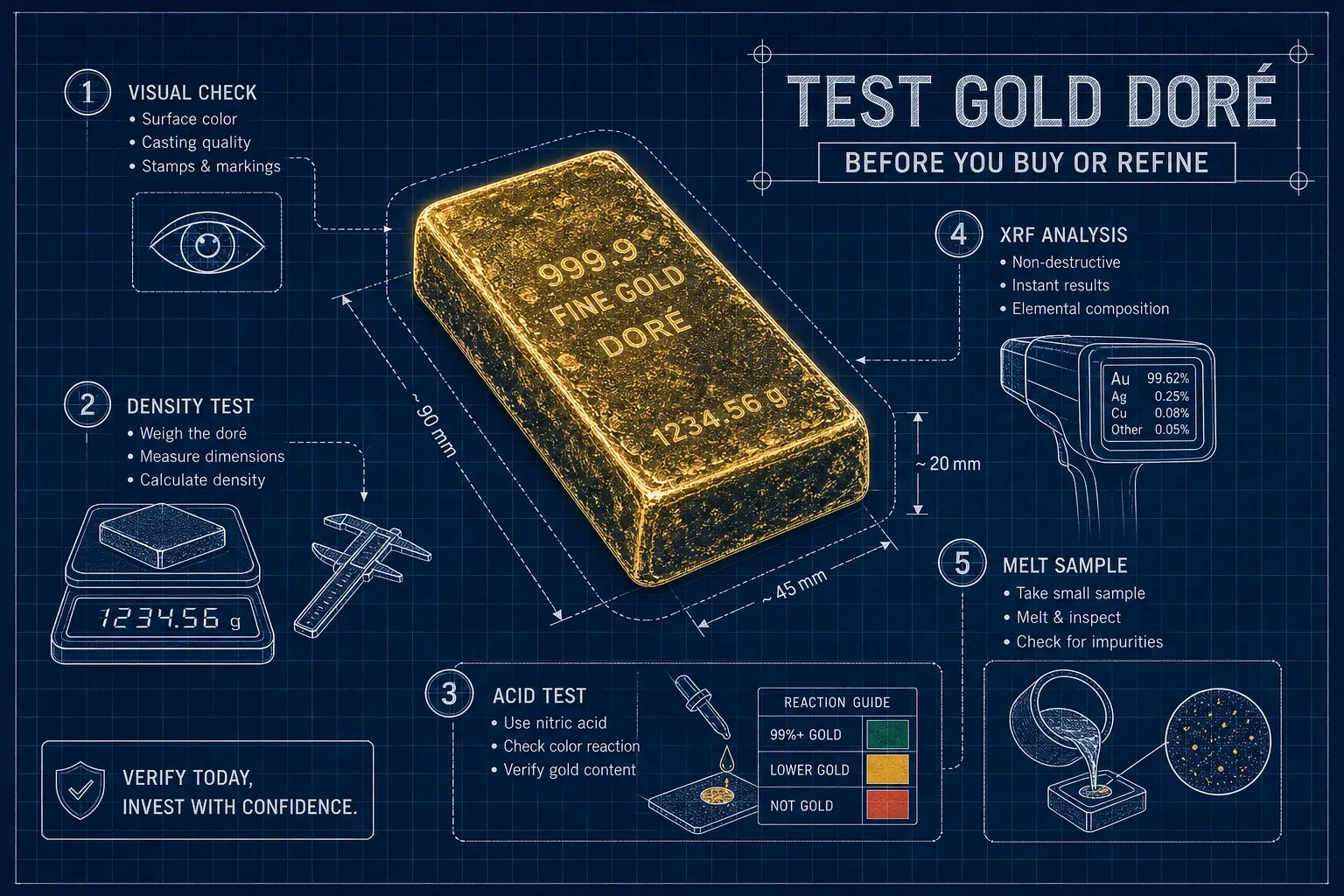
Gold dore testing is a distinct discipline from standard gold verification. Experienced refineries and international trading houses understand that gold purity must be confirmed before payment or processing begins, but doré material presents a specific challenge that ordinary screening tools are not designed to handle. This guide covers the methods used in professional gold dore testing, where each one applies, and how to arrange independent laboratory verification before committing funds or accepting material for processing. Unlike a refined bullion bar declared at a specific fineness by a certified refinery, gold doré is an unrefined intermediate product with no standardized composition.
Its gold content, associated impurities, and internal structure vary widely between sources, between batches, and sometimes within a single bar. Testing it correctly requires an understanding of these characteristics and the selection of methods that account for them. Independent laboratory services specifically experienced with East African doré material are available to international clients who cannot be present at the source location. What gold doré is and why its composition demands specialist testing Gold doré is an unrefined alloy produced at mine sites or artisanal processing facilities by smelting raw gold-bearing material.
The resulting bar contains gold alongside silver, copper, iron, and other base metals, with gold content varying widely depending on the ore source and processing method. A doré bar is not refined bullion: it is an intermediate product that retains significant impurities. This distinction matters because doré cannot be valued or traded on the assumption of a standard purity level. Every bar must be individually assessed.
Unlike investment-grade bullion bars produced to a declared fineness by a certified refinery, doré bars from different mines, regions, or producers carry no standardized composition guarantee. Gold content in commercially traded doré can range from below 40 percent to above 90 percent by mass, with silver and base metals making up the balance. East African artisanal and small-scale mining operations typically produce doré in the 60 to 92 percent gold range, depending on origin and processing method, a range consistent with regional trade data for artisanal and small-scale gold production. The presence of penalty elements (those that increase refining costs or create processing complications) may also affect the final value a refinery offers.
A buyer or refinery that accepts doré without independent testing is making a financial decision without the data required to support it. Why standard gold screening tools are not suited to doré material XRF analysis, acid tests, and electronic testers are all surface-measurement tools. They characterize the outermost layer of a sample and report accordingly. With a refined gold bar of uniform composition, a surface reading is a reasonable approximation of the whole.
With doré material, the surface and the interior may differ substantially in composition because of how the alloy solidifies, surface oxidation, segregation of elements during cooling, and the presence of slag inclusions all contribute to that divergence. Relying on a surface reading for doré is equivalent to judging the nutritional content of a mixed food product by its outer coating alone. An XRF reading on a doré bar can indicate which elements are present at the surface and provide approximate percentages. This is useful as a preliminary orientation, but it does not establish the representative gold content of the bulk material.
The surface penetration depth of XRF on unrefined gold material is typically in the range of 20 to 100 micrometers (varying by instrument and alloy composition), meaning that internal variations, subsurface segregation, and cooling-skin effects are not captured. Acid and touchstone tests carry the same fundamental limitation and add the complication of being semi-destructive to the surface of a bar whose market value depends on its integrity. Consumer gold test kits and karat testing devices share these same surface-only constraints and are similarly inappropriate for doré evaluation. These screening methods are not generally suitable for refinery settlement on doré; fire assay is the method of record for bulk doré settlement, purchase pricing, and formal dispute resolution.
Gold dore testing method of record: fire assay before purchase or refining Fire assay is the established reference method for determining gold content in doré and other complex, unrefined materials. The process begins with taking a representative sample from the submitted material, then combining it with fluxes in a crucible and melting it at high temperature to separate the precious metals from base metals and slag. The precious-metal bead is then processed through cupellation, a step in which base metals are oxidized away, leaving a refined precious-metal residue that is weighed accurately. The ratio of the recovered gold weight to the original sample weight gives the gold content expressed as a fineness or percentage.
Because fire assay measures the actual recovered gold from a processed and dissolved sample rather than inferring composition from a surface scan, it produces a bulk result that accounts for variations within the material. Refineries use fire assay results to determine the value they will pay for incoming doré, and many commercial doré purchase contracts specify fire assay as the method of record for settlement. The result is reproducible, transparent, and widely recognized by buyers, sellers, and financial institutions involved in precious-metals transactions. For doré material in particular, no other method provides equivalent credibility.
Where XRF fits into a gold dore testing workflow XRF analysis has a legitimate role in a doré testing workflow, but it is a role with well-defined boundaries. Before fire assay, XRF can provide rapid elemental screening of the bar's surface, identify the presence of penalty elements such as arsenic or bismuth, and flag obvious anomalies that might warrant additional investigation. XRF detection of trace penalty elements does carry instrument-dependent sensitivity limits, so identified flags should be confirmed through fire assay rather than acted on in isolation. This preliminary information helps a laboratory and client understand the approximate character of the material before committing to the more labor-intensive fire assay process.
An XRF result on doré should always be interpreted in the context of those limitations. Surface segregation, oxidation layers, and the heterogeneous nature of unrefined alloys mean that XRF gold readings on doré bars can diverge meaningfully from fire assay results on the same bar. A buyer who accepts an XRF report as the basis for purchasing doré material at a high gold-content price is taking a risk that fire assay would eliminate. The two methods are complementary in sequence: XRF for orientation and preliminary screening, fire assay for the definitive result on which financial decisions are based.
Representative sampling: the foundation of any credible doré assay Even the most accurate laboratory method produces an unreliable result if the sample submitted does not represent the bulk material being evaluated. A doré bar is not homogeneous. The gold content at one end may differ from the content at another point within the same bar. If a buyer or seller submits only a surface scraping or a small fragment from a corner, the fire assay result will reflect that fragment rather than the bar as a whole.
This is the single most common source of genuine assay disputes and commercial misunderstandings in doré transactions. A qualified laboratory will apply specific sampling protocols designed to provide a representative portion of the submitted material. For doré bars, this typically involves drilling or sawing to obtain material from multiple points within the bar, homogenizing the collected sample, and weighing the assay portion accurately before analysis. Buyers arranging independent testing should ask the laboratory what sampling procedure it applies to doré and request that the sampling method be documented alongside the assay result.
A result without a documented sampling methodology carries less evidential weight in a commercial dispute. Sampling is not a procedural detail: it is the step that determines whether the laboratory result is meaningful for the lot being traded. How to arrange independent gold dore testing in East Africa before committing funds An international buyer or refinery evaluating doré material connected to East Africa should request independent fire assay from a laboratory that operates separately from the seller and has no commercial interest in the transaction outcome. The laboratory submission should include clear documentation of the sample received, the sampling procedure applied, the method used, the result expressed in appropriate units, and the date of analysis.
A properly documented gold dore testing report will typically include a Certificate of Analysis, sample identification and chain-of-custody details, the method reference (such as fire assay conducted in accordance with ISO 11426), reported gold content, and notes on any deviations or quality-control observations. This documentation becomes part of the transaction record and supports informed decision-making on pricing, shipment authorization, and refinery intake acceptance. Bilex Minerals EA provides independent precious-metals testing and gold assaying services specifically supporting cross-border doré transactions connected to East Africa. Bilex delivers fire assay and XRF analysis for submitted doré samples, with documented laboratory findings that clients can use as the technical basis for purchase decisions, refinery submissions, and pre-shipment verification.
For international buyers who cannot be present at the source location, Bilex offers a structured submission and reporting process designed to give clients the independent technical information they need before funds are released or material is accepted for processing. Enquiries regarding doré testing services can be directed to the Bilex client team. Conclusion Gold dore testing is not a task for general-purpose screening tools, consumer test kits, or karat testing devices. Doré is a complex, heterogeneous material with no standardized composition, and the financial decisions associated with purchasing or refining it depend on accurate, representative, laboratory-grade data.
Fire assay remains the appropriate reference method for establishing bulk gold content in doré, supported by XRF as a preliminary screening step when elemental orientation is useful before committing to the complete assay process. Representative sampling is the non-negotiable foundation on which any credible assay result rests. A fire assay conducted on a poorly selected sample will produce a precise result for the wrong material. Ensuring that the laboratory applies and documents a sound sampling methodology is as important as selecting the correct analytical method.
International buyers and refineries dealing with East African doré material have access to independent laboratory services specifically positioned to support these requirements. Arranging independent gold dore testing before purchase or shipment is not a precaution: it is the standard of practice appropriate to transactions of this value and risk profile.
Keep the answer within its proper scope.
Can this article replace transaction-specific professional advice?
No. It is educational. Confirm current legal, customs, tax, regulatory, technical, and commercial requirements with the responsible authorities and appropriately qualified advisers.
Does an assay approve the wider gold transaction?
No. An assay describes the submitted sample under the stated method. Ownership, origin, seller authority, payment, export, import, sanctions, and logistics require separate checks.
What should I verify before relying on a document or result?
Verify the issuer, scope, date, reference, sample or shipment identity, units, validity, and direct connection to the current parties and material.
Official and primary sources