
Focused resource · Gold Buying
Due Diligence Checklist for Buying Gold in Sub-Saharan Africa
A structured checklist covering buyer purpose, seller authority, source, material, documents, payment, logistics, compliance, and stop conditions.
11 min read · Knowledge Centre resource
Direct answer
Gold due diligence combines supplier, origin, ownership, material, document, payment, and route checks. No single certificate completes the process.
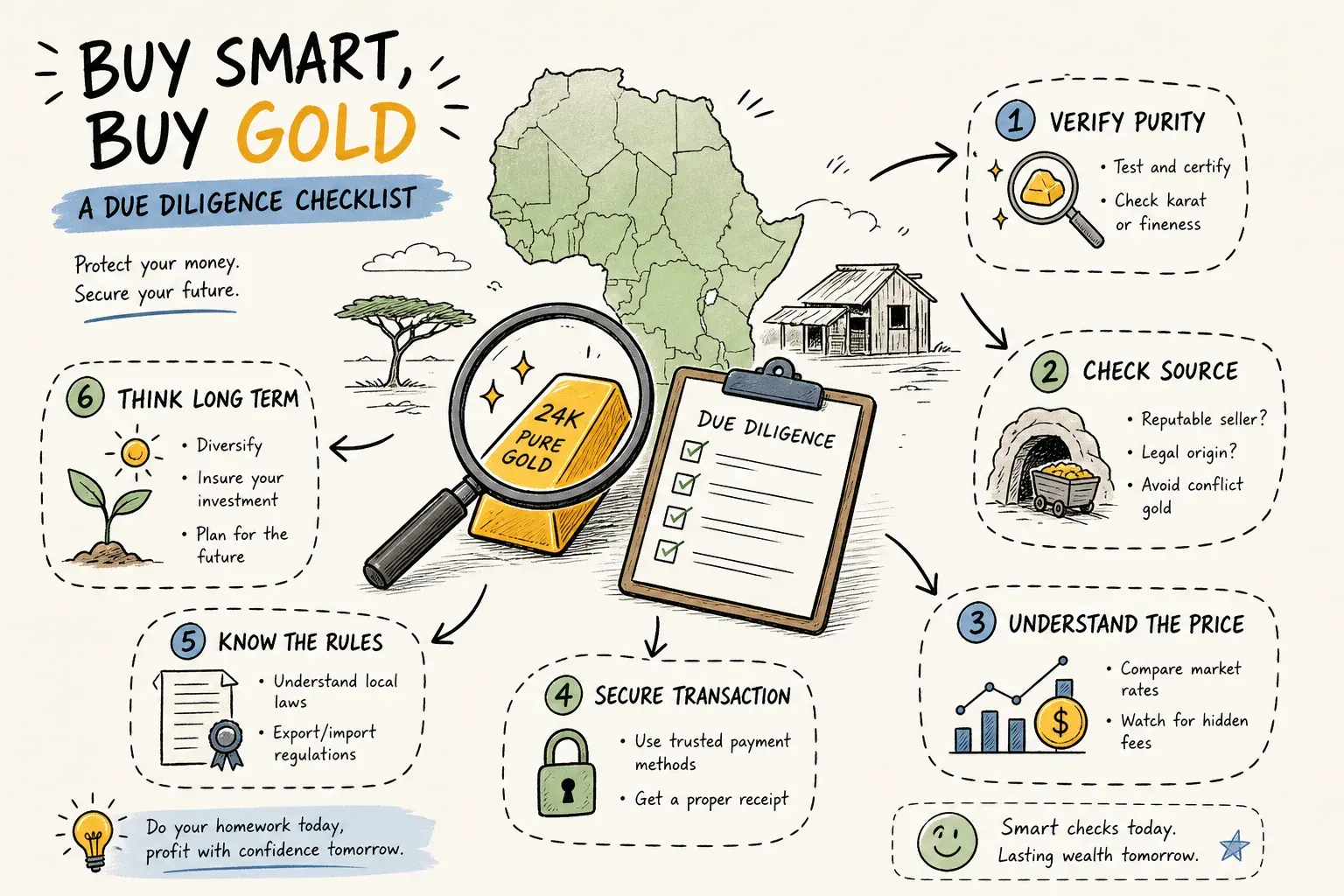
This due diligence checklist for buying gold in Sub-Saharan Africa addresses every major failure point that turns legitimate transactions into costly mistakes. Documentation gaps and outright fraud can cost buyers significant capital, and most of it is preventable. The problem is not that the region lacks legitimate gold. Sub-Saharan Africa holds substantial gold reserves, and legitimate supply chains operate out of Ghana, Tanzania, Kenya, Zimbabwe, and the DRC every day.
The problem is that buyers skip steps or accept documents at face value, and that habit is expensive. Every item in this checklist corresponds to a real failure point seen in cross-border gold transactions. Follow it in order, and you have a defensible, repeatable process that holds up to regulatory scrutiny and protects your capital. 1.
Confirm the seller's legal standing before anything else This is the step most buyers rush past, and it causes the most damage. A seller who cannot demonstrate current, valid authorization to deal in gold cannot deliver legal title to the gold, regardless of how good the sample looks or how competitive the price is. Licensing is not a formality. It is the legal foundation of the entire transaction.
Most countries in Sub-Saharan Africa require some form of license to buy, aggregate, or sell gold commercially. In Ghana, that means a GoldBod-issued license under the 2025 framework, which established GoldBod as the sole licensing authority for artisanal and small-scale mining gold, replacing prior PMMC and ministry-level authorizations. In Tanzania, it means a minerals trading license issued by the Ministry of Minerals. In the DRC, expect proof of authorization to trade artisanal gold through the applicable provincial and national channels.
Ask for the license, verify the license number directly with the issuing authority, and confirm it is current. Beyond the mining or dealer license, request the seller's certificate of incorporation, tax identification number, and any required precious metals dealer registration. Identify who actually owns and controls the entity, because beneficial ownership links the gold to the legal person responsible for it and is the first question a compliance officer or regulator will ask. Before any further engagement, run the seller's name, company name, and key principals through OFAC, UN, and EU sanctions lists along with a basic adverse media search.
This takes less than an hour and eliminates a category of risk that has no remedy after funds are sent. 2. The document package every compliant transaction requires Reputable buyers do not move money until they hold a complete, internally consistent document package. Inconsistencies between documents are the clearest signal of fraud or non-compliance, and the standard to apply is simple: every quantity, fineness figure, and lot reference must reconcile across every document in the file.
The minimum package for any cross-border gold purchase includes a certificate of origin verified by the relevant national authority or licensed exporter; an export permit or export authorization naming the exporter, buyer, quantity, fineness, and destination; a commercial invoice and packing list that match the assay certificate; and customs export clearance documentation. Required documents vary by jurisdiction and by the requirements of the receiving refiner or buyer, verify the minimum legal export documentation for your specific source country and confirm what your counterparty requires before assuming this list is exhaustive. Chain-of-custody documentation, part of any credible gold supplier verification checklist, traces the gold from the mine or first point of purchase through every intermediate handler to the current seller. That means mine production records or first-purchase receipts, copies of prior assay or origin documents, purchase receipts at each transfer point, and evidence that the seller's license was current at the time of each transfer. For gold originating from conflict-affected regions like the DRC, OECD-aligned due diligence documentation and ICGLR conflict-free certification are required by downstream buyers and LBMA refiners operating under the LBMA Responsible Gold Guidance, treat them as additional requirements, not optional extras.
Tax and royalty payment evidence matters too. Confirm that duties owed to the producing country were paid, and request payment records showing funds were transferred through traceable banking channels to the licensed exporter's corporate account. A clean banking trail typically includes wire transfer confirmations, bank statements showing the receiving account in the licensed entity's name, and any applicable royalty payment receipts issued by the relevant authority. Cash-only transactions with no banking trail are a material red flag, regardless of the accompanying paperwork.
3. Independent assay and purity verification: the item most buyers under-specify Seller-provided assay results are not independent assay results. A seller's in-house test, or a test conducted by a lab the seller selects and pays for without buyer input, introduces a conflict of interest that defeats the purpose of verification. Your due diligence checklist for gold in Africa requires a certified third-party assay from a lab with no commercial interest in the transaction.
This is non-negotiable for any high-value purchase. XRF screening XRF spectrometry is the right tool for rapid, non-destructive preliminary screening. It gives you a surface composition reading quickly and cost-effectively. Use it as the first-pass gate: if the XRF result is inconsistent with the declared fineness, stop before spending on logistics or fire assay fees.
Fire assay Fire assay, using the cupellation method, is the reference method for definitive fineness. It destroys the sample but delivers an internationally accepted result used by refiners, banks, and regulators worldwide. For high-value lots or import transactions, require both methods. Use XRF as the screening step and fire assay as the binding result.
A certificate that satisfies this checklist item must state the lab's name and accreditation details, a sample identification that matches the lot reference in your documents, the testing method used, the purity result expressed in fineness or karats, the date of assay, and the analyst's signature and certificate number. International refiners and buyers operating under ISO/IEC 17025 and LBMA acceptance criteria reject certificates that omit the method, the accreditation basis, or a traceable sample reference. Full stop. For transactions originating in Kenya or Tanzania, Bilex Minerals EA operates as an independent third-party assaying laboratory with offices in Nairobi and Dar es Salaam.
They provide both XRF screening and fire assay with documented chain-of-custody, and their certified assay reports carry no commercial interest in the gold being tested. That separation of interest is exactly what this checklist item requires: a lab that works for the transaction's integrity, not for either party. 4. AML and KYC checks you cannot skip Anti-money laundering obligations apply to gold purchases across virtually every jurisdiction involved in a Sub-Saharan Africa trade, including the destination country.
For US-based buyers, FinCEN's AML program requirements for precious metals dealers require documented due diligence at the transaction level, and cash transactions above $10,000 trigger currency reporting obligations. Dodd-Frank Section 1502 adds conflict minerals reporting requirements for SEC-reporting companies sourcing from the DRC or adjoining countries. These are legal requirements, not optional best practices. Verify the full legal identity of every natural person and entity on both sides of the transaction.
For companies, identify the ultimate beneficial owner, meaning go beyond the registered company name to confirm who actually controls the entity and who will receive the funds. Screen all counterparties against OFAC, UN, and EU sanctions lists, and apply enhanced due diligence automatically if the seller or any intermediary is a politically exposed person, is connected to a conflict-affected region, or if the gold originates from a jurisdiction classified as high-risk. Ask how the seller acquired the gold and how the purchase is being financed. Transactions structured to stay below reporting thresholds, or that route payment through multiple intermediaries without clear economic rationale, are suspicious regardless of documentation quality.
FATF guidance identifies USD 15,000 as a common threshold for precious metals transactions, but your AML program should set its own thresholds based on risk, not just regulatory minimums. 5. Export and import compliance: a pre-condition, not an afterthought Legal title to gold means nothing if it cannot cross a border. Confirming export authorization in the source country and import eligibility in the destination country is a pre-condition for every transaction, not an administrative detail to resolve after the deal is agreed.
Confirm it before any payment is authorized. Source-country export controls vary by jurisdiction and need to be verified separately from the trading license. In Ghana, only GoldBod or GoldBod-licensed entities may export ASM gold under the current framework. In Tanzania, an export permit from the Ministry of Minerals is required, along with formal valuation and customs clearance.
In Zimbabwe, gold export is subject to state approval and exchange-control oversight that makes private export without proper authorization effectively impossible. Do not assume a licensed dealer automatically holds a current export license. Verify it separately, directly with the issuing authority. For US imports, Dodd-Frank Section 1502 conflict minerals rules apply if the gold could be connected to covered countries in the Great Lakes region.
OFAC sanctions rules apply universally to all counterparties and transactions. For transactions that will flow through LBMA Good Delivery refiners, source documentation must satisfy the LBMA Responsible Gold Guidance, which is built on the OECD five-step due diligence framework. If the gold originates from the Great Lakes region, ITSCI traceability documentation may also be required by your refinery or downstream buyer. Confirm all of this with your compliance counsel before the shipment moves.
6. Country-specific checkpoints that change by jurisdiction The baseline steps above apply to every gold buying due diligence process in Sub-Saharan Africa. These jurisdiction-specific flags apply on top of them and determine where you need heightened scrutiny or additional documentation. Think of this section as a layered filter, not a separate checklist.
In Ghana, verify the seller's GoldBod license directly with GoldBod. Do not accept a photocopy alone, because the 2025 framework rendered prior PMMC and ministry-issued licenses ineffective for gold trading, contact GoldBod directly to confirm current authorization status. In Mali and Burkina Faso, scrutinize origin documentation closely given elevated conflict-minerals and political risk in both countries. Apply the full OECD five-step framework here, not a selective version of it.
Tanzania requires a minerals trading license for buying and a separate export permit for moving gold out of the country. Sellers who claim they can export without a permit are describing an illegal transaction. For Kenyan transactions, export licensing and customs valuation requirements apply, confirm the specifics with the relevant Kenyan authorities or local counsel, since requirements can shift. Bilex Minerals EA's operations across both Tanzania and Kenya make it practical to satisfy the independent assay requirement without involving a third country, which simplifies both logistics and chain-of-custody documentation.
In the DRC, demand ICGLR conflict-free certification documentation in addition to standard paperwork. In Zimbabwe, any transaction that bypasses the authorized buyer system or central bank exchange-control framework should be treated as non-compliant until proven otherwise. These are not bureaucratic formalities. They are the difference between a legal import and a potential sanctions exposure.
Use this checklist as a sequential protocol, not a menu Each step in this process closes a gap that fraud, misrepresentation, or regulatory exposure can exploit. Seller credentials come first. Documents come second. Independent assay and purity verification comes third, and it must be genuinely independent.
AML and KYC checks run in parallel with every other step. Export and import compliance gets confirmed before any payment is authorized. Country-specific risks get layered on top of the baseline. Buyers who follow this sequence consistently protect themselves, protect their counterparties, and contribute to the integrity of legitimate supply chains across the region.
The goal is not to make every deal harder. It is to make every legitimate deal defensible, documented, and repeatable. This due diligence checklist for buying gold in Sub-Saharan Africa is most effective when applied before a transaction begins, not after problems surface. If you are sourcing gold from Kenya or Tanzania and need certified third-party assay results, export documentation support, or chain-of-custody records that satisfy international buyer requirements, Bilex Minerals EA provides independent testing and assaying services built specifically for this market.
Contact them directly to discuss your transaction requirements before the process begins.
Keep the answer within its proper scope.
Can this article replace transaction-specific professional advice?
No. It is educational. Confirm current legal, customs, tax, regulatory, technical, and commercial requirements with the responsible authorities and appropriately qualified advisers.
Does an assay approve the wider gold transaction?
No. An assay describes the submitted sample under the stated method. Ownership, origin, seller authority, payment, export, import, sanctions, and logistics require separate checks.
What should I verify before relying on a document or result?
Verify the issuer, scope, date, reference, sample or shipment identity, units, validity, and direct connection to the current parties and material.
Official and primary sources
Check current requirements directly.
Government-backed risk-based due diligence guidance for mineral supply chains.
LBMA Responsible Sourcing GuidanceCurrent responsible sourcing documents for Good Delivery refiners.
Kenya State Department for MiningOfficial information about mineral dealing rights and export-permit processing in Kenya.
Tanzania Mining Commission Export ProceduresOfficial information about eligible exporters, permits, fees, and responsible authority contacts.