
Focused resource · Gold Buying
How Professional Gold Buyers Use Assay Labs to Prevent Fraud
How controlled sampling, staged testing, custody, report verification, payment conditions, and retained evidence reduce transaction risk.
11 min read · Knowledge Centre resource
Direct answer
Professional buyers use the laboratory as one independent control within a wider due-diligence process. They do not ask the laboratory to validate the seller or transaction.
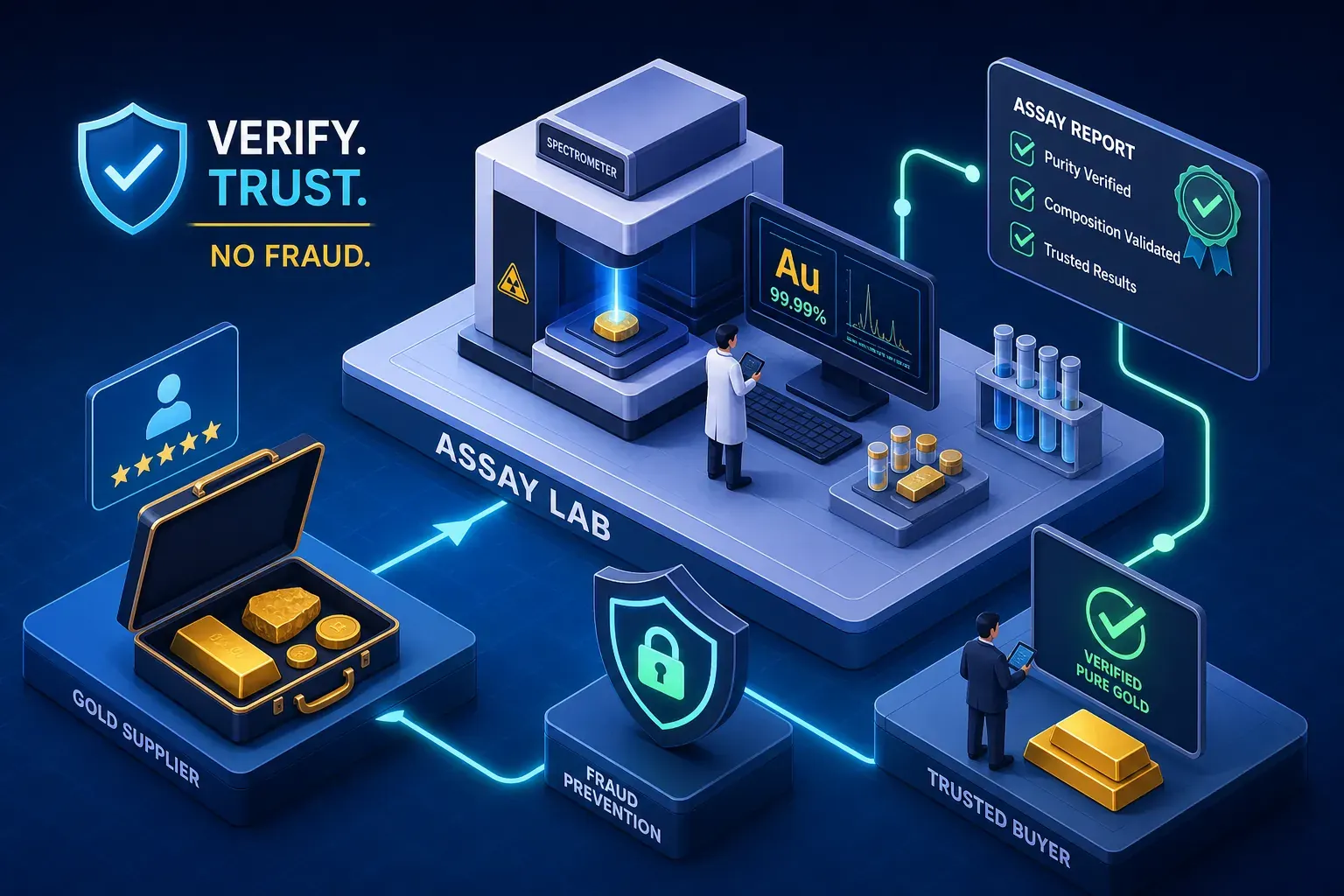
A buyer in East Africa completes a large gold purchase, hands over the funds, and ships the lot to a refinery. Days later, the refinery rejects the material because the fineness is off by 15 percent. The buyer has no certified documentation, no chain of custody records, and no independent assay report. The seller is unreachable.
The loss is total. That scenario plays out more often than the industry publicly acknowledges, and it is precisely why understanding how professional gold buyers use assay labs to protect against fraud is not an academic question, it is the difference between a recoverable transaction and a total write-off. Professional buyers use assay labs the way an attorney uses a contract: as structured protection built before something goes wrong. How professional gold buyers use assay labs to protect against fraud follows a consistent process, lab selection, tiered testing protocols, documented custody transfers, and certified results that hold up in negotiations, refinery settlements, and legal disputes.
For buyers operating across East Africa, that protection depends on engaging independent, third-party labs that hold no commercial stake in the gold being tested. What follows is the exact process professionals use, from choosing the right lab to acting when results expose a problem. How Professional Gold Buyers Select a Trustworthy Assay Lab ISO/IEC 17025 accreditation is the baseline credential buyers should require from any lab they engage. It signals that the lab has demonstrated technical competence for specific test methods and participates in external quality assurance audits.
The critical detail is that ISO 17025 applies only within a defined scope: the accreditation covers specific methods, sample types, and analytes listed in the lab's scope document. Requesting the full scope document, not just the certificate, is non-negotiable. Buyers must confirm the scope explicitly covers the assay method and material type they need, and the accrediting body must be an ILAC MRA signatory for results to carry international weight. Beyond ISO 17025, professional buyers in bullion markets ask whether a lab participates in proficiency testing rounds.
These are external inter-laboratory comparisons that measure how accurately a lab's results compare against peers using the same reference materials. A lab that consistently performs well in proficiency rounds has demonstrated more than a documented quality management system; it has proven its results hold up against independent scrutiny. Sector-specific credentials, including alignment with recognized Good Delivery frameworks and hallmarking standards, signal that the lab operates within an ecosystem that institutional buyers and major refineries recognize. The most undervalued credential in this process is independence.
A lab's technical accreditation means very little if it has a financial relationship with the seller, processes the seller's material regularly, or has any incentive to report a favorable result. Professional buyers specifically seek third-party independent labs that profit only from the testing fee and hold no commercial interest in the outcome. Bilex Minerals EA operates on exactly this model from its locations in Nairobi and Dar es Salaam: the lab holds no gold, buys no gold, and its only relationship to the transaction is the analytical work. That separation is what makes the result usable as neutral evidence when a deal goes sideways. How Professional Gold Buyers Use Assay Labs to Protect Against Fraud: The Testing Ladder XRF (X-ray fluorescence) is the first tool most professional buyers deploy for screening.
It is fast, non-destructive, and delivers an elemental composition reading within minutes, making it practical for evaluating material at the point of acquisition. The limitation is fundamental: XRF reads the surface. A plated bar or clad coin, a common counterfeit gold detection scenario, can appear to pass XRF when the core metal is base. Professional buyers treat XRF as a triage tool, strong enough to reject obvious fakes or flag suspicious lots, but never sufficient as the sole basis for pricing a significant purchase.
Bullion authentication at this stage is a screen, not a verdict. Fire assay is the method that closes the argument on purity. It melts the sample and chemically separates gold from base metals, measuring the entire material rather than just the surface layer. The result is internationally recognized as the reference standard for precious metal content, and it is the method refineries rely on for final settlement.
Standard commercial fire assay at an ISO 17025-accredited lab typically delivers results within 24 to 72 hours for routine batches. Any purchase above a threshold value should be priced only on a certified fire assay result, not on XRF alone. The method is destructive and more time-intensive than XRF, but that is the trade-off for a result that holds up to independent scrutiny. ICP-OES and ICP-MS analysis enter the picture when buyers need high-sensitivity trace element data beyond what XRF can provide.
If a refinery quotes a deduction for specific contaminants, or if a lot's composition is unusual, ICP methods give the detailed elemental picture that informs those conversations. The method requires sample dissolution and more intensive lab preparation, so it is not the first tool in the process. Professional buyers use ICP as the third layer in complex or high-value situations where they need to understand exactly what is in a lot before a refinery processes it. Refiner verification of deductions is far harder to dispute when the buyer arrives with ICP data in hand.
Sample Submission and Chain of Custody Protocols Before a gram of gold leaves a buyer's possession on the way to the lab, every item in the lot must be documented. Serial numbers, refinery marks, weights, fineness stamps, and photographs should all be recorded in a pre-shipment inventory that serves as the baseline for every subsequent check. Professional buyers also attach a written transfer authorization specifying who may release the sample and who may receive it at each stage. That document removes ambiguity about custody at every handoff point and forms the foundation of an auditable chain of record.
Sending gold to an assay lab is not a standard courier job. Professional buyers use licensed armored or bonded logistics providers, with dual-control handover documented at the point of origin and a signed receipt confirmed at the destination. At the lab, the package is opened in a controlled area, seals are verified against the pre-shipment manifest, and any discrepancy is noted immediately before the sample enters the testing queue. This witnessed opening is the moment the chain of custody formally transfers to the lab, without it, any result the lab issues is harder to defend as uncompromised.
Insurance coverage should be in force from pickup through signed lab receipt, with no gap between custody stages. Decoding Your Assay Certificate: What Legitimate Results Look Like A legitimate assay certificate is a controlled document with a unique reference number, the lab's name and accreditation details, the exact method used, the sample identifier, the date of testing, and the authorized signature of the responsible analyst. In ISO 17025-compliant labs, the results section includes measured values with units and a statement of measurement uncertainty. Buyers should confirm that the methods listed on the certificate match those in the lab's accredited scope, because an authentic lab will never claim a result under a method it is not authorized to perform.
Forged assay certificates share common tells. Look for inconsistent fonts or misaligned page elements, results that claim broader analytical scope than the lab's official accreditation covers, missing or altered issue dates, and signatures or seals that appear digitally copied rather than physically applied. The simplest verification step is to contact the lab directly, using contact information sourced independently, not from the certificate itself, and ask the lab to confirm the certificate number and corresponding results. Professional buyers do this routinely before releasing funds, and it takes less than five minutes.
Using Assay Certificates to Protect Against Fraud in Negotiations and Legal Disputes An assay certificate from an accredited, independent lab is the closest thing to neutral evidence in a gold transaction. When a buyer presents a certified result showing fineness below what a seller claimed, the burden of proof shifts. Refineries use assay certificates as the contractual basis for settlement, which means a buyer who walks into a refinery with a certified independent assay occupies a fundamentally stronger position than one relying on the seller's own documentation. Professional buyers treat every assay certificate as a risk-management instrument first and a test result second.
For buyers subject to U.S. regulations, including Dodd-Frank conflict minerals rules and AML sourcing requirements, a certified independent assay report paired with chain of custody records forms the core of a complete compliance file. Regulators and institutional counterparties expect documentation that traces gold back to a specific lot with a verified purity figure from a credible, independent source. Labs that also support export documentation, as Bilex Minerals EA does for buyers operating in East Africa, reduce the number of intermediaries needed and create a consolidated compliance record that covers both the analytical result and the regulatory paperwork in one place. What Professional Buyers Do When Assay Results Reveal a Problem When an assay result shows a significant discrepancy from what a seller represented, the first move is to secure all documentation before any communication with the counterparty.
This means timestamping emails, preserving chain of custody records, and retaining the original assay report in its issued form. Professional buyers do not return or release the gold before taking legal advice, because the physical material and the accompanying documentation together constitute the evidence. Acting prematurely or informally before that record is secured can undermine any subsequent claim. A second independent assay from a different accredited lab is standard practice after a disputed result.
It eliminates any argument about the first lab's accuracy and produces two independent confirmatory records. From there, the buyer's options broaden considerably: contractual rescission, fraud claims, breach of contract suits, and regulatory complaints are all available depending on the jurisdiction and the nature of the misrepresentation. The viability of each path depends heavily on the quality of the documentation assembled from the very beginning of the transaction. The entire process described here exists for one downstream purpose: to produce a paper trail that speaks clearly when words fail.
A transaction that moves from accredited lab selection through documented custody to a certified assay report gives a buyer the tools to pursue a contractual claim, file a regulatory complaint, or cooperate with law enforcement. Without that chain of documentation, a buyer who was defrauded has a financial loss and no evidence. With it, the record makes the case. Build the Protection Before You Need It The full process described above is not a compliance exercise, it is the mechanism by which professional gold buyers use assay labs to convert a risky transaction into a defensible one.
From selecting an ISO 17025-accredited independent lab, through tiered XRF and fire assay testing, through documented chain of custody, and through certified results verified for accuracy, each step is structured protection that works precisely because it was in place before something went wrong. That is what separates buyers who recover from fraud from those who absorb the loss quietly. For buyers sourcing gold across East Africa, that process is available through Bilex Minerals EA, which provides independent fire assay and XRF testing with no commercial interest in the gold being tested, and supports the export documentation that closes the compliance loop. The best time to engage an independent assay lab is before the transaction settles, not after a refinery rejects the lot.
Buyers sourcing across East Africa can engage Bilex Minerals EA directly to begin that process before the next transaction closes.
Keep the answer within its proper scope.
Can this article replace transaction-specific professional advice?
No. It is educational. Confirm current legal, customs, tax, regulatory, technical, and commercial requirements with the responsible authorities and appropriately qualified advisers.
Does an assay approve the wider gold transaction?
No. An assay describes the submitted sample under the stated method. Ownership, origin, seller authority, payment, export, import, sanctions, and logistics require separate checks.
What should I verify before relying on a document or result?
Verify the issuer, scope, date, reference, sample or shipment identity, units, validity, and direct connection to the current parties and material.
Official and primary sources
Check current requirements directly.
Official ISO page for the current cupellation method standard for determining gold in suitable materials.
ISO/IEC 17025 Laboratory CompetenceOfficial ISO overview of competence, impartiality, and consistent operation requirements for testing laboratories.
OECD Responsible Mineral Supply ChainsGovernment-backed risk-based due diligence guidance for mineral supply chains.