
Focused resource · Trade Support
Gold Trade Documents: What Every Buyer and Seller Needs
How to organise identity, authority, material, assay, contract, invoice, payment, export, transport, insurance, customs, and receipt records.
11 min read · Knowledge Centre resource
Direct answer
A reliable trade file connects the same legal parties, material, weights, references, values, route, and dates across every document.
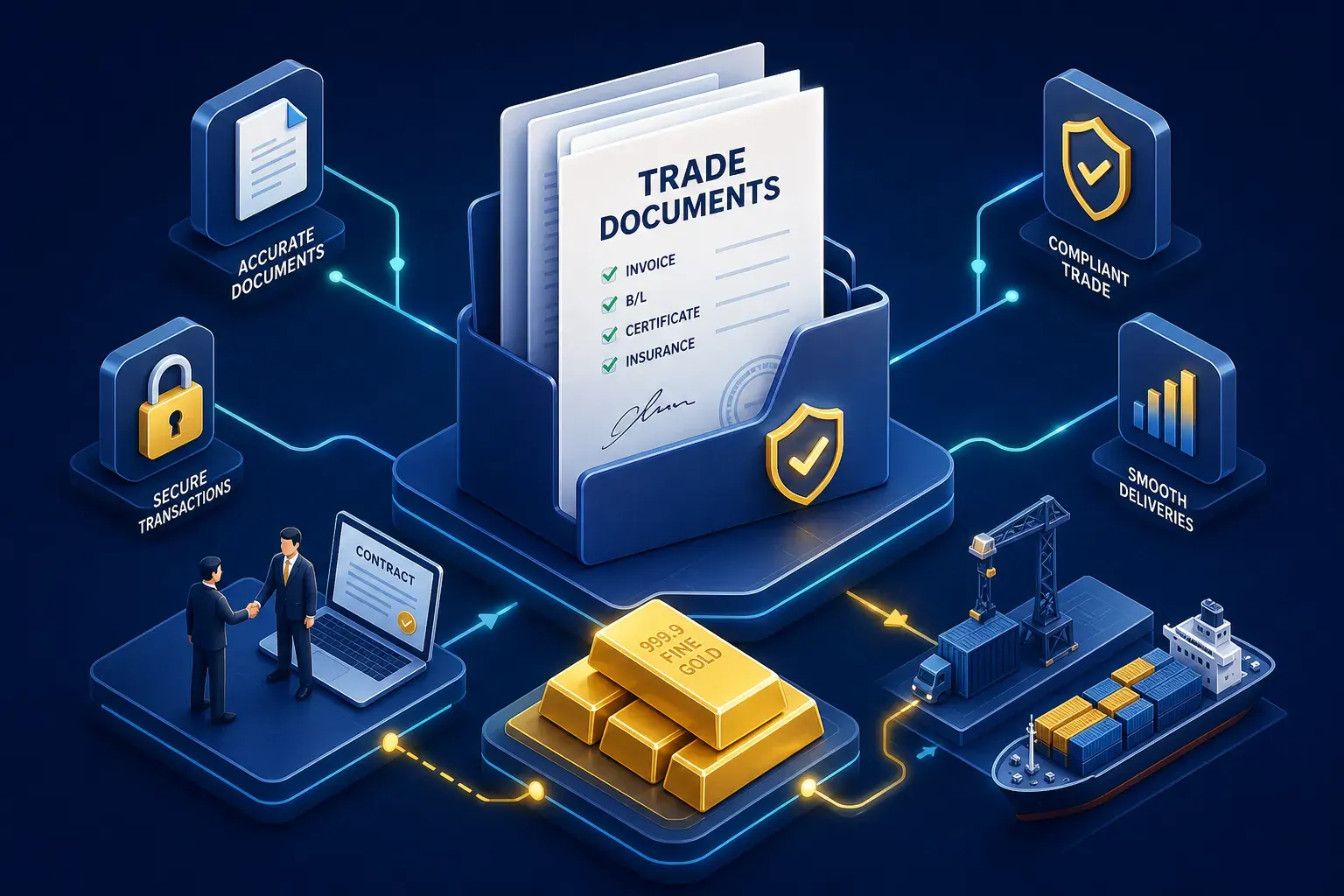
A gold transaction is only as solid as the paperwork behind it. Understanding gold trade documents is the first step to avoiding seized shipments, rejected consignments at the refinery gate, or, worse, no legal recourse when something goes wrong. The full set of papers required to buy, sell, import, or export gold spans multiple categories, each issued by a different authority and each proving a different fact about the metal, its origin, and the parties involved. Some of those categories overlap in practice.
An independent laboratory like Bilex Minerals EA, operating from Nairobi and Dar es Salaam, addresses two of the most critical document categories within a single client engagement: the fire-assay-based certificate that defines the gold itself, and export documentation support that helps authorize it to leave the country. That combination matters because every extra intermediary in the documentation chain is another opportunity for delay or error. This article covers every major category of gold trade paperwork, what each document proves, and who issues it. By the end, you will have a practical reference you can use to audit your own file before the next deal moves forward.
Gold trade documents, part one: the assay certificate The assay certificate is the foundational document of any gold trade. It establishes the metal's purity (fineness), weight, and identity, tying those facts to a specific lot, bar, or parcel through a serial number and the issuing laboratory's mark. Without it, a buyer has no independent basis for the price they are agreeing to pay. What an assay certificate must contain For an assay certificate for gold to be accepted by international buyers, LBMA-listed refiners, or US customs, it must include the following fields: the refinery or laboratory name; gold fineness expressed as a decimal (such as .9999 or 999.9/1000); weight in troy ounces or grams; a unique serial number matching the bar or parcel; the assay method used; the date of the assay; and the issuing assayer's signature or stamp.
Per LBMA Good Delivery rules, certificates must also report individual trial results to five significant figures along with the mean. That level of precision is what separates a defensible certificate from a generic purity claim. Fire assay (cupellation) is the internationally accepted standard for a final, legally defensible purity determination. XRF spectrometry serves as a rapid, non-destructive screening tool useful for preliminary evaluation, but it does not carry the same evidentiary weight in trade and compliance contexts.
When the deal is large or the stakes are high, fire assay is the method that holds up. Why independence matters more than you think Assay certificates can come from the refiner, a government hallmarking authority, or an independent third-party laboratory. For trade and compliance purposes, third-party certification carries the most weight because there is no commercial interest in the outcome. A seller's own test result, however accurately produced, creates a conflict of interest that no serious buyer should accept at face value.
Bilex Minerals EA issues fire-assay-based certificates and supports export documentation from the same engagement, which means clients can reduce the number of intermediaries they need to coordinate before a shipment moves. As an independent laboratory, Bilex has no stake in whether fineness comes in higher or lower, and that independence is precisely what gives the certificate its credibility with buyers and refiners. The assay certificate also anchors the commercial invoice value and is commonly required by destination-country customs authorities. A discrepancy between the declared value and what the assay certificate shows is a reliable way to get a shipment flagged for examination, per standard CBP admissibility review practice.
Gold trade documents, part two: export license and certificate of origin Once the gold's purity is certified, the next set of documents establishes that the metal is leaving its source country legally and that its geographic origin is accurately declared. These two documents are distinct, issued by different authorities, and both are required for international trade. The export license: government authorization to move the metal An export license is the formal authorization from the source country's mineral authority permitting a specific consignment to cross the border. In Kenya, this is issued by the State Department for Mining through the Director of Mines.
In Tanzania, the issuing authority is the Mining Commission. The license references the lot, weight, and purity being exported, linking directly back to the assay certificate. Legitimate international buyers commonly require an export license before accepting a shipment, and most reputable freight forwarders will request one before moving gold. In Kenya, the process also requires a Mineral Dealer's Licence (obtained through the Mining Cadastre Portal), a Tax Compliance Certificate from the Kenya Revenue Authority, an Export Declaration Form filed through the Kenya National Single Window system, and proof that royalties have been paid under the Trading in Unwrought Precious Metals Act.
Each of these elements must be in place before the shipment can legally depart. Certificate of origin: tracing the metal to its source country The certificate of origin establishes the country where the gold was mined or refined. In Kenya, it is typically issued by the Kenya National Chamber of Commerce and Industry or a designated government body; in Tanzania, the Tanzania Chamber of Commerce, Industry and Agriculture performs a similar function. US customs commonly requires a certificate of origin as part of the commercial import file, depending on the shipment and any tariff treatment being claimed, and it is a compliance necessity for buyers operating under Dodd-Frank conflict minerals rules, which require gold to be traced back to its country of origin.
Treating a certificate of origin as a shipping formality misses the point: it is a sourcing compliance record that the buyer may need to produce for years after the transaction closes. Gold trade documents for shipping: bills of lading, invoices, and packing lists The transport layer of gold trade paperwork is dense. Each document serves a specific function in the logistics and customs chain, and an incomplete file at this stage is one of the most common reasons cleared shipments get delayed or held. Commercial invoice and packing list The commercial invoice for a gold shipment is far more detailed than a standard export invoice.
It must include a full description of the goods, the HS code, purity, weight, serial numbers, declared value, and shipper and consignee details. Many jurisdictions require multiple signed copies. The packing list supports the invoice by itemizing the physical contents: number of bars, gross and net weight, serial numbers, and packaging details. Customs authorities at the destination use these two documents together to verify that what was declared matches what arrived.
Bill of lading and air waybill The bill of lading (sea freight) and air waybill (air cargo) are the transport contracts that establish ownership and custody of the gold while it is in transit. For high-value gold cargo, original documents are typically required, and the description wording must be precise. Processing times vary widely by origin, destination, and mode, but incomplete or vague paperwork is the most common reason clearance timelines extend significantly. A complete document file is the single most reliable way to keep cargo moving on schedule.
Chain-of-custody records and responsible sourcing documentation Chain-of-custody records answer a question that regulators, refiners, and international buyers increasingly require a documented answer to: where did this gold come from, and can you prove it at every stage? This is no longer optional procedural overhead; for buyers sourcing from sub-Saharan Africa, documented chain of custody is a baseline expectation from refiners and institutional counterparties alike. What chain-of-custody documentation covers Chain-of-custody records track the gold from mine or collection point through processing, testing, and shipment. At each stage, the file should capture what the material is, how much there is, who had it, when it moved, and under what legal or compliance authority.
In practice, that means supplier identity documents, mining licenses or permits, purchase agreements, weight and assay records at each transfer point, and transport records connecting each stage. The goal is an unbroken paper trail that holds up under a due diligence review. LBMA responsible sourcing requirements and the OECD framework LBMA's Responsible Gold Guidance requires refiners to produce annual Compliance Reports, Assurance Reports, and Management Reports, audited by an LBMA-approved assurance provider. Supporting documentation includes country-of-origin data, beneficial ownership records for suppliers, corrective action plans where non-conformances are identified, and all underlying mining and transport records.
These requirements are built on the OECD five-step due diligence framework, which means the documentation standard applies to any buyer conducting responsible sourcing due diligence, not just LBMA refiners. KYC and AML declarations: the compliance layer every dealer must build Anti-money laundering and know-your-customer requirements apply to gold dealers and traders in most major jurisdictions. These documents do not describe the gold; they describe the parties and verify that the transaction is legitimate. Skipping this layer is not a paperwork shortcut, it is a regulatory violation.
What KYC documentation requires Standard KYC elements include government-issued photo ID, proof of address, business registration documents for corporate entities, beneficial ownership records, source-of-funds declarations, and purpose-of-relationship documentation. For US dealers, FinCEN guidance requires a written AML program covering a compliance officer, risk assessment, employee training, independent testing, and recordkeeping for covered transactions. The program must be risk-based, which means higher-risk customers and transactions require more documentation, not less. Transaction records and reporting obligations IRS/FinCEN Form 8300 is required for cash transactions above the applicable reporting threshold in the United States.
Under FinCEN guidance, AML-related records, KYC files, transaction records, and supporting documents must generally be retained for at least five years. For international transactions sourcing gold from East Africa, US buyers must also consider Dodd-Frank conflict minerals compliance and may need sourcing declarations from their supply chain partners. Sanctions screening records and politically exposed person (PEP) assessments round out a defensible AML file. What US buyers need at customs clearance For American importers, document requirements layer on top of everything already described.
Understanding these steps prevents delays and potential seizures at the port of entry. CBP forms and the $10,000 declaration threshold For personal imports, CBP Form 6059B covers general traveler declarations. FinCEN Form 105 is required when the value of gold or related monetary instruments exceeds $10,000 at any entry point. For commercial shipments, CBP Form 3461 handles entry and immediate delivery, while CBP Form 7501 covers the entry summary.
Gold is generally duty-free when properly declared, but the paperwork must still be complete and accurate. Missing or incorrect forms are the primary reason commercial gold shipments get held at the border. Supporting documents that customs expects A US customs broker typically assembles the commercial invoice, packing list, certificate of origin, assay certificate, and, where applicable, insurance documentation. CBP may also require documents sufficient to determine admissibility, which in practice means clear evidence of the gold's weight, purity, declared value, and origin.
The assay certificate, export license, and certificate of origin issued at origin form the backbone of the US customs file. Having those documents finalized before the shipment departs the source country is the single most effective way to prevent processing delays on arrival. Getting your documentation right from the start Gold trade paperwork is not bureaucratic overhead. It is the mechanism by which buyers verify what they are getting, customs authorities verify that the movement is legal, and compliance programs verify that the money is clean.
A gap in any one of the document categories covered here creates real exposure: to fraud, to customs seizure, to regulatory sanction, or to a rejected consignment at the refinery. Use this checklist to confirm your gold trade documents before a shipment moves: the assay certificate, the export license, the certificate of origin, commercial shipping documents (invoice, packing list, bill of lading or air waybill), chain-of-custody records, KYC and AML declarations, and the applicable US customs forms. Each one proves something different, and none can substitute for another. If your transactions involve sourcing gold from East Africa, working with an independent laboratory like Bilex Minerals EA means the fire-assay-based certificate and export documentation support come from a single, credible source, reducing the number of intermediaries between your deal and its completion.
Contact the Bilex team in Nairobi or Dar es Salaam before your next shipment moves, while there is still time to close any gaps in the file.
Keep the answer within its proper scope.
Can this article replace transaction-specific professional advice?
No. It is educational. Confirm current legal, customs, tax, regulatory, technical, and commercial requirements with the responsible authorities and appropriately qualified advisers.
Does an assay approve the wider gold transaction?
No. An assay describes the submitted sample under the stated method. Ownership, origin, seller authority, payment, export, import, sanctions, and logistics require separate checks.
What should I verify before relying on a document or result?
Verify the issuer, scope, date, reference, sample or shipment identity, units, validity, and direct connection to the current parties and material.
Official and primary sources
Check current requirements directly.
Government-backed risk-based due diligence guidance for mineral supply chains.
Kenya State Department for MiningOfficial information about mineral dealing rights and export-permit processing in Kenya.
Tanzania Mining Commission Export ProceduresOfficial information about eligible exporters, permits, fees, and responsible authority contacts.
US Customs Guidance on Bullion and Gold CoinsOfficial customs information on declaring bullion, gold coins, and medals.