
Focused resource · Responsible Sourcing
How ESG Officers Verify Responsible African Gold Sourcing
How ESG teams connect environmental, social, governance, traceability, supplier, grievance, and performance evidence.
11 min read · Knowledge Centre resource
Direct answer
ESG verification is an evidence and governance process. Officers test claims against documented controls, independent information, stakeholder input, and tracked outcomes.
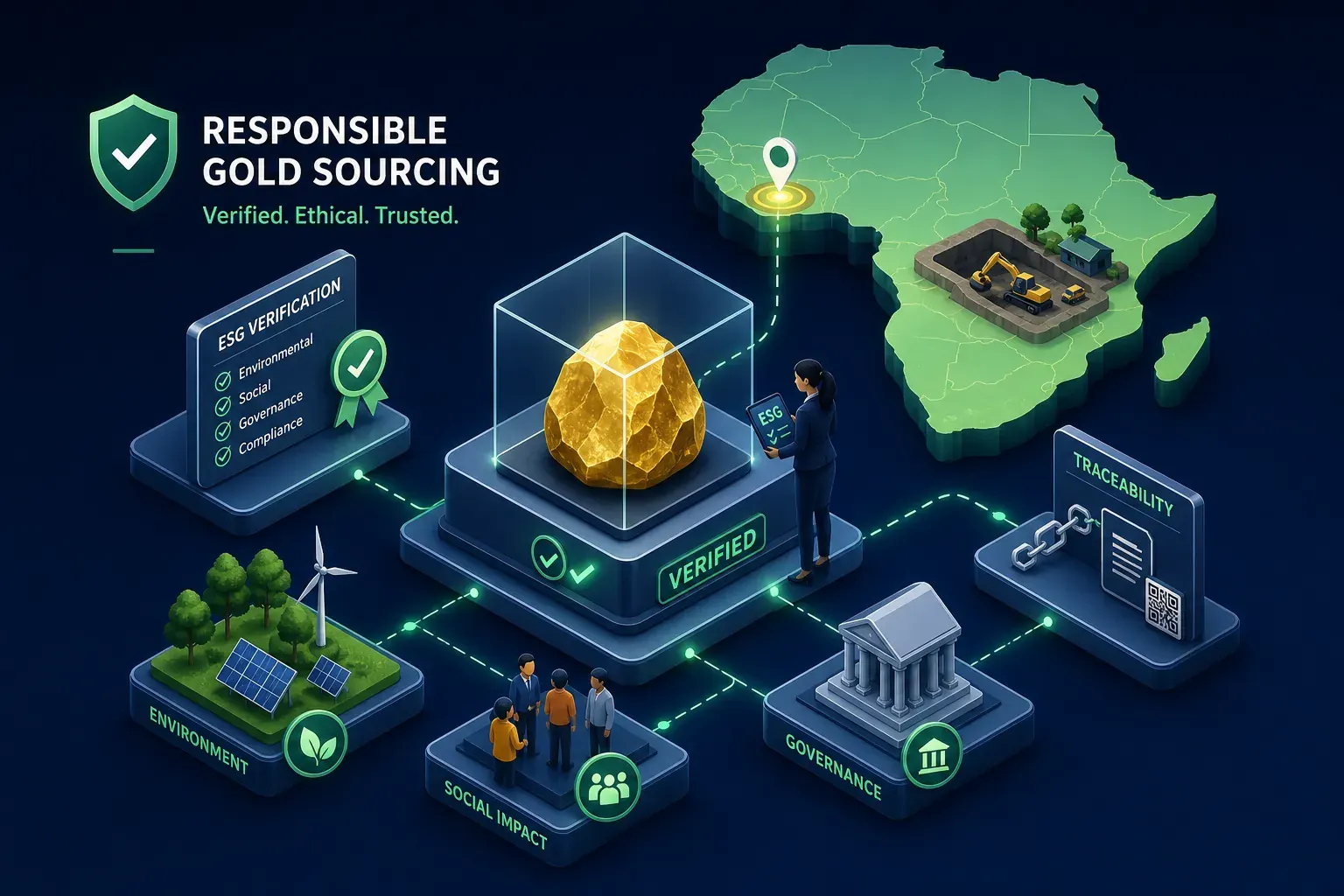
How do ESG compliance officers verify responsible sourcing of African gold? For most compliance teams, the answer isn't a single document or a supplier declaration, it's a multi-layer process requiring the right standards, the right documents, and independently verified field evidence. Paper reviews alone no longer satisfy audit expectations. External auditors reviewing OECD-aligned compliance files now expect physical verification, certified independent testing, and a traceable chain of custody that holds together under scrutiny.
The stakes are real. Dodd-Frank conflict minerals obligations and LBMA Responsible Gold requirements both demand that your verification process goes well beyond collecting supplier-provided documents, and investor-grade ESG due diligence raises that bar further still. Independent East African assay laboratories serve as the physical anchor that ties a documentation package to the actual material, and that connection is what closes the evidentiary gap most compliance files leave open. This guide walks through a practical verification process from the compliance framework down to audit-ready evidence assembly.
How ESG compliance officers verify responsible sourcing of African gold: the framework The OECD five-step due diligence process for gold The OECD Due Diligence Guidance for Responsible Supply Chains of Minerals from Conflict-Affected and High-Risk Areas defines a five-step risk-based process: establish a company supply chain policy, map and assess supply chain risks, design and implement a risk response strategy, commission independent third-party audits, and report annually. For gold specifically, the Guidance's Gold Supplement adds enhanced due diligence requirements when supply chains originate in conflict-affected or high-risk areas, a designation that applies directly to portions of sub-Saharan Africa. Steps 3 and 4 generate the heaviest documentation burden for ESG officers because they require documented mitigation decisions and independent audit evidence, not just policy statements. Treat the OECD Guidance as the minimum compliance floor, not the ceiling your process should reach.
LBMA Responsible Gold and what it means for upstream suppliers LBMA Good Delivery refiners must maintain OECD-aligned due diligence and pass annual independent assurance reviews to retain their listing. If your gold passes through an LBMA-listed refiner, that refiner's compliance structure covers part of your due diligence chain, but it does not eliminate your obligation to verify what happens upstream of the refinery. ESG officers evaluating artisanal and small-scale mining (ASM) gold face the highest evidentiary burden because ASM supply chains rarely have refiner-level controls already in place. That upstream gap is yours to close, and the documentation requirements to close it are substantial.
The document package that proves responsible sourcing of African gold Core licensing and certification documents to request A single document from a supplier proves nothing on its own. The evidentiary value of a provenance file comes from the cross-referenced consistency between multiple records, each of which can be independently verified. At minimum, your document request should cover: Certificate of origin issued by a recognized national authority, chamber of mines, or trade body Valid mining license or small-scale mining registration for the producing operation Export license and export permit from the relevant national minerals authority (Kenya's Ministry of Mining, Tanzania's Mining Commission) Tax and royalty payment receipts confirming government obligations were met KYC documentation for all counterparties: company registration, beneficial ownership, and identity verification Cross-reference every document against the others. A mining license that covers a different geographic area than the stated mine location, or a certificate of origin that doesn't align with the assay composition, signals an inconsistency that demands resolution before the file closes.
Chain-of-custody records from mine site to export point A strong chain-of-custody file documents the gold's movement through every handoff: mine production records, first-purchase receipts from the miner or aggregator, transfer agreements at each subsequent handoff, transport documentation, storage records, and final export papers. Every document in the chain should reference a consistent lot identifier that links back to the physical material. The gap between mine site and first aggregator is the most common weak point in African gold supply chains, and auditors reviewing OECD Step 4 evidence focus on that gap first. If a supplier cannot provide first-purchase receipts that match the mining license holder's production records, treat that as a substantive red flag, not an administrative oversight.
Why independent assay testing holds up in an audit What a certified assay report confirms and why it matters A certified assay report from an accredited independent laboratory documents gold purity (fineness), weight in troy ounces or grams, and elemental composition. Fire assay (cupellation) delivers the most precise and internationally accepted purity determination; XRF spectrometry provides rapid non-destructive screening useful for preliminary evaluation or lot-level sampling. For ESG compliance purposes, the assay report serves as the physical anchor that ties your documentation file to the actual material. A certificate of origin means very little if the metal's composition cannot be independently confirmed.
Auditors reviewing OECD Step 4 specifically look for unbiased lab evidence that was not generated by the seller, the buyer, or a lab with a disclosed commercial relationship to either party. How Bilex Minerals EA generates the assay evidence ESG teams require Bilex Minerals EA operates as an independent, conflict-free testing laboratory from Nairobi, Kenya and Dar es Salaam, Tanzania, with no commercial interest in the gold being tested. That independence is the critical qualifier: third-party auditors reviewing your compliance file need assay evidence from a laboratory that had no stake in the transaction outcome. Bilex provides certified assay reports using both fire assay and XRF methods, with results reviewed directly with the client and formatted for inclusion in ESG compliance files and export documentation packages.
The combination of licensed export documentation support and independent assay certification under one roof reduces the number of intermediaries ESG teams must manage in East African supply chains. For compliance officers building a verifiable provenance file on Kenyan or Tanzanian gold, that single-source capability meaningfully simplifies the evidence assembly process. Field-level provenance checks and traceability tools beyond paper Traceability technologies being applied to African gold supply chains Blockchain-based platforms have completed verified deployments in several African gold-producing regions. Minexx has documented traceable gold exports from Burkina Faso and Ghana, including the first blockchain-tracked kilogram shipped from Burkina Faso and a fully traced export from Ghana's Obeng mine. Minespider has operated a Digital Product Passport-based system for DRC artisanal gold in partnership with Society Artisanal.
These platforms create tamper-evident digital chains of custody from pit head to export point using tag-and-bag systems, geo-location capture at each handoff, and blockchain timestamping. The practical limitation matters equally: blockchain creates auditable traceability but does not independently guarantee responsible practices. The data entered at the source point still requires physical verification. Ask suppliers which platform they participate in and request the platform's audit logs as part of your documentation package.
Supplier vetting and site-level verification Desk-based document review must be supplemented with counterparty verification. That means third-party auditor site visits, miner registration cross-checks with national mining registries, and reference checks with country-level certifying bodies. CRAFT-aligned programs and in-country due diligence auditors provide an additional verification layer specifically for ASM gold, where formal controls are thinnest. Any ESG compliance file credible enough for a board-level report or investor disclosure should include at least one form of physical or field-level verification.
Reviewed documents alone do not satisfy the evidentiary standard that OECD Step 4 and LBMA independent assurance reviews now expect. Red flags that should pause your sourcing process Documentation inconsistencies that signal risk OECD Step 4 review findings consistently flag mismatches across documents rather than any single missing item. Lot identifiers or weights that don't reconcile across the assay certificate, commercial invoice, and export permit are a primary concern. Certificates of origin issued by bodies that cannot be independently verified, or that aren't recognized by the relevant national authority, warrant immediate follow-up.
Mining licenses that are expired, cover a different geographic area than the stated mine location, or don't match the scale of production claimed are equally serious. Assay results provided only by the seller, or by a lab with a disclosed commercial relationship to the seller, fail the independence test and should be treated as unverified regardless of how credible the certificate appears. Supplier behavior and chain-of-custody red flags Resistance to sharing KYC documentation or beneficial ownership details is a consistent indicator of a supply chain that won't survive scrutiny. Supply chains with unexplained gaps between mine production records and export volumes, or gold described as originating from a country that doesn't align with its declared assay composition or mineralogical characteristics, both warrant pausing the process and requesting documented explanations before proceeding.
A sudden, unexplained change in supplier, transport route, or origin country between transactions warrants the same response. In each case, the issue isn't the individual anomaly; it's what the anomaly suggests about the integrity of the chain behind it. Assembling your audit-ready evidence package for annual reporting What a complete, auditor-ready compliance file looks like A matched set of documents forms the backbone of an auditor-ready compliance file: certificate of origin, mining and export licenses, chain-of-custody records, assay certificate from an independent laboratory, transport papers, and KYC files for all counterparties. All documents should be cross-referenced by lot identifier and stored in a format that can be retrieved and presented quickly under audit conditions.
Independent assay reports, particularly those generated by a laboratory with no financial stake in the transaction, carry the most weight with external auditors and form the evidentiary backbone of the file. Any adverse findings, supplier suspensions, or risk mitigation decisions should be documented alongside the evidence that triggered them; auditors reviewing OECD Step 4 specifically examine whether your responses to identified risks are documented and proportionate. How this maps to OECD Step 5 disclosure expectations Annual responsible sourcing reports must describe due diligence practices, risk findings, and responses. The evidence package built transaction by transaction is the foundation for that disclosure.
Maintain a supplier risk register updated after each transaction, with flagged issues and resolution notes, so the annual report reflects actual practice rather than policy commitments. LBMA-aligned refiners conduct their own annual assurance review, but ESG teams sourcing upstream of a Good Delivery refiner still need to demonstrate their own upstream due diligence layer independently. The refiner's compliance structure doesn't substitute for yours; it runs in parallel with it. Closing your compliance file with confidence When ESG compliance officers verify responsible sourcing of African gold, they need more than a document stack, they need every layer to hold together under external scrutiny.
That means aligning with OECD and LBMA standards, building a complete document chain, and anchoring that chain with independent assay evidence. No single document, technology platform, or desk-based review replaces the combination of paper verification, physical testing, and field-level due diligence. Each layer addresses a distinct evidentiary gap that the others cannot fill, and a compliance file without all three will not survive a serious audit. For ESG teams sourcing gold from Kenya, Tanzania, or neighboring East African markets, Bilex Minerals EA provides the independent laboratory verification that closes the most critical gap in the evidence chain.
Operating from two strategic East African hubs with no commercial interest in the gold being tested, Bilex generates certified fire assay and XRF reports formatted for inclusion in compliance files, alongside licensed export documentation support. That combination delivers the physical evidence layer your auditors require without adding intermediaries to an already complex supply chain. When your next East African sourcing review requires certified, independent assay documentation, reach out to Bilex Minerals EA directly. The compliance file you build with verified physical evidence is the one that holds up when it matters most.
Keep the answer within its proper scope.
Can this article replace transaction-specific professional advice?
No. It is educational. Confirm current legal, customs, tax, regulatory, technical, and commercial requirements with the responsible authorities and appropriately qualified advisers.
Does an assay approve the wider gold transaction?
No. An assay describes the submitted sample under the stated method. Ownership, origin, seller authority, payment, export, import, sanctions, and logistics require separate checks.
What should I verify before relying on a document or result?
Verify the issuer, scope, date, reference, sample or shipment identity, units, validity, and direct connection to the current parties and material.
Official and primary sources
Check current requirements directly.
Government-backed risk-based due diligence guidance for mineral supply chains.
LBMA Responsible Sourcing GuidanceCurrent responsible sourcing documents for Good Delivery refiners.
UNEP Artisanal and Small-Scale Gold Mining ResourcesOfficial resources on formalisation, mercury reduction, safer mining, and responsible market access.