
Focused resource · Responsible Sourcing
OECD Due Diligence for African Gold Supply Chains Explained
A practical explanation of the OECD five-step framework, red flags, supplier engagement, risk mitigation, audits, and reporting.
12 min read · Knowledge Centre resource
Direct answer
OECD due diligence is a continuing, risk-based management process. It asks companies to build systems, identify risks, respond, support review, and communicate their work.
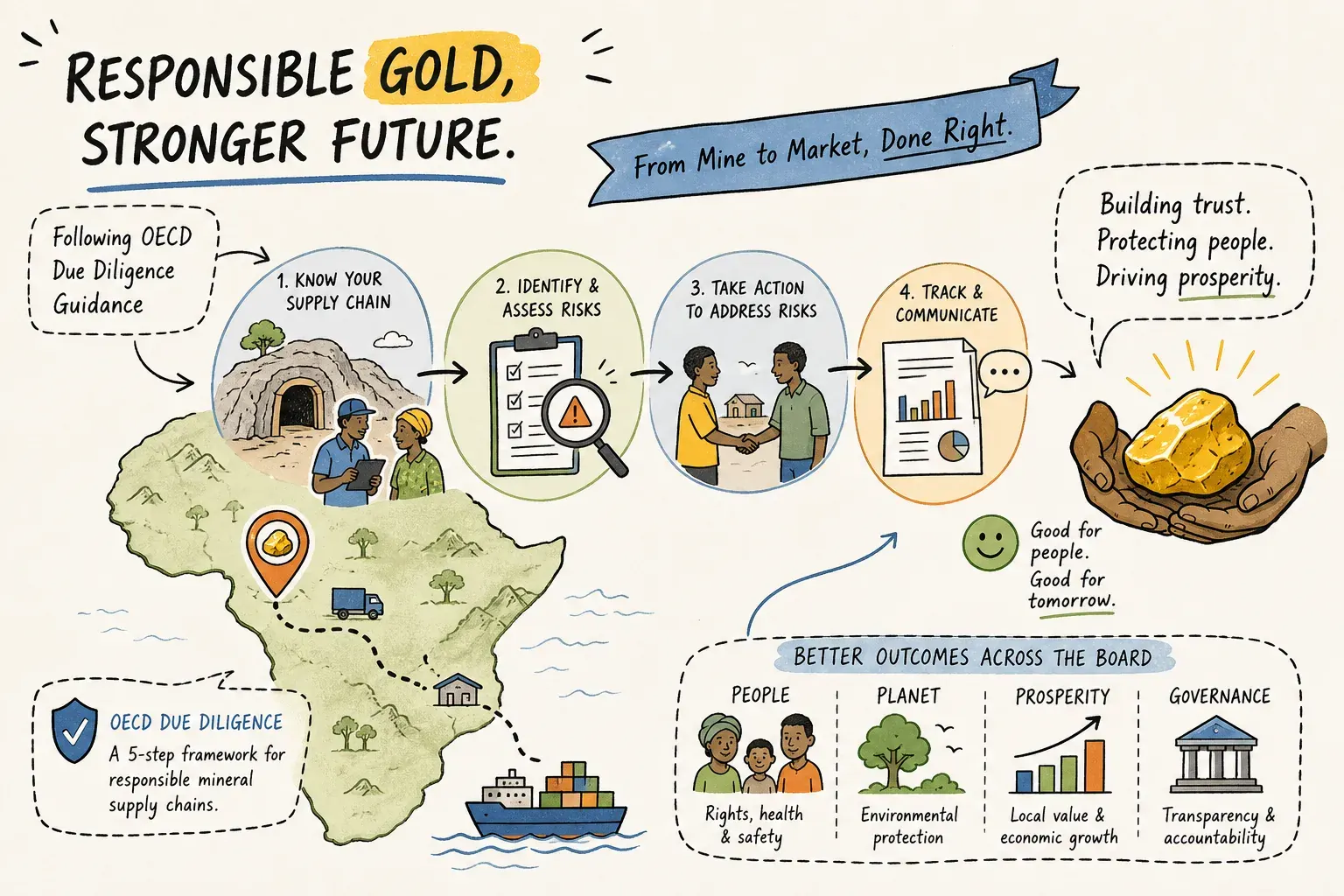
OECD due diligence guidance for African gold supply chains sets a clear compliance test for any company sourcing gold from the continent: can you demonstrate, step by step, that your supply chain meets the standard for responsible mineral sourcing? If you can't, buyers, regulators, and ESG auditors won't take your word for it. The OECD Due Diligence Guidance for Responsible Supply Chains of Minerals from Conflict-Affected and High-Risk Areas has become the global benchmark that refiners, downstream manufacturers, and compliance teams measure African gold against. That benchmark creates real, practical obligations well before gold reaches a vault or a fabrication floor.
This article walks through the OECD five-step framework as it applies specifically to African gold: what each step demands, which regions trigger enhanced scrutiny, what red flags look like in practice, and what documentation you need to produce at every stage. A key part of that documentation is independent laboratory verification of gold composition, something that shapes the risk-response decisions at the heart of this framework. By the end, you'll have a clear structure for mapping your own supply chain and building a compliance checklist that holds up under audit. What the OECD due diligence guidance actually covers The OECD Due Diligence Guidance is not a ban on African gold, and it's not a simple checklist you tick through once a year.
It is a structured, risk-based management process that applies across the entire mineral supply chain, from miners and traders through processors, refiners, exporters, and downstream manufacturers who use gold as an input. If you touch the gold supply chain at any point, the framework applies to you at a level proportionate to your role and position. Annex II of the Guidance defines the categories of serious risk the framework targets: financial or material support for armed groups, human rights abuses, bribery and money laundering, and fraud in mineral origin documentation. (A direct reference to the OECD Due Diligence Guidance, Third Edition, Annex II, confirms these categories.) These aren't abstract concerns in the African gold trade. They represent specific, documented patterns of harm that major buyers and regulators have consistently identified in sourcing regions across Central and West Africa.
One distinction that matters commercially is the intersection with regional law. The EU Conflict Minerals Regulation (2017/821) legally mandates OECD-aligned due diligence for covered EU importers of gold and other 3TG minerals, which means the framework is not merely a voluntary best-practice standard for companies selling into European markets, it is a binding legal obligation. US-based importers and investors aren't directly covered by the EU regulation, but major refiners and downstream buyers globally have built their supplier codes around OECD-aligned requirements regardless of legal jurisdiction. In commercial practice, the framework functions as a de facto requirement for any serious market participant.
OECD due diligence guidance for African gold supply chains: the five-step framework Step 1 requires companies to adopt and publicly communicate a gold supply-chain policy, assign internal ownership of due diligence, set up a chain-of-custody or traceability system, and build a supplier grievance mechanism. For African gold specifically, this means establishing clear chain-of-custody controls and credible origin evidence before accepting provenance claims or finalizing purchases. A policy that says "we source responsibly" without specifying traceability controls, supplier vetting criteria, and a named internal owner is not a Step 1 policy, it's a statement of intent with no compliance weight. Step 2: Mapping and assessing supply chain risk Step 2 is where you map and assess where risks actually exist in your chain.
For African gold, that means evaluating your sourcing region against known conflict-affected and high-risk area (CAHRA) designations, checking supplier relationships for proximity to armed actors, and flagging documentation gaps in the origin record. The OECD Gold Supplement directs companies to gather first-hand and credible evidence on origin and transport, reviewing supplier KYC information, inspecting shipment declarations, and confirming that declared gold volumes are consistent with the known output capacity of the named source area. Step 3: Responding to identified risks Step 3 is where many companies stall. The framework requires a formal response to identified risks: continue, suspend, or disengage from the supplier, depending on severity, with measurable improvement timelines documented in writing for any continuation decision.
Certified analytical documentation becomes critical at this stage, legally and commercially. A company cannot assess or defend a risk response if it cannot verify what it is actually buying. That is why independent assay laboratories are woven directly into Step 3 compliance workflows. Certified test reports using fire assay and XRF spectrometry, confirming gold composition, fineness, and purity, form part of the risk-assessment evidence package submitted to senior management and kept on file for audit.
Bilex Minerals EA provides this service from its Nairobi and Dar es Salaam laboratories, generating chain-of-custody-linked documentation for inclusion in a responsible sourcing file. Without a certified, third-party assay report, a company's Step 3 documentation relies on the seller's representation alone, a position that OECD guidance and most major refinery buyer requirements do not treat as independent verification. Steps 4 and 5: Audit and public reporting Steps 4 and 5 close the loop. Step 4 requires independent third-party audits at identified high-risk points in the supply chain, audits of suppliers, aggregators, and processing points, not just internal process reviews.
Step 5 is the annual public disclosure: how the company identified suppliers, what risks it found, what actions it took, and what it will do differently next year. Increasingly, this annual reporting is cross-checked against the chain-of-custody and assay records a company maintained throughout the year, so the quality of your upstream documentation directly affects the credibility of your public report. Which African regions trigger enhanced due diligence Not all African gold is conflict gold. That assumption is both factually wrong and commercially damaging, because it drives buyers away from legitimate, well-documented supply chains.
The accurate picture is more specific, and understanding it is essential for calibrating your due diligence proportionately. The countries most consistently classified as CAHRAs for gold are the Democratic Republic of Congo (DRC), Central African Republic (CAR), Sudan (particularly North Darfur and South Kordofan), and South Sudan. Within these countries, risk is driven by armed group control of mining sites, government-linked extortion at transit checkpoints, and documented smuggling of gold through informal channels. Ethiopia's Oromia and Benishangul-Gumuz regions and West Africa's Sahel belt, especially Burkina Faso and Mali, are also consistently treated as elevated-risk sourcing environments.
In these areas, armed groups and governments compete for control of artisanal and small-scale mining sites. A separate category of risk applies to transit and consolidation countries. Uganda, Rwanda, Kenya, Burundi, Tanzania, Chad, and Cameroon appear frequently in due diligence frameworks not as primary conflict sources but as points where gold originating in higher-risk zones is consolidated, re-labeled, or re-exported into apparently clean supply chains. Sourcing from these countries does not automatically indicate conflict gold, but the OECD framework requires companies sourcing from these transit points to trace gold upstream to its extraction origin.
Re-labeled or re-exported conflict gold entering clean supply chains at transit points is a pattern that compliance auditors flag regularly during supplier reviews, documented in NGO analyses and industry audit reports covering the Great Lakes region. Red flags and documentation gaps that signal real risk Applying Step 2 risk identification in practice means knowing what to look for when you review supplier documentation. Vague or unverifiable mine-of-origin claims are the most common warning sign: a supplier who can name only a country, not a region, sub-region, or mine site, is providing information that cannot be independently verified. Inconsistencies between declared gold volume and the known output capacity of the named source area are another reliable indicator, as are tax, royalty, or export-fee receipts that don't align with official government records for the declared origin region.
An unusual number of intermediaries between the mine and the point of first sale is also worth scrutinizing, particularly in known transit corridors. Each additional intermediary creates another point where documentation can be altered, re-attributed, or lost entirely. The OECD framework does not prohibit multi-intermediary chains, but it does require traceability evidence spanning the entire chain from extraction to purchase, not just the final transaction. A complete, compliant due-diligence file at Step 3 should include the following components: A completed supplier KYC and due-diligence questionnaire with verifiable supporting documentation Chain-of-custody records tracing the gold from extraction site to point of sale Tax and royalty payment receipts aligned to official government schedules for the declared origin region A certified independent assay report confirming gold composition and fineness from an accredited third-party laboratory A signed supplier declaration aligned to the company's sourcing policy Buyers, refineries, and EU importers increasingly specify that assay reports must come from an accredited, independent third-party laboratory, not from the seller's in-house testing operation.
For example, the LBMA Responsible Gold Guidance and major refiner supplier codes explicitly require independent verification as a condition of responsible sourcing acceptance. The reason is straightforward: a seller's own test result carries an inherent conflict of interest that no compliance auditor can treat as independent verification. Traceability tools and building your compliance checklist Several digital traceability platforms have documented deployments in Africa. GoldChain has been piloted in Ghana for blockchain-based supply-chain traceability, focusing on combating smuggling and supporting legitimate artisanal mining. Minespider has partnered with cooperatives in the DRC to track conflict-free artisanal gold from mine to smelting facility using handheld capture devices and blockchain-stamped custody events, with further applications documented in South Africa.
In Burkina Faso and Ghana, the Minexx platform has supported the export of blockchain-tracked gold and worked toward CRAFT Code alignment, details available in Minexx's published project documentation. The certification and audit frameworks that major refiners and buyers check compliance against include the LBMA Responsible Gold Guidance, the World Gold Council Responsible Gold Mining Principles, and the Responsible Jewellery Council Chain of Custody certification. All three are built on the OECD five-step logic, so demonstrating alignment with any of them simultaneously advances your OECD compliance position. No single platform solves the full due diligence requirement on its own: platforms capture custody data, but the OECD framework also requires companies to assess, respond, audit, and report.
Technology is a supporting tool, not a substitute for the framework. A practical OECD-aligned compliance checklist for African gold maps each step to specific action items: Step 1: Publish a supply-chain policy; assign named internal ownership; include due diligence clauses in all supplier contracts Step 2: Complete a risk mapping of sourcing regions against current CAHRA designations; run supplier KYC questionnaires; flag all Annex II red flags in writing Step 3: Obtain certified independent assay reports for all gold batches; document the risk-response decision with supporting evidence; set improvement timelines in writing for any continuation decision Step 4: Schedule third-party supply-chain audits at identified high-risk nodes, not just internal process reviews Step 5: Compile and publish an annual due diligence report covering each step's outcomes, referencing the chain-of-custody and assay records maintained throughout the year Assembling a defensible compliance file The OECD due diligence guidance for African gold supply chains is a structured, evidence-based process running from internal policy through to public annual reporting. Every step requires documentation that can be verified by an independent party. The five steps are not parallel tasks you can complete in any order, they build on each other, and a weakness at any one step invalidates the credibility of the entire compliance file.
The most common gap companies discover when they first run this process is at Step 3: they have risk assessments, but they lack the certified, independent analytical evidence to support the risk-response decisions recorded in those assessments. That is exactly where a third-party assay laboratory matters. A laboratory with no commercial interest in the gold under review eliminates the conflict-of-interest problem that makes seller-provided test results unacceptable under both OECD guidance and major buyer requirements. Bilex Minerals EA's Nairobi and Dar es Salaam operations are structured on that basis, providing fire assay and XRF-based certified test reports that generate independently verified, chain-of-custody-linked documentation for inclusion in a responsible sourcing file.
If you are building or reviewing a due diligence program for African gold, start with the five-step structure above, map your existing documentation against each step, and identify where your evidence chain breaks down. The gaps you find are exactly where to focus first. A supply chain that can answer every stage of the OECD due diligence guidance for African gold supply chains with verifiable documentation is one that can withstand scrutiny from any buyer, auditor, or regulator who asks.
Keep the answer within its proper scope.
Can this article replace transaction-specific professional advice?
No. It is educational. Confirm current legal, customs, tax, regulatory, technical, and commercial requirements with the responsible authorities and appropriately qualified advisers.
Does an assay approve the wider gold transaction?
No. An assay describes the submitted sample under the stated method. Ownership, origin, seller authority, payment, export, import, sanctions, and logistics require separate checks.
What should I verify before relying on a document or result?
Verify the issuer, scope, date, reference, sample or shipment identity, units, validity, and direct connection to the current parties and material.
Official and primary sources