
Focused resource · Responsible Sourcing
Artisanal Gold Mining in Africa: Challenges, Scale, and Solutions
A balanced view of livelihoods, informality, mercury, safety, environment, market access, formalisation, and responsible buyer engagement.
11 min read · Knowledge Centre resource
Direct answer
Artisanal and small-scale gold mining supports many livelihoods while presenting serious safety, environmental, governance, and market-access challenges that require practical, inclusive responses.
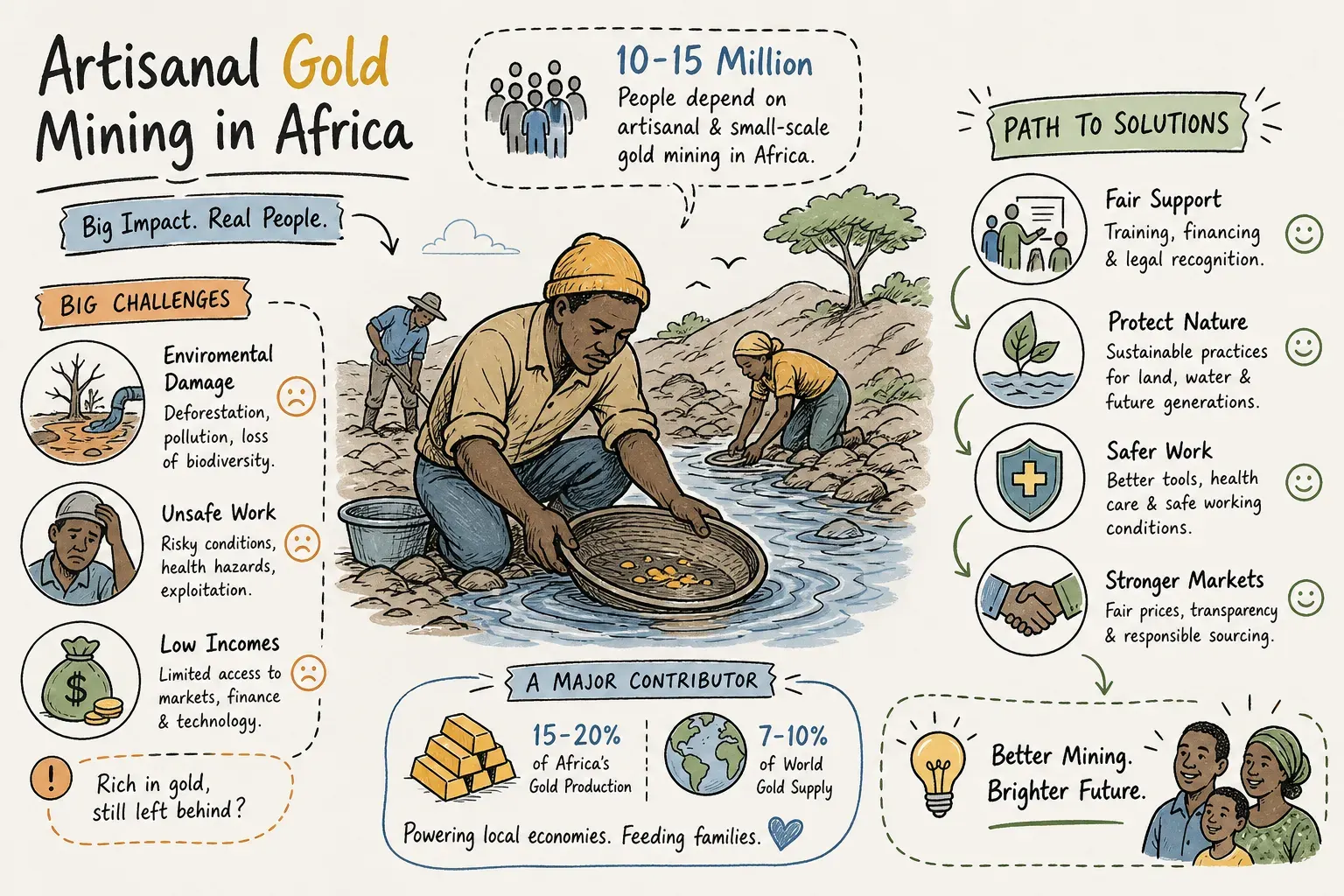
Artisanal gold in Africa represents one of the most consequential and least formally documented industries on the planet. Artisanal and small-scale gold mining employs an estimated 10 million people across sub-Saharan Africa and contributes roughly 20% of global gold production. Yet most of that gold never enters a formal, documented trade channel. An industry of this scale, operating this far outside legal frameworks, is not just an environmental or social problem.
It is fundamentally a documentation and verification problem, and the gap between the pit and the legitimate market runs directly through the absence of certified, independent records. In countries like Kenya and Tanzania, a growing number of artisanal miners are starting to close that gap. They are getting licensed, engaging independent laboratories, and presenting certified assay results to buyers who would otherwise have no way to distinguish legally extracted gold from material that moved through illicit hands. That shift, still modest in scale, points toward the clearest path forward available in artisanal gold mining across Africa today.
How much gold artisanal miners produce across Africa, and why the numbers are hard to pin down The scale of artisanal gold mining in Africa West Africa and the Sahel dominate artisanal gold production on the continent. Ghana, Mali, Burkina Faso, Côte d'Ivoire, Guinea, and their neighbors sit on some of the world's most productive gold belts, and informal mining follows those belts into nearly every country in the region. The Sudan-Chad-Niger-Mali corridor has expanded significantly over the past decade, adding substantial but poorly quantified output to already uncertain continental totals. At the continental level, artisanal and small-scale mining (ASM) is active in at least 40 of Africa's 54 countries, with East Africa, particularly Tanzania, representing a smaller but strategically important piece of the picture.
The production figures that do exist are striking. Ghana's artisanal sector accounts for roughly 35% of national gold output. In Burkina Faso, an estimated one million miners produce approximately half the country's gold. The Sahel belt alone is estimated to produce between 15 and 85 tonnes per year.
These are not marginal numbers. They represent a major, functioning industry whose output flows primarily through channels that generate no tax receipts, no assay documentation, and no chain-of-custody records that buyers or regulators can rely on. The core problem is not a lack of gold. It is a near-total lack of documentation.
Roughly 72% to 80% of artisanal gold production across Africa is undeclared, and sector analysts estimate the share operating entirely outside formal legal frameworks may be as high as 85%. When production of this scale is invisible to formal trade systems, the consequences reach far beyond the mine site. What working conditions and daily risks actually look like at artisanal mine sites Environmental and health hazards on the ground Mercury is the most pervasive hazard in African artisanal gold mining. It is used to amalgamate gold from ore, and it is released into soil, water, and air in quantities that accumulate across entire watersheds.
Untreated mine tailings in West Africa have been recorded at 901.5 mg/kg of mercury. In Ghana, sediment mercury exceeded guideline values in 64% of sampled sites, while arsenic exceeded limits in 67% of water samples, cadmium in 17%, and lead in 24%. These are not isolated incidents. They reflect a baseline condition across much of the continent's artisanal gold mining sector.
Beyond mercury, artisanal mining sites commonly involve the removal of topsoil and forest cover, the destruction of adjacent farmland, and open pits that persist long after miners move on. Health effects include respiratory illness from dust and smoke, skin conditions from direct contact with contaminated soil and water, and the cumulative effects of heavy-metal exposure over years or decades. For communities near active sites, the mine does not just change the landscape. It changes the water, the air, and the long-term viability of the land.
The documentation gap starts at the pit itself. Most artisanal miners have no formal record of what they extracted, what it weighed, or what its gold content is. Without a chain-of-custody document, a sample prep record, or a certified assay result, the gold a miner brings to market looks legally indistinguishable from smuggled material. This is not a failure of individual discipline.
It is a structural feature of a sector that has operated informally for generations, without the infrastructure that makes documentation possible. How informality connects artisanal gold to illegal trade and armed-group financing Illicit networks and the compliance burden on buyers In the Democratic Republic of Congo, an estimated 80 to 98% of artisanal gold is smuggled out of the country. In the Sahel, Islamist militant groups have developed growing involvement in artisanal mining operations, using mine sites and trade routes as revenue sources in regions where formal state presence is limited. In the Central African Republic, armed groups including 3R, UPC, and MPC control mine sites directly, taxing gold trade as a primary funding mechanism.
These are not peripheral examples. They represent a well-documented pattern across some of the continent's most productive artisanal gold regions. Corruption compounds the problem at every level. Falsified export permits, bribed officials, and organized crime networks create trade corridors that move gold from informal mines to international refiners without generating the documentation those refiners are increasingly required to have.
The illicit and the legitimate become difficult to separate not because buyers don't care, but because the evidence needed to separate them was never created. The downstream compliance consequences are real for buyers and refiners. US buyers face Dodd-Frank conflict minerals requirements and anti-money-laundering obligations. European refiners must demonstrate OECD-aligned due diligence.
When artisanal gold supply from Africa moves through informal channels without documentation, satisfying responsible-sourcing requirements at the refinery or import stage becomes nearly impossible. The absence of assay documentation at origin is not just a miner's problem. It is a buyer's compliance problem, and it becomes a legal exposure when the source cannot be verified. Formalization programs: what the evidence actually shows Formalizing artisanal gold mining in Africa Tanzania's licensing reforms offer the clearest evidence that formalization works when bureaucratic barriers are reduced.
The country cut the time required to obtain a Primary Mining Licence from 18 months to 2 months, digitized the mineral cadastre, and saw licensed miners grow from 4,000 to 35,000. Artisanal and small-scale gold mining's share of national output rose from 10% in 2012 to 30% in 2020. Those numbers represent a genuine sector-wide shift, not a pilot program outcome. When the legal path becomes accessible, miners take it.
Other certification and responsible-sourcing frameworks, including Fairmined, Fairtrade Gold, the CRAFT Code, the LBMA Responsible Gold Guidance, and the ICGLR Regional Certification Mechanism, each address different points in the supply chain. The CRAFT Code, now aligned with OECD Due Diligence Guidance and recognized by the Responsible Minerals Initiative, is being implemented across West Africa to help miners bridge the gap between informal production and formal market requirements. Traceability pilots in eastern DRC, including programs implemented under the iTSCi framework, have shown that when cooperative support and independent audits are paired together, artisanal gold can be made documentably legitimate. The consistent bottleneck across all of these schemes is market access and documentation capacity.
Artisanal gold producers across Africa often struggle to meet the chain-of-custody, audit, and documentation costs that sustained participation requires. Certification is useful. It is not sufficient on its own, and it does not replace the foundational step of knowing, in a verifiable way, exactly what purity of gold is actually being sold. Why independent assaying is the step most artisanal miners skip, and why it matters The role of certified assaying in responsible artisanal gold supply from Africa A certified assay report, produced by an independent third-party laboratory using fire assay or XRF spectrometry, documents the purity and composition of a gold sample in a form accepted by refiners, buyers, and export authorities.
It separates the miner's material from undocumented gold in the market and gives a buyer a defensible basis for pricing and due diligence. Without it, even legally extracted gold from a licensed artisanal miner is difficult to sell into formal trade channels, because no verifiable purity record is attached to it. In Kenya and Tanzania, where formalization frameworks are more developed than in much of West Africa, artisanal miners increasingly have access to independent assay laboratories. Bilex Minerals EA operates from Nairobi and Dar es Salaam specifically to serve this need. Miners bring samples, receive certified fire assay or XRF results, and leave with documentation they can present to buyers or attach to export applications.
The laboratory holds no commercial interest in the gold being tested, which means the results carry the independence that buyers and regulators require. For a miner who has completed Tanzania's licensing process and needs to complete a legal sale, the certified assay result is the final piece that makes the transaction legitimate, and often the piece that first-time participants in formal markets don't know they need until a buyer asks for it. The value of independent assaying extends well beyond the individual miner's transaction. When a laboratory with no stake in the outcome produces a certified result, it creates a document that buyers, refiners, and regulators can trust.
That trust is what allows artisanal gold in Africa to move from informal local sale into legitimate international trade, the mechanism that connects the licensing framework to actual market access. Building a responsible artisanal gold supply chain: what buyers, governments, and NGOs need to prioritize Practical steps for sourcing artisanal gold responsibly from Africa Buyers sourcing artisanal gold from Africa should require, at minimum, three documents: a certified assay report from an independent laboratory, evidence of the miner's licensing status, and a chain-of-custody record from site to point of sale. These three documents, taken together, create a defensible due-diligence paper trail for OECD guidance and AML compliance. Requiring them also creates market incentives for miners to formalize, because buyers who ask for documentation generate demand for the services that produce it.
Governments have the clearest lever available: simplified licensing combined with accessible testing infrastructure. The Tanzania example demonstrates that reducing bureaucratic barriers moves tens of thousands of miners into formal status within years, not decades. But formalization without a credible assay infrastructure is incomplete. Miners who get licensed but cannot access affordable, independent testing will continue to sell informally to buyers who don't ask for documentation.
The licensing reform and the laboratory access need to be built in parallel, not sequentially. NGOs and development programs working on responsible artisanal gold mining in Africa should include laboratory access and documentation support alongside standard training and finance components. The CRAFT Code's approach of helping miners progressively meet due-diligence requirements, paired with field-level technical assistance, points in the right direction. But that progression stalls at the documentation step if miners have nowhere to get a credible, independent assay result.
Building that infrastructure in East Africa, where the regulatory environment is already more developed, is where investment has the clearest chance of producing measurable outcomes. Artisanal gold in Africa: the path forward is known Artisanal gold mining in Africa is not a marginal activity. It is a sector of continental economic significance, employing millions of people and producing a substantial share of global gold supply. The problems are real: environmental damage, persistent health risks, documentation gaps, and exposure to illicit trade networks that complicate responsible sourcing at every point downstream.
The path forward is clearer than the scale of those problems might suggest. Formalization works when barriers are genuinely reduced, as Tanzania's experience proves. Certification schemes work when they are paired with field support and market access. Independent assaying, accessible today for artisanal miners in Kenya, Tanzania, and beyond, is the practical step that connects a licensed miner to a legal buyer.
For anyone sourcing artisanal gold from Africa, working with artisanal mining communities, or evaluating supply chains for compliance purposes, the question that matters most is the same one every assayer starts with: do you know exactly what you have, and do you have a document that proves it? Responsible sourcing of artisanal gold from Africa starts with that answer. Bilex Minerals EA provides the independent testing, certified documentation, and export support that makes that answer possible, serving miners, buyers, and compliance teams across East Africa from laboratories in Nairobi and Dar es Salaam.
Keep the answer within its proper scope.
Can this article replace transaction-specific professional advice?
No. It is educational. Confirm current legal, customs, tax, regulatory, technical, and commercial requirements with the responsible authorities and appropriately qualified advisers.
Does an assay approve the wider gold transaction?
No. An assay describes the submitted sample under the stated method. Ownership, origin, seller authority, payment, export, import, sanctions, and logistics require separate checks.
What should I verify before relying on a document or result?
Verify the issuer, scope, date, reference, sample or shipment identity, units, validity, and direct connection to the current parties and material.
Official and primary sources