
Focused resource · Responsible Sourcing
Conflict-Free Gold Sourcing: What Buyers Need to Know
How buyers can use risk-based due diligence to examine source, route, counterparties, human-rights concerns, payments, and supplier controls.
11 min read · Knowledge Centre resource
Direct answer
Responsible sourcing requires an ongoing, documented process to identify and respond to supply-chain risks. A conflict-free label or assay result alone is not enough.
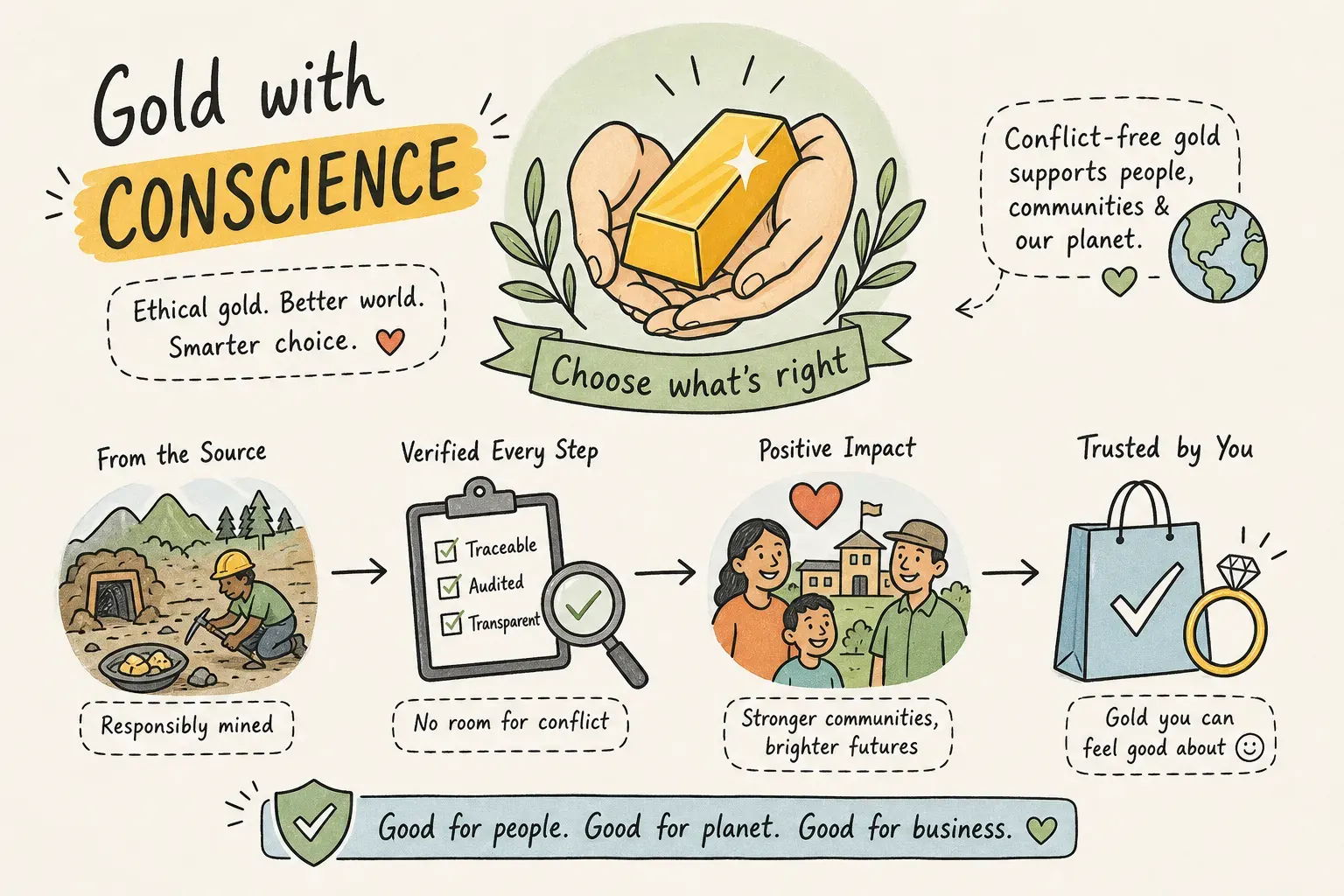
Conflict free gold sourcing requires more than a supplier declaration or a label on the packaging, it carries specific legal obligations, internationally recognized due diligence frameworks, and a documentation trail that regulators and auditors will scrutinize. "Conflict-free" has become a checkbox on a supplier intake form rather than a standard anyone actually verifies. It is not sufficient. This article breaks down exactly what the standard requires, where your legal exposure sits, and what a credible verification process looks like from start to finish.
The stakes are real and growing. U.S. import regulators, institutional buyers, and ESG auditors have sharpened their expectations around what "verified" actually means, a shift reflected in tightened LBMA assurance requirements and evolving FinCEN guidance on precious metals transactions. Suppliers who cannot produce the right documents, from the right parties, covering the right chain of custody, are getting flagged. Understanding the framework before you engage a supplier is far less costly than trying to retrofit compliance after a transaction is already in motion.
What "conflict-free" actually means for gold Under responsible mineral sourcing frameworks, gold qualifies as conflict-free when it demonstrably does not finance or benefit armed groups involved in unlawful conflict, and when its extraction and trade do not involve serious human rights abuses or breaches of international humanitarian law. A supplier saying so does not satisfy that standard. Documented proof across the supply chain, from the mine to the point of sale, is required. The World Gold Council Conflict-Free Gold Standard operationalizes the OECD Due Diligence Guidance specifically for gold producers.
It is structured across five assessment areas: conflict assessment, company assessment, commodity assessment, externally sourced gold assessment, and a formal management statement of conformance. Companies must publicly commit to not supporting unlawful armed conflict, conduct human rights due diligence, control how mine security providers operate, and apply risk-based checks on any third-party miners supplying material. Conformance also requires independent external assurance on public reporting, not just internal sign-off. The distinction between a marketing claim and a documented position matters because auditors and regulators treat them differently.
A claim is a starting point for inquiry. A documented position, supported by assay certificates, chain-of-custody records, and licensed export documentation, is the outcome of a verifiable process. Buyers who conflate the two expose themselves to both regulatory risk and reputational liability. The regulatory framework every buyer needs to understand Dodd-Frank Section 1502 applies to SEC registrants that use conflict minerals, including gold, in manufactured products.
If your company is publicly traded in the U.S. and your products contain gold that may have originated from the Democratic Republic of Congo or adjoining countries, you carry annual disclosure obligations under Form SD. This includes describing due diligence measures, the facilities used to process the mineral, and, where the gold is not DRC conflict-free, an independent private-sector audit of your report. If you are a physical gold buyer, bullion trader, or importer who is not an SEC registrant, Section 1502 does not create a direct filing obligation. However, it shapes what your downstream customers and partners will demand from you.
The more pressing federal obligations for most physical buyers come from the Bank Secrecy Act: if your annual purchases and sales of precious metals exceed $50,000, FinCEN guidance requires a written anti-money-laundering program, sanctions screening against the U.S. Treasury SDN list, and IRS Form 8300 filings on cash transactions over $10,000. The OECD Due Diligence Guidance for Responsible Supply Chains of Minerals from Conflict-Affected and High-Risk Areas serves as the global benchmark that most international buyers, refiners, and certification bodies use to assess sourcing practices. Regions like East Africa, including parts of Kenya, Tanzania, and neighboring countries, can qualify as high-risk areas depending on local mining conditions.
Sourcing from these regions triggers enhanced due diligence requirements, not a blanket prohibition. The OECD framework makes clear that responsible sourcing and commercial engagement are not mutually exclusive; they require more rigorous process. Conflict-free gold sourcing: how OECD due diligence works in practice The OECD framework runs across five steps. Steps one and two focus on building internal infrastructure before you approach any supplier.
Step one requires a written supply-chain policy aligned with the OECD model, clear internal accountability for due diligence, traceability controls, and a grievance mechanism that suppliers and stakeholders can use. Without this foundational system in place, the rest of the process has nothing to anchor it. Step two requires mapping the actual factual circumstances of how the gold moves: where it is mined, who handles transport, who processes it, and where red flags appear. For artisanal and small-scale mining (ASM) gold from East Africa, this mapping step is a common gap.
Many buyers can confirm the country of origin but not the mine site, the trading intermediary, or the transport route, each of which carries a distinct risk profile under OECD guidance. Industry traceability audits and OECD field assessments have consistently identified upstream chain-of-custody documentation as the weakest link in ASM supply chains across the region. Steps three through five address what happens once risks are identified. Step three requires a written mitigation plan with timelines and active supplier engagement.
Buyers retain the option to continue sourcing during mitigation only if risks can be managed within a reasonable period. Step four requires independent third-party audits at key control points; for gold, the OECD gold supplement identifies the refiner as a primary audit focus, with upstream documentation expected to support that audit. Step five is public annual reporting on due diligence activity. These five steps mean that conflict-free gold sourcing is an ongoing, documented process, not a one-time vetting exercise.
The documentation trail that proves responsible sourcing A credible conflict-free sourcing record is built from a specific set of documents, not from supplier assurances. The core documentation includes a signed supplier declaration of origin and conflict-free status, chain-of-custody records covering transport and handling from mine to point of sale, export licenses and mineral export certificates from the source country, and an independently produced assay certificate confirming the gold's purity, weight, and composition. Each document serves a different evidentiary function, and regulators will check whether the set is complete. Assay certificates: what they prove and what they don't An independent assay certificate is a critical anchor in the documentation chain, it verifies the gold's purity, weight, and composition with a credibility that no seller-issued document can match.
It is produced by a laboratory with no commercial interest in the transaction, which is what gives it standing with refiners, auditors, and import regulators. That said, an assay certificate establishes the identity and quality of the metal; provenance and chain-of-custody must be established through parallel documentation including export licenses, origin declarations, and transport records. For gold moving through East Africa, this means engaging a laboratory operating locally, with the technical capability to produce results under internationally accepted methods such as fire assay (cupellation) and XRF spectrometry. Bilex Minerals EA, operating from Nairobi and Dar es Salaam, provides exactly this function: third-party assay reports produced by a lab that holds no stake in the transaction, alongside licensed mineral export documentation support from within the same supply chain jurisdiction.
That combination, verified purity plus documented export compliance from an independent source, is what turns a supplier's claim into a defensible sourcing record that regulators and downstream buyers can rely on. Kenya and Tanzania export documentation requirements Gold exported from Kenya requires a mineral export license issued by the relevant mineral authority, a certificate of origin, a certified assay report, an export declaration filed with customs, and supporting commercial documentation, requirements grounded in Kenya's Mining Act and associated mineral export regulations. Tanzania maintains its own export licensing and certification framework under the Mining Act 2010 and subsequent regulations; buyers sourcing from Tanzania should verify current document requirements directly against Tanzanian Ministry of Minerals guidance, as specific requirements may differ from Kenya's. These documents are not interchangeable with lab results produced by a buyer-appointed tester or a seller's in-house certificate.
Regulators and international buyers distinguish between documentation produced by an independent, licensed third party and documentation produced by parties with a financial interest in the deal. How to verify supplier certifications before you buy LBMA Good Delivery refiners are subject to annual independent assurance of their responsible sourcing practices under the LBMA Responsible Gold Guidance, itself built on the OECD framework. The assurance covers governance and policies, supply-chain due diligence, incoming material scope, counterparty and supplier checks, and compliance report disclosures, verified against underlying records by an approved independent auditor applying ISAE 3000 or ISO 19011 standards. RJC Chain-of-Custody certification covers whether precious metals in a supply chain meet conflict-free and responsible-sourcing requirements; LBMA and RJC have established mutual cross-recognition for gold refiner audits, though buyers should confirm the current scope of that recognition with the issuing bodies.
If your refinery supplier holds one of these credentials, verify the currency of the certification directly with the issuing body before relying on it. Listings can go out of date, and an expired certification provides no regulatory cover. Certification status is a baseline, not a substitute for your own due diligence file on the upstream supply chain. Not every supplier gap is a disqualifier, but some are.
Red flags that align with OECD guidance include: inability to identify the mine or mining region of origin, absence of any chain-of-custody documentation, assay results produced only by the seller's own facility or a lab affiliated with the seller, no verifiable export license from the source country, and pricing that sits materially below market without explanation. Any one of these warrants further inquiry. Several together warrant walking away. A practical conflict-free sourcing checklist for East African gold Before signing any purchase agreement, run through the following verification steps.
Skipping them creates documentation gaps that are difficult to close after a transaction is complete. Confirm the country and region of mine origin in writing, including the mine site name or concession reference where available. Request the supplier's OECD-aligned supply-chain policy or equivalent due diligence documentation. Verify that the refiner in the chain holds current LBMA Good Delivery or RJC Chain-of-Custody status, confirmed directly with the issuing body.
Confirm that an independent third-party assay certificate exists for the specific lot, produced by a lab with no financial interest in the transaction. Screen the supplier and all identified intermediaries against the U.S. Treasury OFAC SDN list before any funds move, consistent with FinCEN guidance on precious metals sanctions compliance. At the point of transaction, collect the mineral export license and certified assay report from the source country and retain all chain-of-custody records as part of your internal due diligence file.
File IRS Form 8300 if cash in the transaction exceeds $10,000. Document your review steps and decisions in writing, regulators and auditors will want to see the process, not just the outcome. Build your sourcing record before you need to defend it Conflict-free gold sourcing is not a status a supplier grants you by saying the right things. It is a documented, verifiable position that your company builds through a defined due diligence process, specific paperwork, and independent verification at critical points in the supply chain.
For buyers sourcing from East Africa, that process starts with three core elements: a certified assay report from an independent lab, a complete export documentation file from the source country, and a supplier who can account for the gold's path from ground to transaction. Those three elements form the foundation. The regulatory filings, the certification checks, and the OECD steps all build on top of them. Getting responsible gold sourcing right is less about the size or sophistication of your operation and more about treating documentation as evidence, and engaging independent verification at the right points in the chain before a question becomes a problem.
If you are sourcing gold from East Africa and need certified third-party assay results and licensed export documentation from a single independent source, contact Bilex Minerals EA to schedule an appointment at our Nairobi or Dar es Salaam laboratory. A defensible sourcing record starts with a test result that no one can question.
Keep the answer within its proper scope.
Can this article replace transaction-specific professional advice?
No. It is educational. Confirm current legal, customs, tax, regulatory, technical, and commercial requirements with the responsible authorities and appropriately qualified advisers.
Does an assay approve the wider gold transaction?
No. An assay describes the submitted sample under the stated method. Ownership, origin, seller authority, payment, export, import, sanctions, and logistics require separate checks.
What should I verify before relying on a document or result?
Verify the issuer, scope, date, reference, sample or shipment identity, units, validity, and direct connection to the current parties and material.
Official and primary sources
Check current requirements directly.
Government-backed risk-based due diligence guidance for mineral supply chains.
LBMA Responsible Sourcing GuidanceCurrent responsible sourcing documents for Good Delivery refiners.
US SEC Conflict Minerals RuleOfficial overview of the disclosure rule implementing Section 1502 of the Dodd-Frank Act.