
Focused resource · Import Compliance
AML Compliance for US Gold Importers From Africa
A risk-based overview of customer due diligence, beneficial ownership, source of funds, transaction monitoring, sanctions, records, and import declarations.
12 min read · Knowledge Centre resource
Direct answer
US obligations depend on the importer, business model, product, counterparties, and activities. Importers should determine their legal status and build controls proportionate to the identified risk.
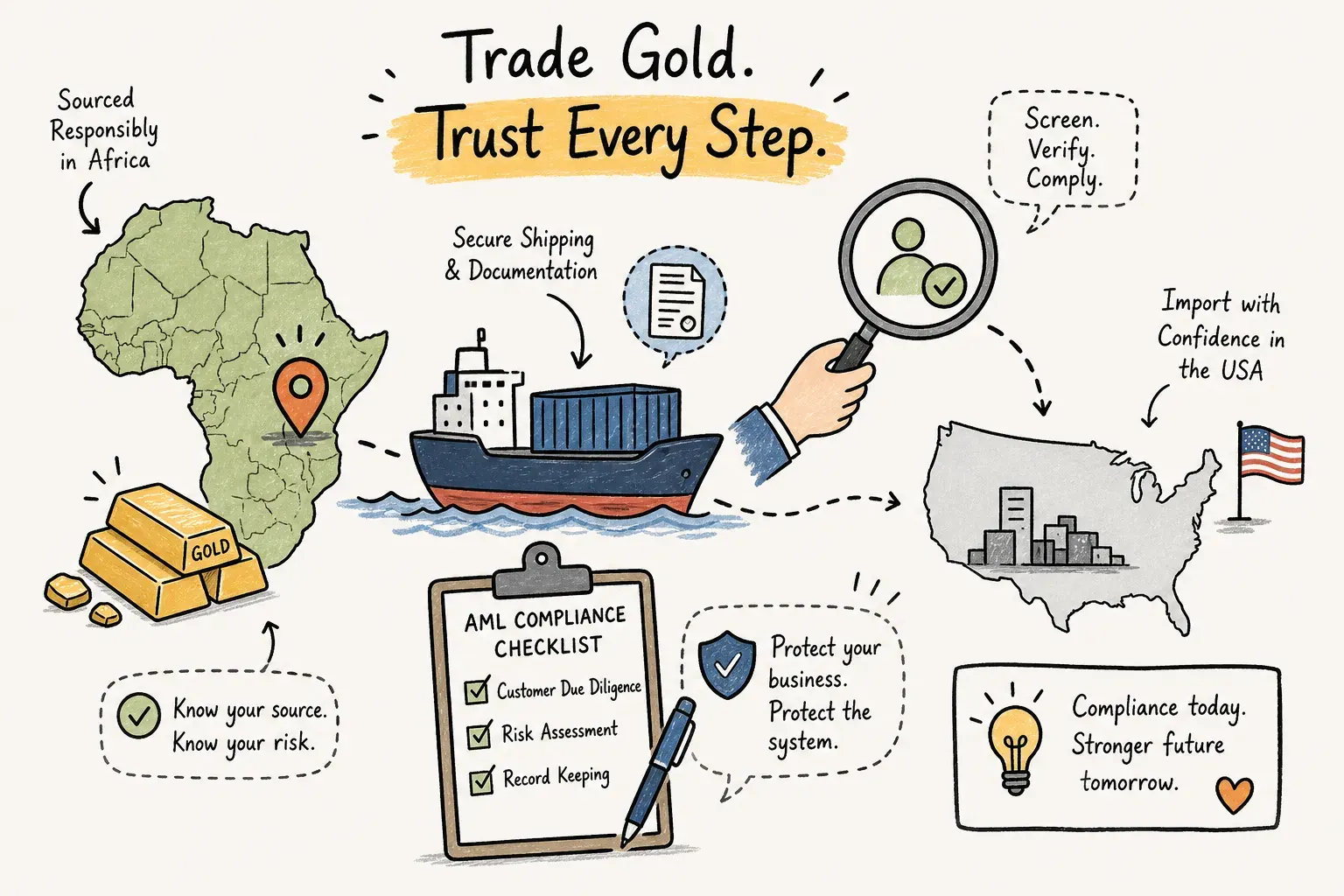
AML compliance requirements for US gold importers from Africa demand a complete, documented file built before the shipment ever arrives stateside. US companies importing gold from Africa are not operating in a grey zone, they are operating in a high-scrutiny sector that FinCEN, OFAC, and CBP all monitor closely. The US Government's Africa Gold Advisory makes exactly that point: African gold supply chains carry elevated money laundering, sanctions evasion, and conflict-financing risk, and regulators know it. A purchase order and a supplier invoice are not enough to protect your business.
What separates a defensible compliance posture from a regulatory liability is a thorough, cross-referenced AML file assembled before the gold moves. One overlooked piece of that file is the independent assay report: a document generated at the source that confirms the metal's purity, weight, and integrity. Accredited independent assay laboratories operating within East African supply chains produce exactly those reports for supply chains heading to international buyers. Bilex Minerals EA, based in Nairobi and Dar es Salaam, is one such laboratory, offering fire assay and XRF-based certified reports to US importers building defensible compliance files.
This guide breaks down every AML obligation you carry as a US importer of African gold and shows you how to meet each one. AML Compliance Requirements for US Gold Importers From Africa: Who Falls Under the Rules The first question to answer is whether these rules apply to your business. Most commercial importers will find they do, and the threshold is lower than many assume. The FinCEN Dealer Definition and the $50,000 Annual Threshold FinCEN's Bank Secrecy Act rules cover any business that purchases and sells "covered goods", which includes gold at 50% purity or greater, when annual purchases and sales each exceed $50,000.
Both conditions must be met: more than $50,000 purchased and more than $50,000 in gross proceeds from sales during the prior calendar or tax year. Many commercial importers may reach that threshold in a single shipment. The purity threshold means raw doré, refined bars, and semi-processed gold all qualify as covered goods. Why Foreign-Source Buyers Cannot Claim the Retailer Exemption There is a retailer exemption under FinCEN's framework, but it carries a hard boundary: it only protects businesses that buy exclusively from US-based suppliers who already maintain their own AML programs.
The moment you source from African miners, exporters, or trading companies, you are outside that exemption entirely. This is not a judgment call or a gray area. FinCEN's intent is to capture precisely the higher-risk scenarios that cross-border procurement from artisanal and small-scale mining regions creates, and importing from Africa places you squarely in that category. Key AML Compliance Requirements for US Gold Importers From Africa: Building a BSA-Compliant Program Confirming that you are covered is the starting point.
The harder task is constructing a program that actually satisfies the BSA standard, one calibrated to your specific supply chain risk, not a generic template pulled from the internet. The Four Required Program Pillars A compliant AML program for a precious metals dealer must contain four core elements. The first is a written policy document reasonably designed to prevent money laundering and terrorist financing. The second is a designated compliance officer with real authority and adequate resources to act on it.
The remaining two elements are operational: documented employee training on a regular cycle, and independent testing or audit of the program to verify it functions as designed. The phrase "reasonably designed" carries real weight, your program must reflect the actual risk profile of your supply chain, not a downloaded industry template. For African gold importers specifically, that means the program document must address cross-border sourcing risk by name. Calibrating Your Controls to African Gold Supply Chain Risk The Africa Gold Advisory is explicit: African gold supply chains require enhanced, ongoing due diligence, not routine onboarding checks.
Your written program should identify the specific high-risk indicators relevant to your sourcing countries: artisanal mining concentration, cash-heavy intermediary networks, and transit through high-risk jurisdictions. It should then describe the controls that address each of those indicators. A generic precious metals AML program that ignores geography will not survive a FinCEN examination. According to the Africa Gold Advisory and FinCEN exam guidance, examiners reviewing programs tied to African sourcing expect to see those geographic risk factors addressed directly and documented explicitly.
Know-Your-Supplier Due Diligence: The Process That Satisfies Regulators KYC for precious metals dealers means going well beyond a business name and an email address. FinCEN examiners and correspondent banks expect documented supplier verification that can withstand scrutiny. Beneficial Ownership and Supplier Identity Verification Start with the supplier entity: verify legal registration, registered address, named officers, and active license status using reliable, independent sources. Then go deeper to identify the actual beneficial owner, the individual who ultimately controls or profits from the sale.
Screen both the entity and the beneficial owner against OFAC's SDN list and relevant consolidated sanctions lists. Apply OFAC's 50% ownership rule: any entity owned 50% or more by a blocked person is treated as blocked, even if it does not appear on the list itself. Document every step of this verification in the transaction file before any payment moves. Mining Licenses, Certificates of Origin, and Chain-of-Custody Records Beyond counterparty identity, you must verify the supply chain itself.
Require a valid mining or export license from the originating country, a declared certificate of origin tied to the specific batch, and a chain-of-custody record tracing the gold from mine to your receiving warehouse. The OECD due diligence framework for responsible mineral supply chains is the accepted international standard for this process. Regulators and financial institutions increasingly expect mine-level documentation, not just exporter-level paperwork. For artisanal sourcing regions in Kenya, Tanzania, or the DRC, that expectation applies with particular force.
OFAC Sanctions Screening for African Gold: Running It Right Sanctions screening is not a checkbox. It is an ongoing, documented process that must cover every party in the transaction chain, every time. Which African Country Programs and SDN Categories Matter Most The active OFAC sanctions programs most relevant to AML compliance for US importers of African gold in 2026 include the DRC, Sudan, Central African Republic, South Sudan, Mali, Zimbabwe, and Libya. The DRC carries the most direct gold-specific exposure: OFAC has specifically designated actors connected to illicit mineral smuggling from eastern DRC, including networks tied to the Rwanda/DRC gold corridor and conflict-linked mineral trafficking.
Sudan carries similar natural-resource-linked trade risks. Gold described as "recycled" from any of these high-risk regions is a documented red flag in OFAC enforcement actions, and that descriptor alone should trigger enhanced review. Screening Frequency, Documentation, and the 50% Rule in Practice Screen every party in the transaction chain: supplier, exporter, freight forwarder, customs broker, and any beneficial owner or controlling individual. Run screening at onboarding and again before each shipment or payment, OFAC designations change frequently, and a counterparty who was clean at onboarding may appear on the SDN list months later.
Record the date of each screening, the tool used, the lists checked, and the outcome. If a potential match appears, document the analysis used to clear or escalate it, including an ownership chart or a written basis for any false-positive clearance. Per OFAC's compliance guidance, a screening record with no supporting analysis is nearly as problematic as no record at all. The Documentation Stack That Holds an AML Compliance File Together Every document in your compliance file should tell part of the same traceable story.
A disorganized collection of paperwork is not a compliance file; it is a liability waiting to be discovered. The Core Document Set Regulators and Financial Institutions Expect A defensible AML compliance file for a gold import from Africa should contain the following: Supplier KYC package: legal registration, beneficial ownership identification, and active license verification Certificate of origin tied to the specific batch or lot Chain-of-custody records from mine to export point Commercial invoice with lot-level detail and declared purity Export license from the originating country Transport documents such as the air waybill or equivalent carrier record CBP Form 7501 entry summary and Form 3461 or equivalent entry documentation OFAC screening records with dates, tools, and results documented Pre-shipment independent assay report confirming purity, weight, and composition Each document should be cross-referenced by lot number or shipment identifier so the file tells a coherent, traceable story from the mine to your warehouse. Why an Independent Assay Report Is the Evidentiary Anchor in Your File There is one document that ties the physical gold to every other piece of paperwork in the file: the pre-shipment assay report. It confirms the metal is exactly what the supplier claims in weight, purity, and composition.
Without it, your compliance file describes a transaction but cannot verify the product. With it, you have independent, third-party evidence that the gold meets the invoiced specifications. That matters because mislabeled or misrepresented origin is a red flag that the Africa Gold Advisory and FinCEN advisories repeatedly flag in the context of African gold. A pre-shipment assay report directly addresses that vulnerability.
How Bilex Minerals EA's Certified Reports Close That Evidentiary Gap Bilex Minerals EA operates from Nairobi and Dar es Salaam, placing it within the East African supply chains where many US importers source gold. Its fire assay and XRF-based certified reports are produced by a laboratory with no commercial interest in the gold being tested, the third-party independence that AML due diligence requires. A Bilex Minerals EA assay certificate attached to your compliance file demonstrates that the purity and weight of the shipment were verified at origin before the gold ever reached a US port. That is a meaningful evidentiary layer that neither a seller's own test report nor an undocumented supplier declaration can provide.
It transforms an unverified supplier claim into a documented, traceable record, exactly the standard that regulators, financial institutions, and auditors expect to see. SAR Triggers, CBP Obligations, and Reporting Thresholds Before Your Next Shipment The reporting side of compliance is where many importers underinvest. Understanding what triggers a SAR and what CBP expects at entry are mandatory parts of any compliant program. Red Flags and SAR Triggers Specific to African Gold Transactions The Africa Gold Advisory and FinCEN typologies identify consistent SAR triggers for gold import transactions.
Payment via cash, barter, or cryptocurrency above market price is a primary trigger. Additional documented red flags include routing payments through unrelated third-party accounts, gold described as "recycled" with no verifiable origin, unexplained volume changes from an artisanal supplier, and counterparties who resist providing mining or export license documentation. A SAR is not an admission of wrongdoing. It is a required report when a transaction raises suspicion that cannot be resolved through normal due diligence.
The filing deadline is 30 calendar days after initial detection of suspicious facts. CBP Declarations, FinCEN Form 105, and the $10,000 Threshold All commercial gold imports must be declared to CBP through a standard entry summary on CBP Form 7501, regardless of duty status. FinCEN Form 105, the Currency and Monetary Instrument Report, applies when currency or monetary instruments exceeding $10,000 are transported into the US. Gold bullion and bars are generally not classified as monetary instruments for Form 105 purposes under current FinCEN guidance, but they still require full CBP declaration on entry. Retain all entry summary documents, commercial invoices, OFAC screening records, and assay reports as part of the transaction file.
These records form the foundation of any BSA recordkeeping defense, and that defense only holds if the file is complete, cross-referenced, and retained from the day the shipment clears customs. Build Your Compliance Stack Before the Shipment Moves AML compliance requirements for US gold importers from Africa are specific, layered, and obligatory for any business that meets the dealer definition. A written AML program, supplier KYC, OFAC screening, chain-of-custody documentation, and complete CBP reporting form the baseline. The element most importers underinvest in is independent verification of the gold itself at the source, and that gap in the file is exactly where regulatory and financial scrutiny lands.
A certified assay report from an independent laboratory like Bilex Minerals EA strengthens the risk profile of the transaction. It turns an unverifiable supplier claim into a documented, independent record, the kind of evidence that holds up when a regulator, financial institution, or auditor opens your file. Build your compliance stack before your next shipment: start with the supplier, confirm the chain of custody, have the gold tested independently at origin, and file every document in a cross-referenced, lot-identified compliance file. That is how you move African gold through US customs with confidence.
To learn more about how Bilex Minerals EA's certified fire assay and XRF reports support your AML due diligence file, contact our laboratory teams in Nairobi or Dar es Salaam before your next procurement cycle begins.
Keep the answer within its proper scope.
Can this article replace transaction-specific professional advice?
No. It is educational. Confirm current legal, customs, tax, regulatory, technical, and commercial requirements with the responsible authorities and appropriately qualified advisers.
Does an assay approve the wider gold transaction?
No. An assay describes the submitted sample under the stated method. Ownership, origin, seller authority, payment, export, import, sanctions, and logistics require separate checks.
What should I verify before relying on a document or result?
Verify the issuer, scope, date, reference, sample or shipment identity, units, validity, and direct connection to the current parties and material.
Official and primary sources
Check current requirements directly.
Official US guidance on risk assessment and anti-money-laundering programmes for covered dealers.
US Customs Guidance on Bullion and Gold CoinsOfficial customs information on declaring bullion, gold coins, and medals.
US SEC Conflict Minerals RuleOfficial overview of the disclosure rule implementing Section 1502 of the Dodd-Frank Act.
OECD Responsible Mineral Supply ChainsGovernment-backed risk-based due diligence guidance for mineral supply chains.