
Focused resource · Gold Purity
How to Use Assay Reports to Negotiate Gold Prices
A practical explanation of how assay, verified weight, payable terms, deductions, and market references connect during price discussions.
15 min read · Knowledge Centre resource
Direct answer
An assay provides a measured composition for the submitted sample. Negotiation then combines that result with verified weight, an agreed price reference, payable percentage, refining terms, and transaction risk.
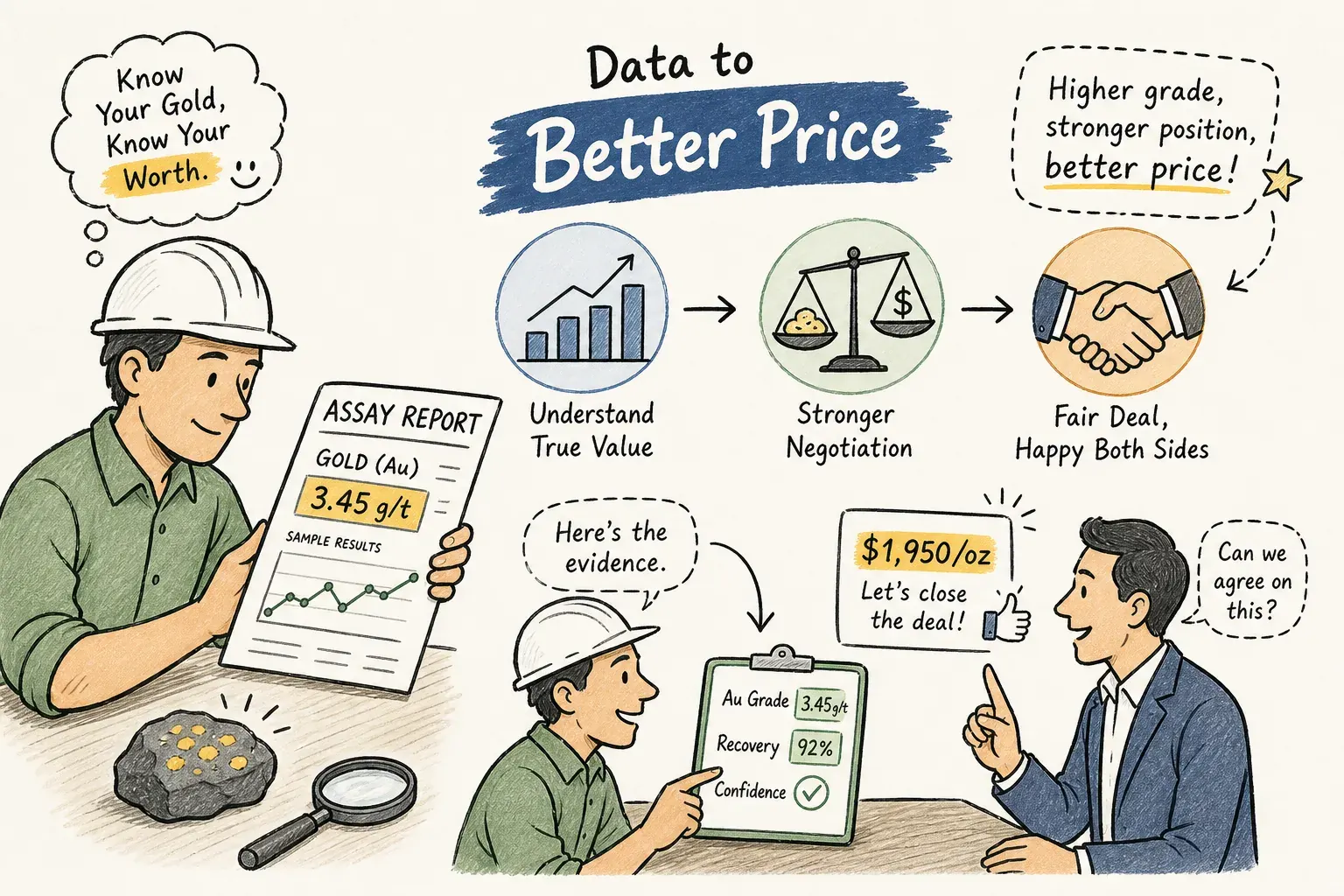
Picture this: you walk out of a gold negotiation with a check in one hand and a certified assay certificate in the other, and somewhere on the drive home, you wonder if those two documents were even connected. The buyer quoted a price, ran their own quick test, and made the numbers work in their favor. Your assay certificate sat in your folder, untouched, while the deal got done. That scenario occurs in gold trading more often than sellers realize, and it costs real money.
Many sellers treat an assay report as a credential to show on request rather than a calculation tool to use at the table. The result is a negotiation where the buyer controls all the data and the seller is left estimating whether the offer sounds reasonable. This article changes that. By the time you finish reading, you'll know how to use assay reports to negotiate gold prices confidently, reading every meaningful number on a certified assay report, converting those numbers into a concrete baseline value, and using that baseline to evaluate any offer you receive.
When you bring a report from an independent lab, one with no commercial stake in the gold being tested, the data carries a neutrality that gives you a real structural advantage at the negotiating table. What a Gold Assay Certificate Actually Contains The Standard Fields Every Trader Should Recognize A certified assay report is a structured document, and knowing the layout means you don't miss anything important. The core fields include a unique sample ID, the date of receipt, the form of the sample (ore, scrap, bullion, or dore), the method used to test it, and the gold content result. Each of these fields serves a specific purpose, and none of them are decorative.
The method field deserves particular attention. Fire assay and XRF spectrometry are both widely used, but they produce results with different levels of precision. Fire assay involves full dissolution and cupellation, which gives you a highly accurate determination of pure gold content. XRF is faster and non-destructive, making it useful for screening, but surface contamination or sample heterogeneity can affect the reading.
A buyer who understands both methods will price a fire assay result differently than an XRF result, and you should expect that distinction to come up. Quality control fields, including blanks, duplicates, and certified standards, tell you whether the lab's results for your sample were produced under conditions you can defend. These aren't just administrative checkboxes. If a buyer questions your report, solid QC data is what backs up the numbers.
Reading the Gold Result: Units, Purity, and Fineness Explained Gold content is reported in different units depending on what's being tested. Ore samples typically show results in grams per tonne (g/t) or parts per million (ppm). Bullion and dore are usually reported in fineness, expressed as parts per thousand. Jewelry is most commonly described in karat, and refined material may appear as a straight percentage. You need to know which unit your report is using before you can run any calculation.
The conversions are straightforward. Fineness divided by 10 gives you percent purity: 750 fineness equals 75% pure gold. Karat divided by 24 gives you the purity fraction: 18 karat divided by 24 equals 0.750. Fineness is widely used and commonly preferred by refiners and international buyers, so if your report shows karat, convert it to fineness before bringing it to the table. Composition Fields, Impurities, and Unusual Observations A thorough assay report lists more than gold content, it identifies every element present in your sample.
Silver, copper, and iron are common companions to gold in dore and alloy material, and each one has direct pricing implications. Silver content in particular is often recoverable value that sellers let buyers absorb silently, simply because they didn't notice it on the report. Unusual observations and method deviations are sections many sellers skip, but they can explain anomalies that affect your result. If the lab noted heterogeneity in the sample, or a deviation from standard preparation, that context matters when a buyer's in-house reading differs from your certified result.
Know what the notes say before someone uses them against you. How to Use Assay Reports to Negotiate Gold Prices: Building Your Baseline The Melt Value Formula, Explained in Plain Terms Melt value is the number your entire negotiation should be anchored to, and the formula has three inputs: Melt Value = Weight (troy oz) × Purity (decimal) × Spot Price (per troy oz). Every buyer offer you receive is derived from this same calculation, so when you know your own version of it, you're working from the same starting point they are. Here's a concrete example.
You have 10 troy ounces of material that tested at 750 fineness, which is an 18K equivalent and a purity decimal of 0.750. Spot price on the day you're negotiating is $3,200 per troy ounce. Your melt value is 10 × 0.750 × $3,200 = $24,000. For scrap and melt transactions, that figure is the practical ceiling of any legitimate offer, any deductions a buyer applies come off that number, so your job is to know it before they quote you a figure.
Note that items with resale or collector value may trade above melt, but for standard refining purposes, melt value is your baseline. Converting Grams to Troy Ounces Without Getting It Wrong One of the quietest ways sellers lose money is in the unit conversion. Avoirdupois ounces, the everyday ounces most people are familiar with, are not the same as troy ounces. One troy ounce equals 31.1035 grams.
A standard avoirdupois ounce is 28.35 grams. That difference of roughly 2.75 grams per ounce adds up fast on any meaningful lot. Your assay report most likely lists weight in grams. The conversion is simple: divide the weight in grams by 31.1035 to get troy ounces.
Confirm before any negotiation that the buyer is using the same unit you are. A buyer who applies your gram weight to a per-troy-ounce calculation without converting is either making an error or counting on you not to notice. How Spot Price Fits Into the Calculation on Any Given Day Spot price is live data that changes throughout every trading day, which means an offer quoted in the morning may reflect a different gold price than one quoted in the afternoon. Before any negotiation, check a live commodities source and record the exact spot price at the time you run your melt value.
That timestamp becomes your reference point for the entire conversation. When comparing offers from multiple buyers, use the same spot price figure for every calculation. A higher offer made when spot was lower may actually be a worse deal than a lower offer made when spot was higher. The only way to compare accurately is to normalize everything against the same number.
How Buyers Build Their Offers From Your Assay Data Payout Percentages and What They Actually Represent Buyers don't pay 100% of melt value. That's not fraud; that's how the market works. The formula behind every offer is: Offer = Melt Value × Payout Percentage, minus any applicable fees. The payout percentage reflects the buyer's cost to refine, handle, and profit from the material.
Knowing the standard ranges tells you immediately whether an offer is competitive. Pawnshops typically pay somewhere in the range of 20 to 60 percent of melt value, with many clustering around 40 percent. Local jewelers and dedicated gold buyers usually fall in the 55 to 80 percent range. Direct refiners and online buyers with low overhead can offer 75 to 95 percent for clean, well-documented lots.
Your assay certificate shifts these numbers in your favor because a certified purity result reduces the buyer's uncertainty, which is part of what they're pricing into their margin. Refining Fees, Lot Fees, and Assay Charges: Legitimate vs. Padded Buyers may itemize several deductions beyond the payout percentage: refining fees, lot or handling fees, their own assay or testing charge, and processing fees. Some of these are entirely legitimate.
Refining a small lot of mixed-karat scrap genuinely costs more per ounce than processing a clean dore bar. Wet samples add preparation time. These costs are real and reasonable to price in. Padding is a different matter.
When deductions are presented as fixed fees without a clear basis, or when the buyer's in-house testing fee gets applied even though you've brought a certified third-party report, those charges are worth questioning. Ask for every deduction in writing, then check each one against your own assay data. If a fee doesn't connect to a real cost that your report already addresses, you have grounds to push back. Penalty Elements, Moisture, and the Factors Most Sellers Overlook What Penalty Elements Are and Why They Reduce Your Payout Penalty elements are impurities in your gold sample, copper, iron, zinc, arsenic, or lead, that increase the cost of refining.
A refinery has to work harder to separate them, and that extra work gets charged back to the seller through reduced payouts or explicit penalty line items. A seller who doesn't know their penalty element profile enters the conversation with a significant blind spot. Your assay report will list these elements if the lab ran a multi-element analysis. Review them before any negotiation.
If the copper concentration is negligible, a buyer who quotes a heavy penalty for base metal contamination is padding. If arsenic is genuinely elevated, the penalty is real and you should factor it into your walk-away threshold before you sit down. Silver is a separate and often overlooked factor. In dore and alloy material, silver content is frequently recoverable and carries its own market value.
Many sellers let buyers absorb silver credit silently because they never read the composition section of their assay report. If your report shows meaningful silver content, ask specifically how the buyer is accounting for it in their offer, that question alone can recover value that would otherwise disappear into the buyer's margin. Moisture Content and How It Shifts the Weight Calculation Gold is priced on dry weight. If your sample was tested in a wet or partially wet state, the effective gold concentration per dry gram is higher than the raw weight calculation suggests.
Reputable labs handle this during sample preparation, drying the material before analysis and noting moisture content on the report. Check that your certificate confirms the sample was analyzed on a dry-weight basis. The practical risk is a discrepancy between a buyer's in-house weight measurement and your certified dry weight. If a buyer weighs your material wet, their weight figure will be higher but their effective purity reading will be lower, which shifts the melt value calculation against you.
On larger lots, that discrepancy represents real dollars, a figure worth confirming before any weight is recorded. Your certified report is the check against that. Why the Source of Your Assay Report Changes the Negotiation Entirely The Problem With Relying on the Buyer's Own Test When the buyer conducts the assay on material they're about to purchase, they control the data that sets the price. That's a fundamental conflict of interest, and it exists even when there's no deliberate fraud.
A buyer's in-house XRF device may be calibrated to their own specifications, positioned to read a surface that isn't representative of the full sample, or subject to instrument drift if calibration hasn't been recently verified. Any of those factors can produce a lower purity reading than a fire assay would confirm, and every one of those discrepancies benefits the buyer. Without an independent benchmark, you have no basis to challenge the reading. You're either trusting the buyer or guessing, and neither of those is a negotiating position.
The conversation about purity should be settled before you walk into any buyer's premises, not determined by the buyer's own instrument after you've arrived. Using an Assay Report to Negotiate Gold Prices: Why Independence Matters A neutral third-party assay is often the most credible common baseline both parties can work from. It doesn't belong to the buyer, and it doesn't belong to the seller. It's a measurement made under documented QA/QC conditions by a party whose only role was to analyze the sample accurately.
That financial disinterest reframes the entire negotiation. Instead of debating whose purity reading is correct, both parties start from a shared, certified baseline. The conversation shifts to refining costs and fees, a far more productive place to negotiate from. Bilex Minerals EA operates as an independent third-party laboratory with no stake in the gold being tested, providing fire assay and XRF analyses under documented quality control standards from its East African facilities.
Sellers who arrive at any negotiation with a certified report from a financially disinterested lab are in a structurally stronger position than sellers who rely on whatever instrument the buyer points at their material. Putting Your Assay Report to Work When Comparing Buyers Run the Same Melt Value Calculation Against Every Offer Calculate your melt value once, using your independent assay certificate and the current spot price, and use that single figure as the standard for every offer you evaluate. Different buyers will quote their offers in different formats: some give a price per gram, some quote a percentage of spot, some present a lump-sum figure. Convert all of them to a payout-versus-melt percentage so you're comparing like with like across buyer types.
A pawnshop offering $18,000 on your $24,000 melt value lot is paying 75%. A refiner offering $22,000 is paying 91.7%. Those two numbers tell you far more than the dollar amounts do on their own, and they give you leverage to go back to the better buyer and confirm the offer is their best. How to Challenge a Deduction With Your Own Data When a buyer presents a purity reading lower than your certified assay report shows, ask for their explanation in writing before accepting their number.
A gap between a certified fire assay result and a buyer's in-house XRF reading is a specific, documentable discrepancy. A buyer who cannot justify that gap with a concrete technical explanation faces a choice: defend an indefensible figure or revise their offer upward. Most experienced buyers know that a certified third-party assay is difficult to argue against. Many will revise rather than create a documented dispute over their own instrument's accuracy.
Your report doesn't need to be confrontational to be effective. It just needs to be present, understood, and cited clearly. When to Walk Away and What That Decision Should Be Based On Set your walk-away threshold before the meeting using your assay data and the current spot price. Calculate what you'd net at the lowest payout percentage you'd accept after all legitimate deductions, and write that number down.
When you're in the room and an offer comes in below that figure, the decision isn't emotional; it's arithmetic. Sellers without certified data have no reliable floor. They're evaluating offers against intuition, which buyers know how to work against. Sellers who negotiate gold prices with an assay report in hand know exactly where every offer sits relative to the metal's actual value, and that knowledge turns a guessing exercise into a data-driven conversation you can control.
Use Your Certificate as the Tool It Was Meant to Be The framework is three steps: read the report thoroughly, calculate your personal melt value baseline, and enter every negotiation with certified, independent data in hand. None of those steps are technically complex once you've done them once. The complexity dissolves when you understand what each field on the certificate actually means and how it connects to the price. The negotiation advantage described throughout this article starts with one decision made before you sit down with any buyer.
The trader who understands their assay certificate is never guessing. Every offer they evaluate is measured against a number they calculated themselves from verified results. That precision compounds over time, the more deals you do with certified data as your starting point, the faster you recognize a weak offer and the more confidence you bring to every negotiation. Before your next sale, learn how to use assay reports to negotiate gold prices confidently by starting with an independent test from a lab that has no skin in the transaction.
Bilex Minerals EA provides fire assay and XRF testing from its East African facilities, with results that carry the kind of third-party neutrality that makes any certified report genuinely difficult for a buyer to dismiss. That report is the most defensible starting point you can bring to any gold negotiation, and it belongs in your hand before you quote a price or accept one.
Keep the answer within its proper scope.
Can this article replace transaction-specific professional advice?
No. It is educational. Confirm current legal, customs, tax, regulatory, technical, and commercial requirements with the responsible authorities and appropriately qualified advisers.
Does an assay approve the wider gold transaction?
No. An assay describes the submitted sample under the stated method. Ownership, origin, seller authority, payment, export, import, sanctions, and logistics require separate checks.
What should I verify before relying on a document or result?
Verify the issuer, scope, date, reference, sample or shipment identity, units, validity, and direct connection to the current parties and material.
Official and primary sources