
Focused resource · Gold Purity
24 Karat vs 999 Fine Gold: What's the Real Difference?
How the 24-part karat system relates to parts-per-thousand fineness, and why nominal labels still require a measured basis.
10 min read · Knowledge Centre resource
Direct answer
Twenty-four karat is the top nominal grade in the karat system. 999 fine means 999 parts gold per thousand, or 99.9 percent on the stated basis.
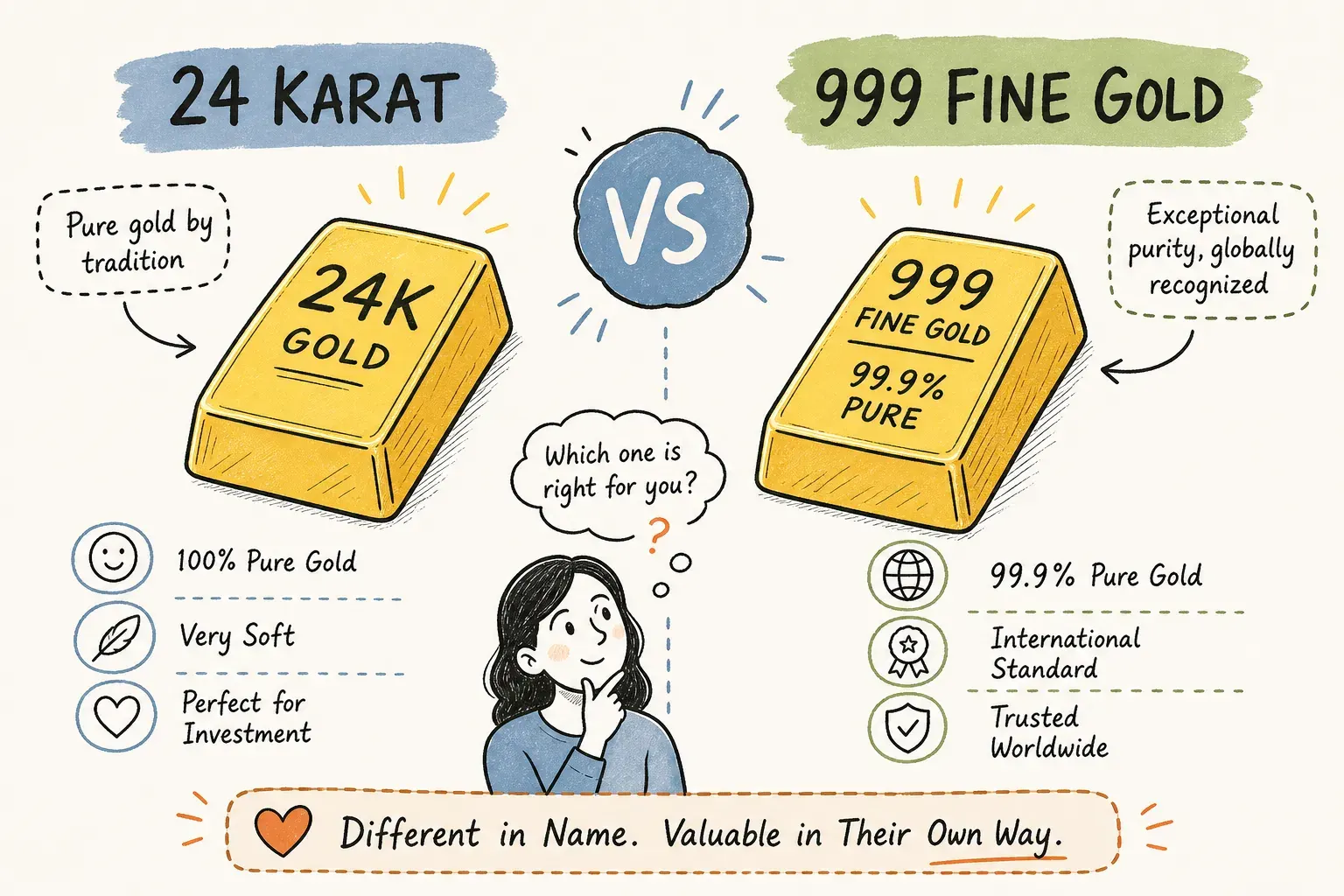
You're looking at two gold bars side by side. One is stamped "24K." The other reads "999." The price is nearly identical, and you assume they're the same thing. In most cases, you'd be close to right, but not always, and the difference between 24 karat and 999 fine gold is just large enough to matter when you're transacting at scale, negotiating with a refinery, or sorting out export documentation. The karat system and the fineness system measure gold purity on different scales.
They translate neatly in theory. In practice, the numbers don't always land in the same place. A 24K stamp is a purity declaration; a 999 stamp is a measured fineness result. Those are not the same thing, and understanding the distinction is what separates an informed buyer from one who discovers the gap only after a dispute or a failed transaction.
This article breaks down the difference between 24 karat and 999 fine gold, walks through the three-tier fineness system (.999, .9999, and 995), explains what the stamps in your market actually mean, and shows you how to verify what you're holding before the transaction closes. How the karat scale and fineness system each measure gold purity The math that links karats to parts per thousand The karat scale divides gold content into 24 parts. Pure gold occupies all 24 parts, so 24K means the metal is 100% gold by that measure. The fineness system operates on a scale of 1,000: a fineness of 999 means 999 out of 1,000 parts are gold, or 99.9% purity.
The conversion formula is straightforward: fineness = (karat / 24) × 1,000. Plug in 24K and you get (24/24) × 1,000 = 1,000. Working backwards: karat = (fineness / 1,000) × 24. For quick reference, 22K converts to 916 fineness, 18K to 750, and 14K to 585.
Those numbers show up on stamps worldwide and are worth memorizing. Why the math says 1,000 but the bar says 999 If 24K theoretically converts to 1,000 fineness, why does every "24K" bar on the market read 999 or 999.9? The answer is refining physics. Absolute purity, meaning zero trace elements, is not achievable through any commercial refining process.
The 999 and 999.9 stamps are measured, documented fineness levels, not shorthand for a theoretical ideal. A 24K designation on a piece declares the maker's intent. The fineness number tells you the actual result. That's the core distinction: one is a label, the other is a measurement.
Treating them as identical is where most buyer confusion starts. The difference between 24 karat and 999 fine gold: purity tiers, fineness, and what the numbers mean Three nines vs. four nines: what the distinction actually means .999 gold is 99.9% pure. .9999 gold is 99.99% pure. The measured gap between them is 0.09 percentage points, which sounds almost too small to discuss. For most private buyers, it is.
For refiners, investment-grade bullion buyers, and certain industrial applications, the tier distinction is meaningful enough to drive separate product lines and different mint premiums. Achieving four-nines fineness requires additional refining steps and tighter quality control than three-nines. That added process cost is why .9999 bars and coins typically carry a higher premium over spot than .999 equivalents. The raw metal content difference per ounce is negligible; the price difference reflects a production-quality tier, not a dramatically different amount of gold.
Where the 995 standard fits in The London Bullion Market Association (LBMA) sets 995 fineness (99.5% gold) as the minimum acceptable for good delivery bars, the large settlement bars accepted on the global gold market. That means 995, .999, and .9999 are all legitimate products within the high-purity category, just at different measured levels. A 995 bar contains slightly more trace alloy metals than a .999 bar, which makes it marginally more durable and fully acceptable for large-scale commodity trade. For buyers, knowing which tier they're holding changes how they price it, where they can sell it, and what documentation refiners will require on receipt.
Assuming all high-purity gold is interchangeable can create friction at exactly the wrong moment in a transaction. Jewelry versus bullion: where purity level actually changes the product The softness problem with ultra-pure gold Pure gold is genuinely soft. At 999.9 fineness, gold measures around 25 on the Vickers hardness scale. A standard 18K yellow gold alloy comes in between 150 and 200 HV.
That's not a small gap: 18K gold is roughly six to eight times harder than four-nines fine gold. For a stored bar, that difference is irrelevant. For a ring worn daily, it's the whole story. For jewelry, 18K (750 fineness) and 22K (916 fineness) are the practical standards because alloyed metals harden the structure.
A 22K piece is softer than 18K but significantly more durable than .999 fine. Buyers who choose 24K or .999 fine jewelry are trading wearability for purity, a valid choice, but it should be a conscious one. One distinction that does not exist between the two tiers is color: neither .999 nor .9999 fine gold looks more saturated or "more gold" to the human eye. Where .999 and .9999 gold actually belong For bullion coins, minted bars, and investment-grade product, .999 and .9999 are the right fineness tiers.
A stored bar doesn't scratch against a countertop. There's no durability concern, and the higher fineness simplifies resale, refinery acceptance, and spot-price-based valuation. Most reputable government mints produce their flagship coins at .9999 fineness, with certification from their in-house assay teams backed by ISO 9001 quality systems and international proficiency testing programs. If you're holding bullion for investment or settlement purposes, the fineness on the assay documentation is what matters.
The stamp on the face of the piece is a starting point, not the final word. Reading gold hallmarks and stamps before you buy How stamps read across major markets In the United States, gold carries karat designations: 10K, 14K, 18K, 22K, 24K. Investment bullion typically shows both the karat and the fineness, usually formatted as "24K 999.9" or "FINE GOLD 999.9." In Europe and the UK, millesimal fineness numbers are the dominant convention, so you'll see 999, 916, 750, and 585 on jewelry rather than karat marks. A 999 stamp in a European context carries the same declared purity as a 24K stamp in the US market.
In India, both systems appear in consumer contexts, sometimes on the same piece simultaneously. Understanding which convention your market uses prevents confusion when buying across borders, particularly when sourcing from East African suppliers whose documentation may follow different regional formatting standards. Hallmarks and gold stamps: why a declaration is a starting point, not a final answer A hallmark is a purity declaration from the maker or refiner. For established refiners with documented production processes, that declaration is generally reliable.
For high-value purchases in markets where informal or artisanal production is common, a stamp tells you what the seller claims, not what independent measurement confirms. A stamp is where verification begins. An independent assay certificate is where it ends. The gap between those two things is where disputes and losses happen.
For any transaction involving meaningful money, the hallmark should be followed by documented, third-party testing results before funds change hands. How to verify the exact fineness of gold you're buying XRF screening and fire assay: what each method confirms XRF (X-ray fluorescence) testing delivers a rapid, non-destructive elemental composition result in seconds. Professional XRF is accurate enough for most screening purposes, but it reads surface composition only. A plated piece or a sample with surface enrichment can return an inflated reading that doesn't reflect the bulk composition.
Near the .999 to .9999 boundary, XRF uncertainty typically sits in the range of 10 to 50 parts per million, which means a well-calibrated instrument can flag a probable tier but may not deliver a defensible certification result at the exact boundary. Fire assay (cupellation) is the reference-standard method. It chemically separates gold from all other elements and weighs the isolated pure metal, producing a fineness figure with the tightest uncertainty of any common testing approach. Under controlled laboratory conditions, fire assay achieves expanded uncertainty around 0.01 parts per thousand near the four-nines level, meaning the result reliably falls within 0.01 ppt of the true value, which is the precision needed to place a sample confidently in one tier versus the other. Fire assay from an accredited laboratory is the method refiners and commodity exchanges trust for settlement.
XRF is the right tool for initial screening; fire assay is the confirmation that holds up in a dispute or compliance review. What a proper assay certificate should specify A reliable assay certificate does more than state a karat grade. It includes the sample weight, a unique reference number, the testing method used, the measured fineness expressed in parts per thousand, the date of analysis, and the laboratory's identifying information and authorization signature. Any certificate that only lists "24K" without a fineness figure is incomplete for high-value or compliance purposes.
Independent testing laboratories go further. At Bilex Minerals EA, assay reports specify exact fineness to the decimal level using both XRF screening and fire assay cupellation. Buyers and sellers receive a precise, documented number rather than a rounded label, and results are reviewed directly with the client at the conclusion of the appointment. That specificity removes guesswork from any significant transaction, whether the gold is heading to a refinery, crossing an international border, or completing a private sale where the buyer needs certified documentation to satisfy due diligence requirements.
What to take away: understanding the difference between 24 karat and 999 fine gold The karat and fineness systems measure the same thing on different scales, and their numbers align cleanly in theory. In commercial practice, 24K is a category label while .999, .9999, and 995 are measured fineness tiers. They're closely related, but not interchangeable. Knowing which one you hold affects how you price it, where you can sell it, and what documentation a buyer or refinery will require.
For jewelry, purity above 22K increases softness without improving wearability. For bullion, confirm .999 or .9999 fineness on the assay documentation, not just from the stamp on the piece. The stamp tells you the declared tier; an independent test tells you what the metal actually contains. When it comes to any purchase that matters, the difference between 24 karat and 999 fine gold is not just academic, it affects pricing, documentation, and where you can transact.
A hallmark should not be the last word on a purchase that matters. Get the fineness on paper, from a laboratory that measures it, and you'll always know exactly what you own.
Keep the answer within its proper scope.
Can this article replace transaction-specific professional advice?
No. It is educational. Confirm current legal, customs, tax, regulatory, technical, and commercial requirements with the responsible authorities and appropriately qualified advisers.
Does an assay approve the wider gold transaction?
No. An assay describes the submitted sample under the stated method. Ownership, origin, seller authority, payment, export, import, sanctions, and logistics require separate checks.
What should I verify before relying on a document or result?
Verify the issuer, scope, date, reference, sample or shipment identity, units, validity, and direct connection to the current parties and material.
Official and primary sources