
Focused resource · Gold Purity
Karat vs Fineness: What's the Difference in Gold Purity?
A plain-language conversion guide for karat, fineness, percentage, nominal grades, rounding, and assay reporting.
11 min read · Knowledge Centre resource
Direct answer
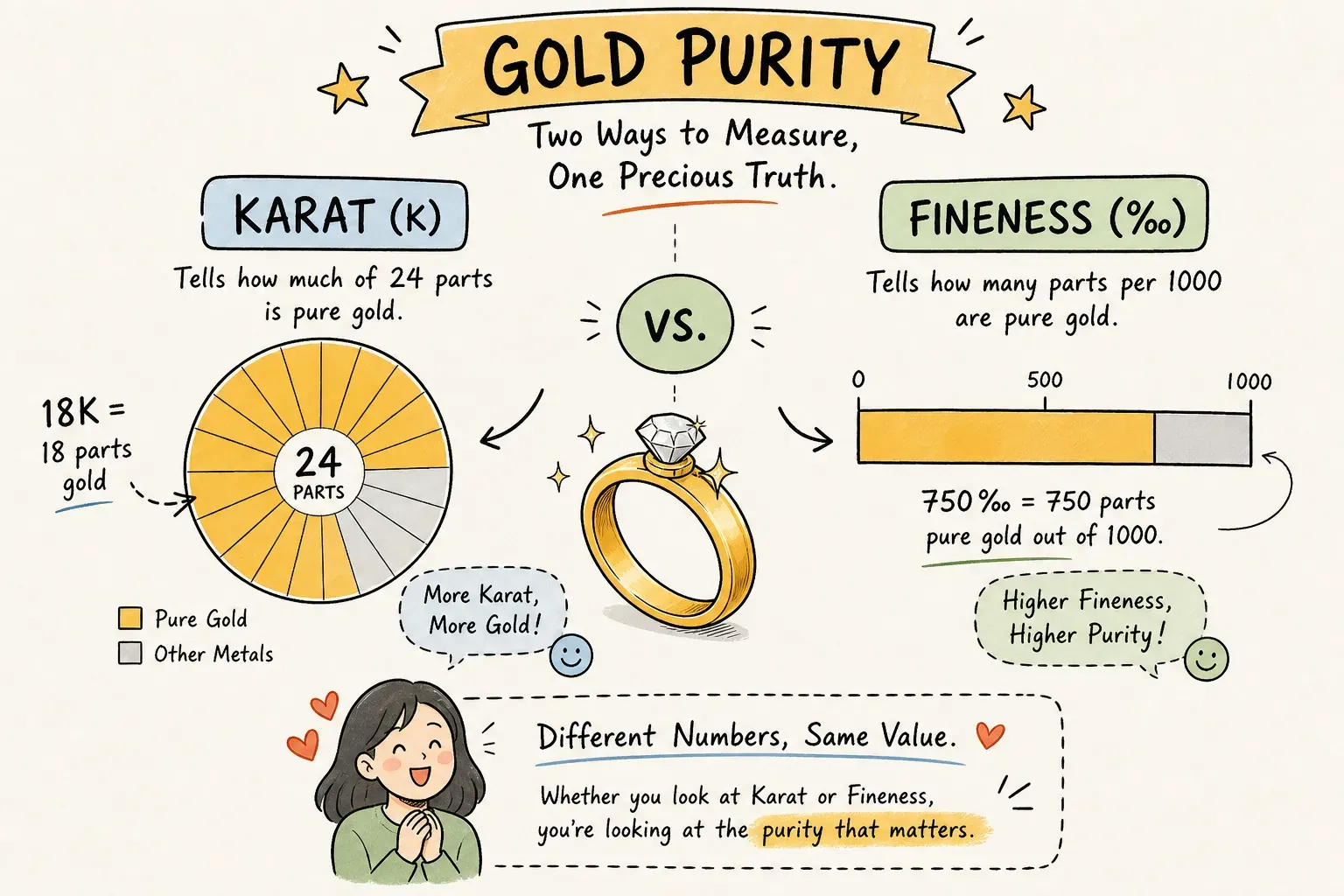
Karat describes gold in 24 parts. Fineness describes gold in 1,000 parts. Both express purity, but fineness usually gives the more precise commercial value.
Picture two people standing over the same gold bar. One says it's 18K. The other says it's 750. They're both right, and they're not even disagreeing.
They're just speaking different languages for the same thing: gold purity. That's the whole story of karat vs fineness in one sentence, but the details matter more than you'd think, especially when money is on the line. Ambiguity between these two systems can cost buyers real money, particularly in large-lot or cross-border deals where purity differences translate directly into pricing gaps. A piece stamped 585 might look unfamiliar to a US buyer trained to think in karats, leading to undervaluation or a missed red flag.
Certified assay reports from professional laboratories, including independent testing labs like Bilex Minerals EA, express results in fineness, not karats. That's not arbitrary. There's a precise reason why the global gold trade runs on fineness, and this article explains it clearly. By the end, you'll be able to convert between both systems using a single formula, decode any hallmark stamped on jewelry or bullion, and understand exactly why fineness has become the universal language of serious gold transactions worldwide.
What the karat system actually measures The 24-part logic behind karat purity Karat measures gold as a fraction of 24 total parts. One karat equals 1/24 of the whole alloy, which works out to roughly 4.17% gold content. So 24K is pure gold, 18K contains 18 parts gold and 6 parts other metals, and 14K is 14 parts gold out of 24. The 24-part system has deep historical roots in grain and coin weights, which is why the denominator doesn't feel particularly intuitive today, yet has survived in jewelry markets for centuries.
The math is simple once you internalize the denominator. Every karat grade is just a proportion of 24, and the remaining parts are alloying metals like silver, copper, zinc, or nickel. Those alloying metals aren't filler: they serve structural and aesthetic purposes that pure gold simply can't deliver on its own. Common karat values and the durability tradeoff The most frequently encountered karat marks each tell a different story.
In the US, 10K is the legal minimum for jewelry sold as "gold," with 14K being the most popular alloy in American jewelry. Moving up the scale, the equivalent of 18K (750 fineness) is common in European fine jewelry; 22K is widely used in Indian and Middle Eastern markets; and 24K is essentially pure gold, used in bullion and some regional Asian jewelry markets. As karat goes up, gold content increases but hardness decreases. 24K gold scratches easily and deforms under normal wear, which is why most wearable jewelry uses lower karats.
The alloying metals in 14K or 18K aren't impurities: they're engineering. A 22K ring carries more gold but less durability than a 14K ring, and a buyer who doesn't understand that tradeoff is likely to pay a premium for the wrong piece. Millesimal fineness: the system built for precision How parts per thousand remove ambiguity Millesimal fineness is the decimal alternative to karat. Instead of expressing purity as parts out of 24, fineness uses parts out of 1,000.
A stamp of 750 means 750 parts per thousand (‰) are pure gold, exactly 75.0%. The system is favored by scientists, assayers, and regulators because it's decimal-based, machine-readable, and doesn't require rounding to the nearest whole number. When you need to price gold to the gram or compare two alloys precisely, fineness gives you a cleaner, unambiguous number. You can also express the same value as a decimal: 0.750 and 750 fineness mean exactly the same thing, and both translate directly into a percentage without any additional conversion step.
That directness is why certified assay laboratories issue results in fineness rather than karats. Standard fineness marks and what they represent The marks a buyer or investor is most likely to encounter form a consistent ladder of purity. At the lower end, 375 represents low-karat gold common in the UK market. Moving up: 417 corresponds to 10K, 585 to 14K, 750 to 18K, and 916 to 22K.
At the top of the scale, 999 indicates near-pure gold found on most coins and bars, while 999.9 (four-nines purity) is the benchmark for investment-grade bullion. Some pieces also display the decimal form of the same value: 0.750 stamped on an older European piece means the same thing as a 750 fineness mark. Don't let the format variation confuse you. The underlying number is the same, and once you know the scale runs from 0 to 1,000, any mark becomes readable in seconds.
Karat vs Fineness: Quick Conversion Guide The formula (and why it's simpler than it looks) There are two conversion formulas, and both are easier to use than they appear. To convert karat to fineness, divide the karat number by 24 and multiply by 1,000. To go the other direction, divide the fineness value by 1,000 and multiply by 24. The formula holds across every karat grade, three calculations confirm it.
Take 18K: 18 divided by 24 equals 0.75, multiplied by 1,000 gives you 750. That's why 18K and 750 are the same thing. Going the other direction: 585 divided by 1,000 is 0.585, multiplied by 24 gives 14.04, which rounds to 14K. Try it with 22K: 22 divided by 24 is 0.9167, multiplied by 1,000 gives 916.7, which rounds to 917.
The relationship is perfectly consistent because the karat system defines 24K as theoretically pure gold, corresponding to a fineness of 1,000, and everything else is a fraction of that fixed relationship. In practice, bullion stamped at the highest purity levels typically carries a 999 or 999.9 mark, reflecting that absolute purity of 1,000 fineness is not achievable through conventional refining. Quick-reference conversion chart The table below covers the six most common karat grades and their fineness equivalents. One note worth keeping in mind: 14K is sometimes stamped as 583 on older European pieces and 585 on modern ones, depending on national rounding conventions.
That small difference matters when you're comparing certificates from different countries, so confirm the issuing country before treating 583 and 585 as interchangeable. Karat Fineness Gold content 24K 999 / 999.9 99.9%+ 22K 917 91.7% 18K 750 75.0% 14K 585 58.5% 10K 417 41.7% 9K 375 37.5% Reading hallmarks: which system is stamped on your gold? Karat countries vs. fineness countries The US stamps jewelry with karat marks, 10K, 14K, 18K, and so on, under Federal Trade Commission guidelines and the National Stamping Act. The UK, most of continental Europe, India, and the majority of international markets use fineness stamps: 375, 585, 750.
Neither convention is wrong. They're different traditions that evolved in parallel, and both communicate the same underlying information once you know which side of the scale to read. Some pieces carry both marks, particularly items made in one country and sold in another. If you're buying from a global marketplace or a cross-border seller, always confirm which system the stamp uses before comparing it to another piece.
A 750 stamp and an 18K stamp are equivalent, but if you assume a number you don't recognize is a maker's code rather than a fineness mark, you'll misread the piece entirely. Recognizing country-specific hallmark symbols Beyond the purity number, hallmarks often include a national symbol or assay office mark that confirms where the piece was tested. UK gold carries one of four assay office symbols: a leopard's head for London, an anchor for Birmingham, a rose for Sheffield, or a castle for Edinburgh. Italian pieces typically pair a five-pointed star with a manufacturer code and a fineness number.
French gold uses an eagle's head for 18K. In the US, the letters "KP" (for "karat plumb") indicate the stamped purity is exact rather than rounded. In practice, start with the purity number, it tells you what you're buying. Then use the surrounding symbols to confirm origin and verify authenticity.
Both pieces of information matter, but if you can only read one, make it the number. Why global gold trade runs on fineness The precision gap that karats can't close Karats are whole-number fractions of 24. That means 14K corresponds to exactly 14/24, or approximately 58.33% gold, and while legal marking tolerances exist under US regulations (per FTC and National Stamping Act guidance), the karat mark itself doesn't capture those incremental differences. Two 14K pieces can vary slightly in actual gold content while both carrying the same stamp.
For a jewelry buyer, the practical difference is minor. For a refinery pricing a kilogram lot, even small variations translate to real dollars lost or gained. Fineness eliminates that ambiguity entirely. The London Bullion Market Association's Good Delivery standard, the benchmark for internationally traded gold bars, specifies a minimum fineness of 995.
Every major commodity exchange, refinery intake form, and certified assay report uses fineness for the same reason: it's exact, it's globally consistent, and it doesn't require interpretation. A fineness figure maps directly to a percentage of pure metal content, which makes it the sensible unit when you're pricing metal by the gram across international borders. Fineness and commodity pricing: how labs report purity When a professional assay laboratory tests a gold sample, the result is expressed as a fineness value, not a karat grade. This is standard practice across LBMA-aligned labs and national assay offices worldwide.
The fineness figure feeds directly into commodity pricing calculations, where spot price, lot weight, and purity percentage are multiplied together to arrive at a precise monetary value. Rounding to a karat grade at that stage would introduce error. Fineness keeps the calculation clean from the first measurement to the final invoice. What this means for cross-border transactions When gold moves across borders, from a mine in East Africa to a refinery in Europe, or from a trading company to an international buyer, all parties need a shared reference point for purity.
That reference is fineness. Professional assay laboratories, including Bilex Minerals EA operating across Nairobi and Dar es Salaam, issue certified results in fineness precisely because a stamp of 750 carries the same meaning in Nairobi, Dubai, London, and New York. It removes one more variable from a transaction where trust and documentation accuracy are everything. If your supplier provides only a karat figure, requesting a fineness-based certified assay report from an independent laboratory is the right next step before any serious purchase.
An independent certified assay report, issued by a lab with no commercial stake in the gold being tested, is the accepted standard for verifying that the number on the bar matches the metal inside it, as recognized by the LBMA and major assay offices. A seller's own test should not replace independent verification. What you now know that most buyers don't Karat measures gold in parts out of 24; fineness measures it in parts out of 1,000. When it comes to karat vs fineness, the conversion formula works consistently in both directions, the reference chart covers every common grade, and hallmarks follow clear country-based conventions once you know what to look for.
These aren't obscure technical details: they're the baseline knowledge every gold buyer needs before putting money on the table. For everyday jewelry shopping, knowing your karats is enough to make informed decisions. For valuing larger lots, verifying supplier claims, or completing cross-border transactions, fineness is the standard that serious buyers and certified laboratories rely on. The next time you see 585 stamped on a piece of gold, you won't need to guess.
You'll know it's 14K, 58.5% pure gold, compatible with any certified assay report issued anywhere in the world. That kind of clarity is what separates a confident buyer from one who takes a seller's word on faith. And in a market where the difference between 583 and 585 can mean real money, faith isn't a strategy.
Keep the answer within its proper scope.
Can this article replace transaction-specific professional advice?
No. It is educational. Confirm current legal, customs, tax, regulatory, technical, and commercial requirements with the responsible authorities and appropriately qualified advisers.
Does an assay approve the wider gold transaction?
No. An assay describes the submitted sample under the stated method. Ownership, origin, seller authority, payment, export, import, sanctions, and logistics require separate checks.
What should I verify before relying on a document or result?
Verify the issuer, scope, date, reference, sample or shipment identity, units, validity, and direct connection to the current parties and material.
Official and primary sources