
Focused resource · Gold Export
Tanzania Mineral Export: Rules, Permits, and Compliance Guide
A practical framework for confirming exporter eligibility, permit type, valuation, royalties, inspection, customs information, and destination documents.
13 min read · Knowledge Centre resource
Direct answer
Tanzania mineral exports are governed by current law and Mining Commission procedures. The required route depends on the exporter, mineral, value, transaction, and destination.
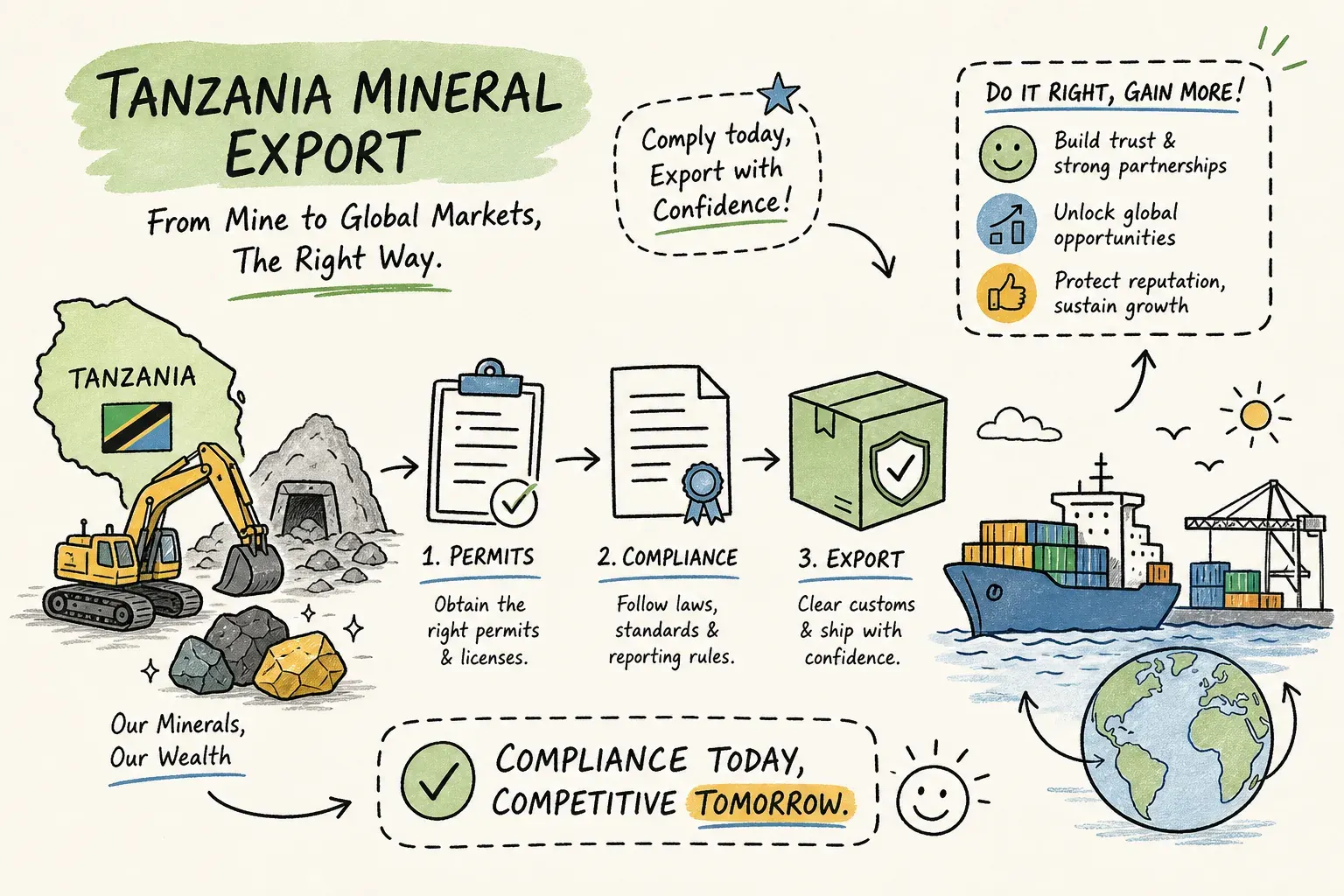
Tanzania's mineral export sector generated USD 5.4 billion in 2025, with gold accounting for roughly 88% of that total. For buyers, traders, and mining companies operating in or sourcing from Tanzania, those numbers represent serious commercial opportunity. But the regulatory framework governing who can legally move minerals across Tanzania's borders has grown significantly more complex since 2017, and the consequences of getting it wrong include criminal charges, cargo confiscation, and licence revocation. The most important thing to understand is that Tanzania does not operate a blanket export ban on all minerals.
What exists instead is a system of conditional exportability: most minerals can be exported, but only by the right category of licence holder, using the right permit type, with the correct documentation assembled before the shipment moves. That distinction matters enormously for anyone who has heard the word "ban" and drawn the wrong conclusions. This guide covers the current legal status of mineral exports in Tanzania, who qualifies to export, the six permit categories in use, the application process and fee schedule, and the penalties that apply when the rules are not followed. For traders who need certified assay documentation as part of their export application, Bilex Minerals EA's Dar es Salaam office offers fire assay and XRF testing alongside mineral export documentation support, providing a single source for both the technical report and the compliance paperwork.
What Tanzania's current export restrictions actually mean in 2026 The 2017 ban and why it still matters today In 2017, Tanzania imposed a restriction on the export of unrefined metallic mineral concentrates and ores, specifically targeting gold, copper, nickel, and silver. The policy was designed to force domestic smelting and processing, keeping more value-addition economic activity inside the country before minerals left it. That decision created the regulatory architecture that still shapes Tanzania's mineral export environment today, even though the hard ban has since evolved into something more nuanced. One important clarification: the 2017 restriction was not applied uniformly across all mineral types.
Mineral sands, for example, were explicitly excluded from the ban. Traders dealing in non-metallic or specialty minerals often misread the scope of the restriction and either over-restrict their activities or, more dangerously, assume it does not apply to them at all. How the 2018 regulations changed the picture The Mining (Minerals and Mineral Concentrates Trading) Regulations of 2018 moved Tanzania from a hard prohibition to a structured permit-based system. Under that framework, holders of qualifying mining, processing, refining, smelting, or dealer licences may export minerals provided they obtain an approved export permit.
Tanzanian courts have upheld the binding nature of the permit requirement, confirming that export approval can legally be withheld where permits are absent. In practical terms, "conditional exportability" means a valid export permit is a prerequisite for any legal mineral shipment, not an administrative formality that can be obtained after the fact. The permit must accompany the shipment at the point of export. The 2024 lithium restriction Tanzania extended its value-addition policy to lithium in 2024, banning unrefined lithium exports from May of that year.
The restriction allows lithium to be exported only after domestic processing, following the same logic applied to metallic concentrates in 2017. For traders active in the critical minerals space, this signals a clear policy direction: the government intends to expand processing requirements to commercially significant minerals as their market value rises. Anyone building a long-term sourcing strategy around Tanzanian minerals should factor this trend into their compliance planning now. Who is legally allowed to export minerals from Tanzania License categories that carry export rights Six categories of mineral right holders are authorized to export: special mining licence holders, mining licence holders, primary mining licence holders, processing licence holders, smelting licence holders, and refining licence holders.
Each category still requires a separate export permit before any shipment moves; the mining licence itself does not grant automatic export authority. Licensed mineral dealers are also eligible to export, but only for minerals purchased through lawful channels from authorized miners or licensed brokers. What brokers can and cannot do Brokers occupy a specific and limited position in Tanzania's mineral trading framework. They may buy and sell minerals within Tanzania, but they are explicitly excluded from the right to export.
According to Ministry of Minerals guidance, broker licences are also restricted to Tanzanian citizens, which removes that pathway entirely for foreign-owned intermediaries. This distinction matters because a significant portion of informal mineral trading activity sits in the grey zone between dealer and broker status, and operators who assume broker-level activity carries export rights are exposed to serious enforcement risk. Non-residents and tourist-visa holders Non-residents may export minerals under a special export permit, but the conditions are strict. Tourist-visa holders face a cap of USD 1,000 in total mineral value and are limited to two export instances per calendar year.
Non-residents operating outside the tourist category follow a separate application pathway through the Commissioner for Minerals and are subject to the USD 2,000 special export permit fee. These are not high-volume commercial pathways; they exist for travelers and small-scale informal transactions, not for commodity trade. The six permit types and the documents that go with each Standard export permits and specialty certifications Tanzania uses six distinct permit and certification types depending on the mineral being exported. The Standard Export Permit covers general mineral exports.
The Certificate of Origin applies specifically to tanzanite minerals and is issued alongside the export permit. The Tanzania Kimberley Process Certificate is mandatory for diamond exports. The ICGLR Certificate applies to tin, tantalum, and tungsten, addressing conflict minerals traceability requirements. The Special Export Permit covers non-residents and tourist-visa holders.
Finally, a separate Export Permit applies to minerals purchased at an authorized Gem Trade Fair in Tanzania. Each certification type serves a distinct regulatory purpose, and using the wrong category for a specific mineral is treated the same as having no permit at all. Tanzania Revenue Authority officers are authorized to confiscate tanzanite exported without a valid Certificate of Origin at the point of interception. Core supporting documents required for any application Every export permit application requires proof of royalty payment, proof of inspection fee payment, and submission of the correct prescribed form.
Per the 2018 Regulations and Ministry of Minerals procedures, Form MTF.1 applies to minerals and mineral samples, Form MBF.1 applies to processed minerals, and Form MTF.13 applies to non-resident export applications. Before the permit is finalized, an authorized officer physically examines and weighs the minerals, so the documentation package must be complete before that inspection takes place. Where professional documentation support makes the difference For traders moving significant volumes, assembling the correct documentation package is where delays and rejections happen most often. Export permit applications that arrive with incomplete assay data, missing royalty receipts, or incorrectly classified mineral descriptions are rejected, and the reapplication process costs time and money.
This is precisely where Bilex Minerals EA's Dar es Salaam office adds direct value. As an independent testing and assaying laboratory offering fire assay and XRF analysis alongside mineral export documentation support, Bilex Minerals EA helps traders obtain certified reports and organize the assay certificates that export authorities require. A certified, independent assay report from a recognized third-party laboratory typically reduces friction at key stages of the permit process and provides the verified mineral identity data that inspecting officers need. How the Tanzania mineral export application process works and what it costs The step-by-step application pathway The export permit process follows a defined sequence.
Each step depends on the one before it being completed correctly, so preparation matters as much as execution. Confirm which permit type applies to your specific mineral and your licence category. Obtain the correct application form: MTF.1 for minerals and mineral samples, MBF.1 for processed minerals, or MTF.13 for non-resident applications. Arrange for the minerals to be examined and weighed by an authorized officer at the Ministry of Minerals.
Pay the applicable royalty and inspection fee and collect documented proof of both payments. Submit the completed application form with all supporting documents to the Commissioner for Minerals. Receive the permit in the prescribed form; the permit must travel with the shipment at export. Fee schedule by applicant type The published application fee for a standard export permit is USD 100.
A special export permit for a tourist-visa holder is listed at USD 250 on the Ministry of Minerals portal (tumemadini.go.tz), applicable where the total mineral value does not exceed USD 1,000; readers should verify the current figure directly with the Ministry, as some sources cite USD 200 for this category. A special export permit for a non-resident costs USD 2,000. Royalty rates are charged separately and vary by mineral type: gold, copper, silver, and platinum are assessed at 4% of gross value; gemstones and diamonds at 5%; tanzanite at 1%; and industrial minerals at 3%. These royalty amounts are in addition to the permit application fee, not included in it.
What happens when you export without a permit Criminal and financial penalties under the Mining Act Individual offenders face a fine of between TSh 5 million and TSh 10 million, up to three years in prison, or both. Corporate offenders face a minimum fine of TSh 50 million. For specific minerals, the consequences extend beyond fines: tanzanite exported without a Certificate of Origin is subject to immediate confiscation by Tanzania Revenue Authority officers at the point of interception. Exporters should review the applicable seizure and appeal procedures under the Mining Act, as statutory provisions govern what recourse, if any, is available after seizure.
Seizure, forfeiture, and enforcement powers Raw minerals seized during or after an attempted illegal export are confiscated by the government and deposited in the National Gold and Gemstone Reserve. Enforcement officers carry authority to enter and search premises, vehicles, vessels, and aircraft without a warrant where reasonable grounds exist. Licence cancellation is a further administrative consequence layered on top of criminal charges for serious violations. The combination of criminal liability, asset forfeiture, and licence revocation means illegal export carries risks that far outweigh the short-term cost of proper compliance, and enforcement activity in Tanzania's mining sector has grown more structured, not less, over the past several years.
Tanzania's mineral export performance and the value-addition push Where Tanzania's mineral exports stand today Tanzania's mineral export revenue climbed from USD 3.4 billion in 2022 to USD 5.4 billion in 2025, a trajectory that reflects both rising gold prices and expanding production. Gold accounted for approximately 88% of total mineral export value in 2025. The 2024 breakdown shows gold at USD 3.37 billion, diamonds at USD 60.3 million, and tanzanite at USD 19.2 million. The sector is growing, but that growth is happening inside an increasingly structured compliance framework, which means the administrative burden on exporters is rising alongside the commercial opportunity.
Why value addition is becoming the default requirement Tanzania's 2017 concentrate ban and the 2024 lithium restriction both point in the same direction: the government intends to capture more economic value domestically before minerals leave the country. For traders and mining companies, the era of exporting raw ore or unprocessed concentrate with minimal documentation is effectively over. Building a compliance infrastructure now, including certified assay documentation and proper permit management, is no longer optional for anyone operating in this market. Waiting for another regulatory update before organizing compliance processes is a losing strategy, and the direction of travel is not in doubt.
Frequently asked questions about Tanzania mineral export compliance How do I apply for a Tanzania mineral export permit? You apply through the Commissioner for Minerals at the Ministry of Minerals (tumemadini.go.tz). The process requires confirming your permit type, obtaining the correct prescribed form (MTF.1, MBF.1, or MTF.13 depending on your situation), arranging physical examination and weighing of the minerals by an authorized officer, paying the applicable royalty and inspection fees, and submitting the completed package for review. The permit is issued in a prescribed form and must accompany the shipment at the point of export.
What are the fees for a non-resident Tanzania mineral export permit? A special export permit for a non-resident costs USD 2,000. Tourist-visa holders who qualify under the lower-value pathway (minerals not exceeding USD 1,000 in total value) are subject to a separate fee listed on the Ministry of Minerals portal; verify the current rate directly with the Ministry, as published figures vary between USD 200 and USD 250. Royalty charges apply separately and depend on the mineral type being exported.
Which minerals require a Certificate of Origin in Tanzania? Tanzanite requires a Certificate of Origin issued alongside the standard export permit. This is a distinct document from the export permit itself. Tanzania Revenue Authority officers are authorized to confiscate tanzanite at the point of interception if it is moving without a valid Certificate of Origin, so this document must be in place before the shipment leaves.
Do I need a certified assay report to export minerals from Tanzania? While the regulations specify required documentation by category, export permit applications that include incomplete or absent assay data are routinely rejected. A certified assay report establishes the mineral's identity, purity, and classification, all of which inspecting officers need to validate the permit application. Obtaining a report from an accredited independent laboratory before submitting your application reduces the risk of rejection and delays.
Getting Tanzania mineral export compliance right from the start Exporting minerals from Tanzania is not prohibited, but it is tightly regulated through a permit-based system that distinguishes by mineral type, applicant category, and processing status. Getting it right requires the correct licence, the correct permit type, properly assembled documentation, and proof of royalty payment before any shipment moves. The penalties for skipping any of those steps are serious: criminal charges, confiscated cargo, and the loss of the licence that authorizes your operations in the first place. The compliance framework rewards preparation.
Traders who have their documentation organized before they approach the Commissioner for Minerals move through the permit process faster and face fewer rejections. That preparation starts with knowing what mineral you have, at what purity, confirmed by a certified independent assay report, not an estimate from the seller. Bilex Minerals EA's Dar es Salaam office provides certified fire assay and XRF testing alongside mineral export documentation support, giving you a single accredited source for both the technical report and the regulatory paperwork. If you are preparing a mineral export application or conducting due diligence on a supply chain that runs through Tanzania, getting the documentation right at the start is the single most effective thing you can do to protect the transaction.
Contact Bilex Minerals EA before your next shipment, not after it is stopped at the border.
Keep the answer within its proper scope.
Can this article replace transaction-specific professional advice?
No. It is educational. Confirm current legal, customs, tax, regulatory, technical, and commercial requirements with the responsible authorities and appropriately qualified advisers.
Does an assay approve the wider gold transaction?
No. An assay describes the submitted sample under the stated method. Ownership, origin, seller authority, payment, export, import, sanctions, and logistics require separate checks.
What should I verify before relying on a document or result?
Verify the issuer, scope, date, reference, sample or shipment identity, units, validity, and direct connection to the current parties and material.
Official and primary sources