
Focused resource · Testing Methods
Precious Metal Analysis: Methods, Accuracy, and What to Expect
A method-selection guide covering analytical question, sample form, Fire Assay, XRF, instrumental techniques, reporting, and uncertainty.
14 min read · Knowledge Centre resource
Direct answer
The right analytical method depends on the metal, material, concentration, sample uniformity, required detection limit, permitted damage, and intended decision.
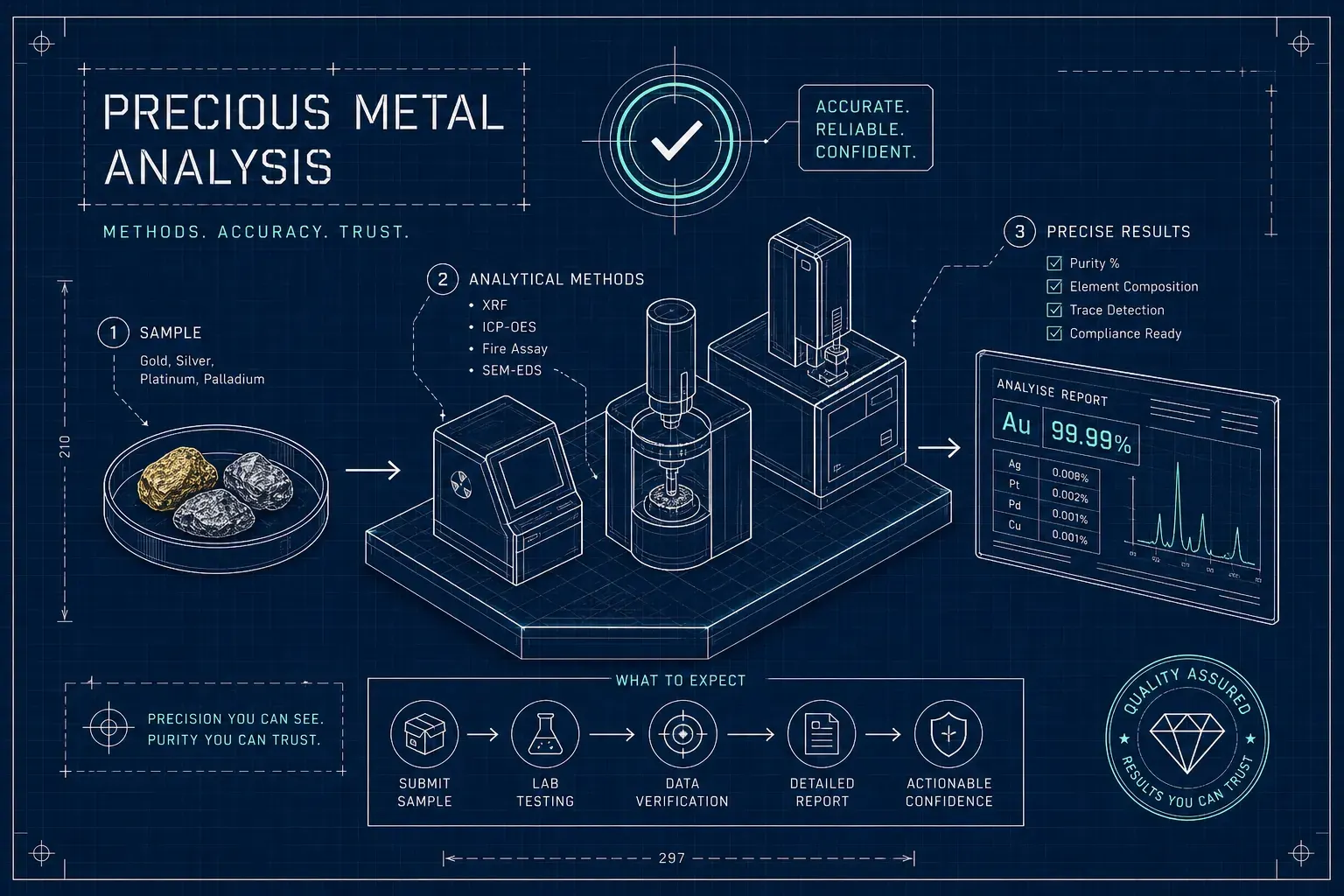
Picture three different people with the same problem. A gold buyer in Nairobi is staring at a 500-gram bar that the seller swears is 22 karat. A jeweler in Houston has a client's scrap that looks like 14k gold but acts like something cheaper. A miner in Tanzania has three kilograms of doré and needs a number to negotiate a fair sale price before export.
Each of them needs the same thing: an objective, defensible measurement of what's actually in that metal. That number comes from what the industry calls precious metal analysis, the laboratory and field techniques used to determine the purity, fineness, and elemental composition of gold, silver, platinum, and related metals. The right technique depends on what you're testing, how precise the result needs to be, and what happens commercially or legally once you have the number. Labs that operate in established markets, including independent assay operations like Bilex Minerals EA in Nairobi and Dar es Salaam, have built their workflows around globally accepted methods precisely because the result needs to hold up when a buyer, refiner, or regulator reviews it.
This guide walks through how each major precious metals analysis method works, where it performs well, and how to choose the one that fits your situation. What a Gold, Silver, or Platinum Assay Actually Tells You The core measurements: fineness, composition, and elemental breakdown A precious metals assay doesn't return a vague grade. It produces specific, quantifiable data: fineness expressed as parts per thousand of pure metal, karat for gold alloys, elemental percentages by mass, and in some cases trace concentrations in parts per million (ppm). For gold, the critical output is gold content expressed as fineness (e.g., 999.9 fine) or karat (24k, 22k, 18k).
For silver, the relevant output is sterling grade or fine silver percentage. For platinum and palladium, the result describes alloy composition or precious metal content by weight. These outputs feed directly into pricing decisions, purchase negotiations, regulatory filings, and export documentation. Why gold, silver, and platinum behave differently under analysis Each precious metal has distinct chemical and physical properties that affect how each testing method performs on it.
Gold is chemically stable and extremely dense, which makes it ideal for fire assay cupellation: it collects cleanly into a lead button and survives the high-temperature refining process. Silver requires different cupellation and flux handling than gold due to its oxidation behavior. Platinum group metals (PGMs) are more complex: platinum and palladium can partially remain in the gold bead during standard cupellation, while other PGMs like ruthenium, iridium, and osmium can be lost entirely during lead collection. For PGMs, fire assay is often paired with an ICP-OES or ICP-MS instrumental finish after dissolving the bead in aqua regia.
Where the full PGE suite, particularly ruthenium, iridium, and osmium, needs to be quantified, nickel sulfide collection fire assay is typically required in place of standard lead collection, and the choice of instrumental finish depends on the specific elements targeted. Precious Metal Analysis Methods: XRF, Fire Assay, and ICP Compared XRF: rapid, non-destructive screening for solid samples X-ray fluorescence (XRF) works by bombarding a sample with X-rays and measuring the fluorescent energy emitted by each element present. The instrument identifies elements by their characteristic emission signatures and returns a composition readout in seconds to minutes without damaging the sample. Handheld XRF analyzers are widely used for field screening of jewelry, scrap, concentrates, and ore pulps.
Benchtop units offer more controlled geometry and better precision for laboratory work. In favorable solid samples, gold detection limits fall around 1 to 10 ppm, and accuracy in jewelry and alloy work typically lands within a few tenths of a percent of fire assay results, though actual performance varies by instrument model and calibration standards. XRF's main limitation is penetration depth. The beam measures a thin surface layer, exact depth varies by instrument energy, target element, and sample matrix, but generally spans just a few microns to tens of microns.
Rough, heterogeneous, or variable samples push the effective detection limit up by an order of magnitude. In real-world ore matrices, silver and platinum XRF limits often land in the 10 to 50 ppm range or worse, compared to much lower spec-sheet values obtained under controlled laboratory conditions. Fire assay: the reference standard for gold and PGMs Fire assay, also called cupellation, is the method that the rest of the industry measures itself against. The process involves mixing a weighed sample with lead-based fluxes, melting everything together at high temperature, and allowing the precious metal to collect into a lead button.
That button is then refined through cupellation, where the lead oxidizes away and leaves behind a pure bead of gold or silver. The bead is weighed to determine fineness. The entire process takes hours, consumes the sample, and requires a skilled operator and proper furnace infrastructure. What fire assay gives you in return is the highest defensible accuracy available, especially for low-grade ores and concentrates where XRF-based screening becomes unreliable.
Mining companies, refiners, export authorities, and international buyers accept fire assay results as the commercial benchmark. The method's precision and traceability are long established through ASTM and ISO frameworks, including ASTM E1335 and ISO 11426, which have governed gold determination in bullion and jewelry alloys for decades. ICP-OES and ICP-MS: trace-level accuracy after digestion Inductively coupled plasma methods work on dissolved solutions. The sample is first digested using acid or fusion techniques, then the resulting solution is introduced into a plasma torch that atomizes and ionizes the elements.
ICP-OES (optical emission spectrometry) handles moderate to high concentrations effectively and is commonly used in multi-element lab packages. ICP-MS (mass spectrometry) reaches sub-ppm and even sub-ppb detection limits, making it the method of choice when trace gold, silver, or PGM concentrations need to be quantified at levels where XRF and fire assay fall short. Neither method is field-deployable; both require full lab infrastructure, controlled sample preparation, and careful calibration. Accuracy, Cost, and Sample Prep Compared What detection limits mean in practice for real samples Detection limits quoted on instrument spec sheets reflect ideal conditions: homogeneous samples, flat geometry, matched calibration standards.
Real samples are rarely that cooperative. XRF performs best on flat, clean, homogeneous surfaces. Layered material, rough ore, or samples with high iron or sulfide content can push the effective detection limit up by an order of magnitude. Fire assay remains the reference for ore and concentrate work precisely because instrument-based screening becomes commercially indefensible below a certain grade threshold.
ICP-MS is the most sensitive method for trace concentrations, but it requires complete acid digestion, incomplete dissolution can introduce errors that undermine the precision the method is otherwise capable of delivering. Cost and throughput at different analytical levels Handheld XRF analyzers run roughly $15,000 to $60,000 in capital cost, with results delivered on-site in seconds. Benchtop systems range from $25,000 to over $150,000 depending on configuration and capability. These instruments require minimal consumables once purchased, which keeps per-reading costs low over time.
Accredited laboratory assays are billed per sample. For fire assay at an accredited lab, costs typically fall in the $120 to $300 range, an indicative market figure that varies by method, turnaround time, and reporting requirements rather than a universal rate. Processing time at a well-run independent lab is typically two business days for a certified fire assay result, though same-day service exists at some facilities. The right choice depends on whether you need a fast screen, a commercial pricing baseline, or a certified value that a refiner or regulator will accept.
Detecting Plating, Coatings, and Counterfeit Material What XRF can and can't see beneath the surface XRF is the most practical non-destructive first-pass test for identifying plated or coated items. It can detect a gold surface over a base-metal core and flag composition mismatches that a visual inspection would miss entirely. For jewelry screening and scrap evaluation, it is genuinely useful. The limitation is physical: thick gold plating over silver or brass can produce an XRF reading that looks like solid gold if the plating extends deep enough to prevent the beam from reaching the underlying material.
In those cases, the surface reading is technically accurate but commercially misleading. When to escalate from screening to destructive analysis If an XRF result looks inconsistent with the item's weight, declared fineness, hallmarks, or physical condition, that's the signal to escalate. A physical cut followed by fire assay of a cross-section removes any ambiguity that surface measurement leaves behind. Experienced assayers look for specific red flags: surface uniformity issues, edge wear that exposes a different metal color, or XRF readings that don't match the expected fineness grades for the material category being tested.
These are the practical judgment calls that separate a quality control screen from a defensible assay result. Why Certified Precious Metal Analysis Matters in Commercial Transactions The accreditation standards behind a trustworthy assay report A certified assay report is only as credible as the laboratory that produced it. For commercial and regulatory purposes, the lab should be accredited to ISO/IEC 17025 by a recognized body such as A2LA, UKAS, ANAB, NABL, or their regional equivalent. The method referenced in the report should align with a recognized standard: ASTM E1335 covers gold determination in bullion by fire assay, ISO 11426 covers gold in jewelry alloys by cupellation, and ISO 10378 applies to gold in minerals, concentrates, and residues.
Reports should clearly state the method used, detection limits, QA/QC traceability, and the lab's accreditation scope. Without that information, a result is an opinion, not a certified finding. Chain of custody and what a certified report must include The assay result answers what the metal is. Chain of custody documentation answers where it came from, who handled it, and whether it moved lawfully.
Buyers, refiners, and export regulators increasingly require both. A commercially complete file typically includes the assay certificate tied to a unique sample or bar identification number, source and origin documents, transfer records at each handoff, export compliance records, and KYC or AML due diligence materials where applicable. The independence of the assaying lab matters here: a lab with no financial interest in the transaction produces a result that both the buyer and the seller can rely on. That separation is what gives the certified number its commercial weight.
How Independent Assay Labs Put This into Practice Why East African labs use globally accepted methods East Africa has an active and growing precious metals trade. Ore, doré, and refined gold move through Kenya, Tanzania, and neighboring countries toward international refiners and buyers who expect documentation that meets their own compliance standards. Independent labs operating in this market, like Bilex Minerals EA based in Nairobi and Dar es Salaam, use the same fire assay and XRF methods that any international counterparty will recognize. Using globally accepted techniques ensures that a certified assay report issued in East Africa carries the same credibility as one produced anywhere else in the supply chain.
That credibility is not incidental: it's the reason the result has commercial value. What the testing process looks like from submission to report At a dedicated assay laboratory, the process starts with a scheduled appointment and a documented chain of custody for sample intake. For gold, fire assay produces a fineness reading that feeds directly into pricing calculations, export documentation, and buyer verification. XRF provides a rapid preliminary screen for clients who need a same-session indication before committing to the full assay process.
Many independent labs review results directly with the client rather than simply mailing or emailing them without context, giving clients the opportunity to ask questions and understand what the number actually means for their transaction, though practices vary by facility. From sample intake to certified report, the full cycle runs one to several business days depending on method and volume. Choosing the Right Precious Metal Analysis Method for Your Situation The decision comes down to what's commercially at stake. XRF is the right tool for rapid, non-destructive screening of solid samples when you need a quick compositional read and the result will inform but not finalize a transaction.
When you need a certified, commercially defensible gold or PGM value that a refiner, buyer, or export authority will accept, fire assay is the standard. ICP-OES or ICP-MS enters the picture when trace concentrations require the highest sensitivity and your lab has the infrastructure to support proper digestion and calibration. The method that matters most is always the one the other party in your transaction will accept. For anyone buying, selling, or exporting gold, an independent precious metal analysis from a qualified laboratory removes the guesswork on both sides of the deal.
Whether the metal is coming out of an artisanal mine in Tanzania or a recycling operation in Ohio, a properly certified analysis is the step that turns a physical metal into a number the market can act on. Get the right test, from the right lab, and the result stands on its own. Frequently Asked Questions About Precious Metal Analysis What is precious metal analysis and why does it matter for transactions? Precious metal analysis is the collective term for laboratory and field techniques used to determine the purity, fineness, and elemental composition of gold, silver, platinum, and related metals. For buyers, sellers, miners, and exporters, it matters because a certified result from an accredited lab is the only figure that a refiner, regulator, or international buyer will accept as commercially binding.
Without it, any declared value is unverified. How accurate is XRF compared to fire assay? In favorable conditions, flat, clean, homogeneous solid samples, XRF accuracy for gold and jewelry alloys typically falls within a few tenths of a percent of fire assay results. For ore, rough scrap, or layered material, that gap widens considerably.
Fire assay remains the reference standard because it measures bulk composition through complete fusion rather than surface composition through beam penetration, making it more reliable for low-grade or heterogeneous samples. When should I use ICP-MS instead of fire assay or XRF? ICP-MS is the appropriate choice when trace concentrations of gold, silver, or PGMs need to be quantified below the practical detection limits of XRF and fire assay. It is also used as an instrumental finish after nickel sulfide or lead collection fire assay for full PGE suite analysis.
The method requires complete acid digestion and controlled lab conditions, so it is not suitable for field work or rapid screening. What does an ISO/IEC 17025-accredited lab provide that a non-accredited one doesn't? ISO/IEC 17025 accreditation means the lab has been independently audited for technical competence, measurement traceability, and quality management. Reports from accredited labs reference validated methods, demonstrate calibration traceability, and carry a scope of accreditation that regulators, refiners, and international buyers recognize.
A result from a non-accredited lab may be technically sound but lacks the third-party verification that makes it commercially and legally defensible.
Keep the answer within its proper scope.
Can this article replace transaction-specific professional advice?
No. It is educational. Confirm current legal, customs, tax, regulatory, technical, and commercial requirements with the responsible authorities and appropriately qualified advisers.
Does an assay approve the wider gold transaction?
No. An assay describes the submitted sample under the stated method. Ownership, origin, seller authority, payment, export, import, sanctions, and logistics require separate checks.
What should I verify before relying on a document or result?
Verify the issuer, scope, date, reference, sample or shipment identity, units, validity, and direct connection to the current parties and material.
Official and primary sources